
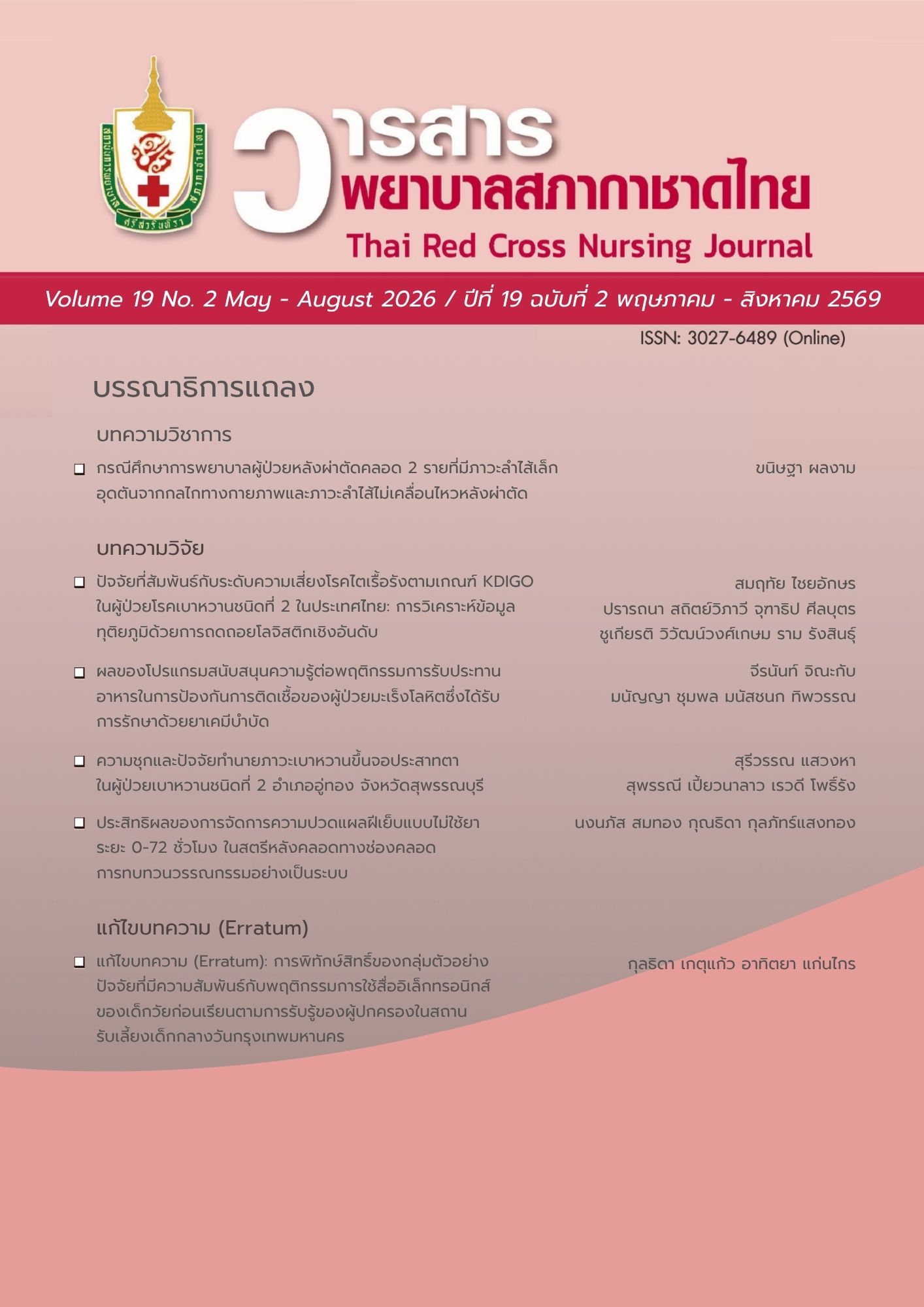
ปัจจัยที่สัมพันธ์กับระดับความเสี่ยงโรคไตเรื้อรังตามเกณฑ์ KDIGO ในผู้ป่วยโรคเบาหวานชนิดที่ 2 ในประเทศไทย: การวิเคราะห์ข้อมูลทุติยภูมิ ด้วยการถดถอยโลจิสติกเชิงอันดับ
DOI:
https://doi.org/10.64767/trcn.2026.281456คำสำคัญ:
โรคไตเรื้อรัง, โรคเบาหวานชนิดที่ 2, KDIGO, การถดถอยลอจีสติกเชิงอันดับบทคัดย่อ
ความเป็นมา: โรคไตเรื้อรังเป็นภาวะแทรกซ้อนสำคัญในผู้ป่วยโรคเบาหวานชนิดที่ 2 ซึ่งเพิ่มความเสี่ยงต่อภาวะไตวายและการเสียชีวิต
วัตถุประสงค์: เพื่อศึกษาปัจจัยที่สัมพันธ์กับระดับความเสี่ยงของโรคไตเรื้อรังตามเกณฑ์ KDIGOในผู้ป่วยโรคเบาหวานชนิดที่ 2 ในประเทศไทย
ระเบียบวิธีวิจัย: การวิจัยเชิงวิเคราะห์จากข้อมูลทุติยภูมิ ซึ่งใช้ฐานข้อมูลโครงการ Thailand DM/HT 2018 กลุ่มที่ศึกษาเป็นผู้ป่วยโรคเบาหวานชนิดที่ 2 อายุ 20 ปีขึ้นไป จำนวน 7,824 ราย ที่มีข้อมูลอัตราการกรองของไต (eGFR) อัลบูมินต่อครีอะตินีนในปัสสาวะ (UACR) และตัวแปรร่วมครบถ้วน จำแนกความเสี่ยงตามเกณฑ์ KDIGO เป็น 4 ระดับ วิเคราะห์ด้วยการถดถอยโลจิสติกเชิงอันดับ รายงานเป็น adjusted odds ratio (aOR) และช่วงความเชื่อมั่น ร้อยละ 95
ผลการศึกษา: ผู้ป่วยอยู่ในระดับความเสี่ยงโรคไตเรื้อรังต่ำ ปานกลาง สูง และสูงมาก ร้อยละ 40.1 34.4 13.5 และ 11.9 ตามลำดับ ปัจจัยที่สัมพันธ์กับโอกาสการอยู่ในระดับความเสี่ยงที่สูงขึ้น ได้แก่ อายุที่เพิ่มขึ้น 1 ปี (aOR = 1.032; 1.027-1.036) ระยะเวลาการเป็นโรคเบาหวานที่เพิ่มขึ้น 1 ปี (aOR = 1.015; 1.006-1.024) ระดับ HbA1c ที่เพิ่มขึ้น 1% (aOR = 1.052; 1.028-1.077) และความดันโลหิตซิสโตลิกที่เพิ่มขึ้น 1 มิลลิเมตรปรอท (aOR = 1.008; 1.005-1.011) นอกจากนี้ ผู้ป่วยที่มีภาวะเบาหวานขึ้นจอประสาทตา (aOR = 1.788; 1.504-2.125) โรคเกาต์ (aOR = 1.693; 1.399-2.049) และโรคหัวใจและหลอดเลือด (aOR = 1.209; 1.022-1.431) มีโอกาสอยู่ในระดับความเสี่ยงที่สูงขึ้นเมื่อเทียบกับผู้ที่ไม่มีภาวะดังกล่าว สำหรับยารักษาโรคเบาหวาน พบว่าการได้รับอินซูลินเดี่ยวมีความสัมพันธ์สูงที่สุดเมื่อเทียบกับผู้ไม่ได้รับยาเบาหวาน (aOR = 4.563; 3.420-6.089) ซึ่งสะท้อนการเลือกใช้ยาตามข้อบ่งชี้และลักษณะทางคลินิกของผู้ป่วย
จึงไม่ควรตีความเชิงสาเหตุ
สรุป: ปัจจัยด้านอายุ ระยะเวลาการเป็นโรคเบาหวาน ระดับน้ำตาลสะสม ความดันโลหิตซิสโตลิก ภาวะเบาหวานขึ้นจอประสาทตา โรคเกาต์ และโรคหัวใจและหลอดเลือด และรูปแบบการได้รับยาเบาหวาน
มีความสัมพันธ์กับระดับความเสี่ยงโรคไตเรื้อรังที่สูงขึ้นในผู้ป่วยโรคเบาหวานชนิดที่ 2 ผลการศึกษาสนับสนุนการประเมินความเสี่ยงโรคไตเรื้อรังโดยใช้ eGFR ร่วมกับ UACR อย่างเป็นระบบ เพื่อช่วยในการคัดกรอง จัดลำดับความสำคัญ และวางแผนการดูแลผู้ป่วยให้เหมาะสมตามระดับความเสี่ยง
Downloads
เอกสารอ้างอิง
International Diabetes Federation. IDF Diabetes Atlas 2025. Brussels, Belgium: International Diabetes Federation; 2025 [cited 2026 April 6]. Available from: https://diabetesatlas.org/resources/idf-diabetes-atlas-2025/
International Diabetes Federation. Diabetes data - Thailand: international diabetes federation; 2025 [cited 2026 April 6]. Available from: https://diabetesatlas.org/data-by-location/country/thailand/
Cook S, Schmedt N, Broughton J, Kalra PA, Tomlinson LA, Quint JK. Characterising the burden of chronic kidney disease among people with type 2 diabetes in England: a cohort study using the Clinical Practice Research Datalink. BMJ Open 2023;13(3):e065927. DOI: https://doi.org/10.1136/bmjopen-2022-065927
Fenta ET, Eshetu HB, Kebede N, Bogale EK, Zewdie A, Kassie TD, et al. Prevalence and predictors of chronic kidney disease among type 2 diabetic patients worldwide, systematic review and meta-analysis. Diabetol Metab Syndr 2023;15(1):245. DOI: https://doi.org/10.1186/s13098-023-01202-x
Gupta M, Rao IR, Nagaraju SP, Bhandary SV, Gupta J, Babu GTC. Diabetic retinopathy is a predictor of progression of diabetic kidney disease: a systematic review and meta-analysis. Int J Nephrol 2022;2022:3922398. DOI: https://doi.org/10.1155/2022/3922398
Jitraknatee J, Ruengorn C, Nochaiwong S. Prevalence and risk factors of chronic kidney disease among type 2 diabetes patients: a cross-sectional study in primary care practice. Sci Rep 2020;10(1):6205. DOI: https://doi.org/10.1038/s41598-020-63443-4
Kidney Disease: Improving Global Outcomes (KDIGO) CKD Work Group. KDIGO 2024 clinical practice guideline for the evaluation and management of chronic kidney disease. Kidney Int 2024;105(4 Suppl):S117-S314. DOI: https://doi.org/10.1016/j.kint.2023.10.018
Nata N, Rangsin R, Supasyndh O, Satirapoj B. Impaired glomerular filtration rate in type 2 diabetes mellitus subjects: a nationwide cross-sectional study in Thailand. J Diabetes Res 2020;2020:6353949. DOI: https://doi.org/10.1155/2020/6353949
Siddiqui K, George TP, Joy SS, Alfadda AA. Risk factors of chronic kidney disease among type 2 diabetic patients with longer duration of diabetes. Front Endocrinol (Lausanne) 2022;13:1079725. DOI: https://doi.org/10.3389/fendo.2022.1079725
TODAY Study Group. Effects of metabolic factors, race-ethnicity, and sex on the development of nephropathy in adolescents and young adults with type 2 diabetes: results from the today study. Diabetes Care 2022;45(5):1056-64. DOI: https://doi.org/10.2337/dc21-1085
Kang SY, Lee YH, Jeong SJ, Kim JS, Jeong KH, Hwang HS. How obesity and metabolic syndrome affect cardiovascular events, progression to kidney failure and all-cause mortality in chronic kidney disease. Nephrol Dial Transplant 2024;39(5):778–87. DOI: https://doi.org/10.1093/ndt/gfad214
Li J, Tu H, Zhang Y, Yang S, Yu P, Liu J. Risks of all-cause mortality in adults with chronic kidney disease with sarcopenia or obesity: a population-based study. J Cachexia Sarcopenia Muscle 2025;16(3):e13828. DOI: https://doi.org/10.1002/jcsm.13828
Wang J, Pi H, Sun Q. The relationship between serum lipid levels and diabetic nephropathy in patients with primary diabetes. BMC Nephrol 2025;26(1):608. DOI: https://doi.org/10.1186/s12882-025-04546-w
Jung I, Lee DY, Chung SM, Park SY, Yu JH, Moon JS, et al. Impact of chronic kidney disease and gout on end-stage renal disease in type 2 diabetes: population-based cohort study. Endocrinol Metab (Seoul) 2024;39(5):748–57. DOI: https://doi.org/10.3803/EnM.2024.2020
Xu Y, Li M, Qin G, Lu J, Yan L, Xu M, et al. Cardiovascular risk based on ASCVD and KDIGO categories in Chinese adults: a nationwide, population-based, prospective cohort study. J Am Soc Nephrol 2021;32(4):927–37. DOI: https://doi.org/10.1681/ASN.2020060856
French B, Shotwell MS. Regression models for ordinal outcomes. JAMA 2022;328(8):772–3. doi: 10.1001/jama.2022.12104. DOI: https://doi.org/10.1001/jama.2022.12104
Cheru A, Edessa D, Regassa LD, Gobena T. Incidence and predictors of chronic kidney disease among patients with diabetes treated at governmental hospitals of Harari Region, eastern Ethiopia, 2022. Front Public Health 2024;11:1290554. DOI: https://doi.org/10.3389/fpubh.2023.1290554
Hung PH, Hsu YC, Chen TH, Lin CL. Recent advances in diabetic kidney diseases: from kidney injury to kidney fibrosis. Int J Mol Sci 2021;22(21):11857. DOI: https://doi.org/10.3390/ijms222111857
Chagnac A, Friedman AN. Measuring albuminuria in individuals with obesity: pitfalls of the urinary albumin-creatinine ratio. Kidney Med 2024;6(4):100804. DOI: https://doi.org/10.1016/j.xkme.2024.100804
Kalantar-Zadeh K, Rhee CM, Chou J, Ahmadi SF, Park J, Chen JL, et al. The obesity paradox in kidney disease: how to reconcile it with obesity management. Kidney Int Rep 2017;2(2):271–81. DOI: https://doi.org/10.1016/j.ekir.2017.01.009
Rutledge JC, Ng KF, Aung HH, Wilson DW. Role of triglyceride-rich lipoproteins in diabetic nephropathy. Nat Rev Nephrol 2010;6(6):361–70. DOI: https://doi.org/10.1038/nrneph.2010.59
Nakada K, Tanaka K, Kimura H, Saito H, Oda A, Watanabe S, et al. High-density lipoprotein cholesterol and kidney disease progression in patients with type 2 diabetes mellitus: the Fukushima Cohort Study. BMJ Open Diabetes Res Care 2025; 13(6):e005581. DOI: https://doi.org/10.1136/bmjdrc-2025-005581
Crowley MJ, Diamantidis CJ, McDuffie JR, Cameron B, Stanifer J, Mock CK, et al. Metformin Use in Patients with Historical Contraindications or Precautions [Internet]. Washington (DC): Department of Veterans Affairs (US); 2016 Sep [cited 2026 April 6]. Available from: https://www.ncbi.nlm.nih.gov/books/NBK409374/
Agur T, Steinmetz T, Goldman S, Zingerman B, Bielopolski D, Nesher E, et al. The impact of metformin on kidney disease progression and mortality in diabetic patients using SGLT2 inhibitors: a real-world cohort study. Cardiovasc Diabetol 2025;24(1):97. DOI: https://doi.org/10.1186/s12933-025-02643-6
Avula A, Johal LK, Ali F, Amir S, Yadav S, Murtuza M, et al. ACE Inhibitors and ARBs in chronic kidney disease: a systematic review of randomized controlled trials on albuminuria reduction, eGFR decline, and safety. Cureus 2025;17(10):e93707. DOI: https://doi.org/10.7759/cureus.93707
ดาวน์โหลด
เผยแพร่แล้ว
รูปแบบการอ้างอิง
ฉบับ
ประเภทบทความ
สัญญาอนุญาต
ลิขสิทธิ์ (c) 2026 สถาบันการพยาบาลศรีสวรินทิรา สภากาชาดไทย

อนุญาตภายใต้เงื่อนไข Creative Commons Attribution-NonCommercial-NoDerivatives 4.0 International License.
เนื้อหาบทความหรือข้อคิดเห็นต่างๆ ในวารสารพยาบาลสภากาชาดไทยนี้ เป็นความคิดเห็นของผู้เขียนบทความ ไม่ใช่ความเห็นของกองบรรณาธิการ หรือสถาบันการพยาบาลศรีสวรินทิรา สภากาชาดไทย


