การพัฒนานวัตกรรมการสื่อสารสำหรับผู้ป่วยใส่ท่อช่วยหายใจ
คำสำคัญ:
นวัตกรรมการสื่อสาร, การสื่อสารในผู้ป่วยใส่ท่อช่วยหายใจ, ผู้ป่วยใส่ท่อช่วยหายใจบทคัดย่อ
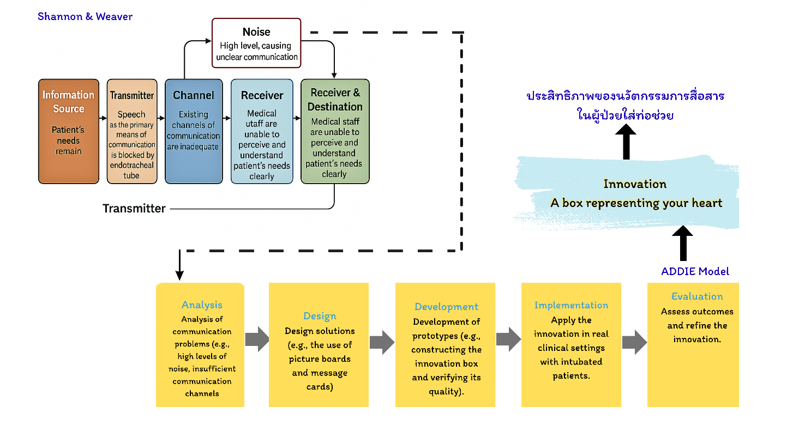
การสื่อสารเป็นองค์ประกอบสำคัญของการพยาบาล โดยเฉพาะในผู้ป่วยที่ใส่ท่อช่วยหายใจซึ่งไม่สามารถเปล่งเสียงพูดได้ งานวิจัยนี้มีวัตถุประสงค์เพื่อ พัฒนาและประเมินประสิทธิภาพของนวัตกรรมการสื่อสารสำหรับผู้ป่วยใส่ท่อช่วยหายใจ โดยใช้รูปแบบการวิจัยและพัฒนา ประกอบด้วย 3 ระยะ คือ ระยะที่ 1 ศึกษาสภาพปัญหาและความต้องการ ระยะที่ 2 ออกแบบและพัฒนานวัตกรรมการสื่อสารชื่อ “A box representing your heart” ระยะที่ 3 ศึกษาประสิทธิภาพของนวัตกรรมด้วยการวิจัยกึ่งทดลอง (Quasi-experimental design) แบบสองกลุ่มวัดก่อนและหลัง
กลุ่มตัวอย่างเป็นผู้ป่วยใส่ท่อช่วยหายใจ จำนวน 60 ราย แบ่งเป็นกลุ่มทดลองและกลุ่มควบคุม กลุ่มละ 30 ราย โดยสุ่มและจับคู่ตามอายุและระดับการศึกษา เครื่องมือวิจัยประกอบด้วย 1.แนวคำถามกึ่งโครงสร้างสำหรับการสนทนากลุ่ม ผลการตรวจสอบพบว่ามีค่าดัชนีความสอดคล้องของเนื้อหา เท่ากับ 0.98 2.เครื่องมือที่ใช้ในการทดลองคือนวัตกรรม “A box representing your heart”ประเมินความเหมาะสมของนวัตกรรมพบว่ามีความเหมาะสมโดยรวมในระดับมากที่สุด 3.แบบประเมินประสิทธิภาพนวัตกรรมการสื่อสารในผู้ป่วยใส่ท่อช่วยหายใจ ตรวจสอบคุณภาพพบว่ามีค่าความสอดคล้องระหว่างข้อคำถามกับวัตถุประสงค์รายข้อ เท่ากับ 1.00 ทุกข้อ ตรวจสอบความเชื่อมั่น (Reliability) พบว่ามีค่าสัมประสิทธิ์แอลฟาของครอนบาค เท่ากับ 0.79 การวิเคราะห์ข้อมูลแบ่งเป็น 2 ส่วน ได้แก่ 1.ข้อมูลเชิงคุณภาพ จากการสนทนากลุ่มกับผู้ป่วย ญาติ และพยาบาล วิเคราะห์ด้วย Content Analysis เพื่อหาประเด็นปัญหา อุปสรรค และความต้องการด้านการสื่อสาร เพื่อนำไปใช้พัฒนานวัตกรรมให้เหมาะสมกับบริบทจริง 2.ข้อมูลเชิงปริมาณ ตรวจสอบการกระจายตัวของข้อมูลด้วย Shapiro–Wilk test จากนั้นใช้ Descriptive statistics รายงานลักษณะทั่วไปของกลุ่มตัวอย่าง Chi-square test และ Independent t-test ตรวจสอบความเหมือนกันของสองกลุ่มก่อนทดลอง ใช้ Paired t-test วิเคราะห์ภายในกลุ่ม และ Independent t-test เปรียบเทียบระหว่างกลุ่ม เพื่อประเมินประสิทธิภาพของนวัตกรรม ผลการพัฒนานวัตกรรม “A box representing your heart” พบว่ามีคุณภาพในระดับ มากที่สุด (M = 4.74, SD = 0.48) ผลการประเมินประสิทธิภาพกลุ่มทดลองที่ใช้นวัตกรรมมีคะแนนเฉลี่ยประสิทธิภาพการสื่อสารหลังการใช้นวัตกรรมสูงขึ้นอย่างมีนัยสำคัญทางสถิติ (ก่อนใช้ M = 45.20, SD = 5.10; หลังใช้ M = 53.60, SD = 4.85; t = -8.75, p < .001) ในขณะที่กลุ่มควบคุมไม่แตกต่างอย่างมีนัยสำคัญ (p > .05) เมื่อเปรียบเทียบระหว่างกลุ่ม พบว่ากลุ่มทดลองมีคะแนนสูงกว่ากลุ่มควบคุมอย่างมีนัยสำคัญ (t = 6.35, p < .001)
นวัตกรรมการสื่อสารที่พัฒนาขึ้นมีประสิทธิภาพในการสื่อสารอยู่ในระดับดี ช่วยเพิ่มประสิทธิภาพการสื่อสารของผู้ป่วยใส่ท่อช่วยหายใจ สามารถประยุกต์ใช้ในทางคลินิกเพื่อพัฒนาคุณภาพการดูแล ลดความวิตกกังวล และเสริมสร้างสัมพันธภาพระหว่างผู้ป่วย ครอบครัว และบุคลากรทางการแพทย์
เอกสารอ้างอิง
American Heart Association. (2020). Advanced cardiovascular life support provider manual. American Heart Association.
Best, J. W. (1977). Research in education (3rd ed.). Prentice-Hall.
Bodet-Contentin, L., Szymkowicz, E., Delpierre, E., Chartier, D., Gadrez, P., Muller, G., Renault, A., & Ehrmann, S. (2022). Eye tracking communication with intubated critically ill patients: a proof-of-concept multicenter pilot study. Minerva anesthesiologic, 88(9), 690–697. https://doi.org/10.23736/S0375-9393.22.16275-9
Chaihan, N. (2021). The effect of promoting the use of an application to communicate needs on frustration and anxiety in intubated patients (Master’s thesis in Nursing Science). Thammasat University.
Chaihan, N., & Bunthan, W. (2023). Needs Communicative Digital Technology Program for Intubated Patients with Critical Illnesses: A Quasi-Experimental Study. Pacific Rim International Journal of Nursing Research, 27(3), 601–616. https://doi.org/10.60099/prijnr.2023.262313
Cohen, J. (2013). Statistical Power Analysis for the Behavioral Sciences (2nd ed.). Routledge. https://doi.org/10.4324/9780203771587
Freeman-Sanderson, A., Morris, K., Elkins, M. R., & Phipps, P. R. (2019). Characteristics of patient communication and prevalence of communication difficulty in the intensive care unit: An observational study. Australian Critical Care, 32(5), 373-377. https://doi.org/10.1016/j.aucc.2018.09.002
Happ, M. B., Garrett, K., Thomas, D. D., Tate, J., George, E., Houze, M., ... Sereika, S. (2011). Nurse-patient communication interactions in the intensive care unit. American Journal of Critical Care, 20(2), e28-e40.
Khalaila, R., Zbidat, W., Anwar, K., Bayya, A., Linton, D. M., & Sviri, S. (2011). Communication difficulties and psychoemotional distress in patients receiving mechanical ventilation. American journal of critical care: an official publication, American Association of Critical-Care Nurses, 20(6), 470–479. https://doi.org/10.4037/ajcc2011989
Shannon, C. E., & Weaver, W. (1949). The mathematical theory of communication. University of Illinois Press. Retrieved from https://pure.mpg.de/pubman/item/item_2383164_3/component/file_2383163/Shannon_ Weaver_1949_Mathematical.pdf
Thapmongkol, M., Udomkwamsuk, W., Phornphibul, P., & Sayasatit, J. (2020). Development and implementation of practice guideline for communication with intubated patients in an intensive care unit. Thai Journal of Nursing and Midwifery Practice, 7(1), 25–40. Retrieved from https://he02.tci-thaijo.org/index.php/apnj/article/view/241466
Zaga, C. J., Berney, S., & Vogel, A. P. (2019). The Feasibility, Utility, and Safety of Communication Interventions With Mechanically Ventilated Intensive Care Unit Patients: A Systematic Review. American journal of speech-language pathology, 28(3), 1335–1355. https://doi.org/10.1044/2019_AJSLP-19-0001
ดาวน์โหลด
เผยแพร่แล้ว
รูปแบบการอ้างอิง
ฉบับ
ประเภทบทความ
สัญญาอนุญาต
ลิขสิทธิ์ (c) 2026 วิทยาลัยพยาบาลบรมราชชนนี นครศรีธรรมราช

อนุญาตภายใต้เงื่อนไข Creative Commons Attribution-NonCommercial-NoDerivatives 4.0 International License.
บทความที่ได้รับการตีพิมพ์เป็นลิขสิทธิ์ของ วิทยาลัยพยาบาลบรมราชชนนี นครศรีธรรมราช
ข้อความที่ปรากฏในบทความแต่ละเรื่องในวารสารวิชาการเล่มนี้เป็นความคิดเห็นส่วนตัวของผู้เขียนแต่ละท่านไม่เกี่ยวข้องกับวิทยาลัยพยาบาลบรมราชชนนี นครศรีธรรมราช และบุคคลากรท่านอื่น ๆ ในวิทยาลัยฯ แต่อย่างใด ความรับผิดชอบองค์ประกอบทั้งหมดของบทความแต่ละเรื่องเป็นของผู้เขียนแต่ละท่าน หากมีความผิดพลาดใดๆ ผู้เขียนแต่ละท่านจะรับผิดชอบบทความของตนเองแต่ผู้เดียว