Development and Evaluation of the Effectiveness of a Communication Innovation for Intubated Patients
Keywords:
Communication Innovation, Communication In Intubated Patients, Intubated PatientsAbstract
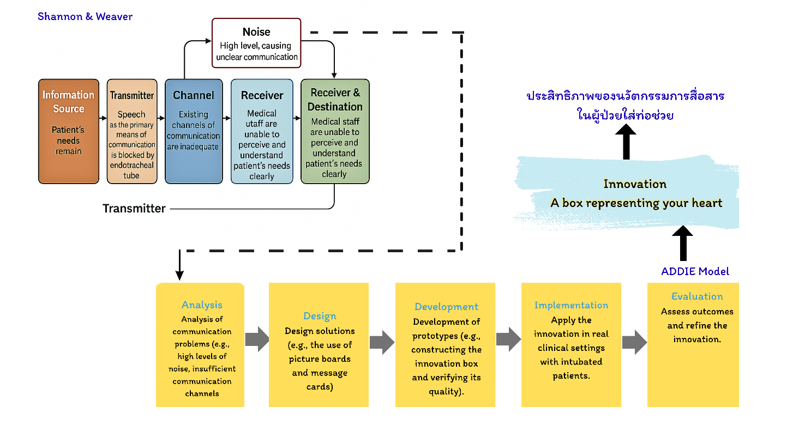
Communication is a fundamental component of nursing care, particularly for patients with endotracheal intubation who are unable to communicate verbally. This study aimed to develop and evaluate the effectiveness of a communication innovation for patients with endotracheal intubation using a research and development approach. The study was conducted in three phases: Phase 1 involved an assessment of problems and needs; Phase 2 focused on the design and development of a communication innovation entitled “A Box Representing Your Heart”; and Phase 3 evaluated the effectiveness of the innovation using a quasi-experimental two-group pretest–posttest design.
Participants were 60 patients with endotracheal intubation, who were randomly assigned and matched by age and educational level into an experimental group (n = 30) and a control group (n = 30). The research instruments included: (1) a semi-structured interview guide for focus group discussions, which demonstrated a content validity index (IOC) of 0.98; (2) the experimental intervention, namely the communication innovation “A Box Representing Your Heart,” which was evaluated and found to have overall appropriateness at the highest level; and (3) an instrument for assessing the effectiveness of the communication innovation for patients with endotracheal intubation. The effectiveness assessment demonstrated excellent content validity, with item–objective congruence (IOC) values of 1.00 for all items, and satisfactory reliability, with a Cronbach’s alpha coefficient of 0.79. Data analysis was conducted in two parts. Qualitative data obtained from focus group discussions with patients, family members, and nurses were analyzed using content analysis to identify communication-related problems, barriers, and needs, which informed the contextualized development of the innovation. Quantitative data were first tested for normality using the Shapiro–Wilk test (p > .05), followed by descriptive statistics to summarize participant characteristics. Chi-square tests and independent t-tests were used to examine baseline equivalence between groups. Paired t-tests were conducted for within-group comparisons, and independent t-tests were used for between-group comparisons to evaluate the effectiveness of the innovation. The results of the development of the communication innovation “A Box Representing Your Heart” indicated that the overall quality of the innovation was rated at the highest level (M = 4.74, SD = 0.48). The effectiveness evaluation showed that the experimental group using the innovation demonstrated a statistically significant increase in mean communication effectiveness scores after the intervention (pre-intervention: M = 45.20, SD = 5.10; post-intervention: M = 53.60, SD = 4.85; t = −8.75, p < .001), whereas no statistically significant difference was observed in the control group (p > .05). Between-group comparisons revealed that the experimental group had significantly higher communication effectiveness scores than the control group (t = 6.35, p < .001).
The developed communication innovation demonstrated good effectiveness in enhancing communication among patients with endotracheal intubation. It can be applied in clinical settings to improve the quality of care, reduce patient anxiety, and strengthen relationships among patients, family members, and healthcare professionals.
References
American Heart Association. (2020). Advanced cardiovascular life support provider manual. American Heart Association.
Best, J. W. (1977). Research in education (3rd ed.). Prentice-Hall.
Bodet-Contentin, L., Szymkowicz, E., Delpierre, E., Chartier, D., Gadrez, P., Muller, G., Renault, A., & Ehrmann, S. (2022). Eye tracking communication with intubated critically ill patients: a proof-of-concept multicenter pilot study. Minerva anesthesiologic, 88(9), 690–697. https://doi.org/10.23736/S0375-9393.22.16275-9
Chaihan, N. (2021). The effect of promoting the use of an application to communicate needs on frustration and anxiety in intubated patients (Master’s thesis in Nursing Science). Thammasat University.
Chaihan, N., & Bunthan, W. (2023). Needs Communicative Digital Technology Program for Intubated Patients with Critical Illnesses: A Quasi-Experimental Study. Pacific Rim International Journal of Nursing Research, 27(3), 601–616. https://doi.org/10.60099/prijnr.2023.262313
Cohen, J. (2013). Statistical Power Analysis for the Behavioral Sciences (2nd ed.). Routledge. https://doi.org/10.4324/9780203771587
Freeman-Sanderson, A., Morris, K., Elkins, M. R., & Phipps, P. R. (2019). Characteristics of patient communication and prevalence of communication difficulty in the intensive care unit: An observational study. Australian Critical Care, 32(5), 373-377. https://doi.org/10.1016/j.aucc.2018.09.002
Happ, M. B., Garrett, K., Thomas, D. D., Tate, J., George, E., Houze, M., ... Sereika, S. (2011). Nurse-patient communication interactions in the intensive care unit. American Journal of Critical Care, 20(2), e28-e40.
Khalaila, R., Zbidat, W., Anwar, K., Bayya, A., Linton, D. M., & Sviri, S. (2011). Communication difficulties and psychoemotional distress in patients receiving mechanical ventilation. American journal of critical care: an official publication, American Association of Critical-Care Nurses, 20(6), 470–479. https://doi.org/10.4037/ajcc2011989
Shannon, C. E., & Weaver, W. (1949). The mathematical theory of communication. University of Illinois Press. Retrieved from https://pure.mpg.de/pubman/item/item_2383164_3/component/file_2383163/Shannon_ Weaver_1949_Mathematical.pdf
Thapmongkol, M., Udomkwamsuk, W., Phornphibul, P., & Sayasatit, J. (2020). Development and implementation of practice guideline for communication with intubated patients in an intensive care unit. Thai Journal of Nursing and Midwifery Practice, 7(1), 25–40. Retrieved from https://he02.tci-thaijo.org/index.php/apnj/article/view/241466
Zaga, C. J., Berney, S., & Vogel, A. P. (2019). The Feasibility, Utility, and Safety of Communication Interventions With Mechanically Ventilated Intensive Care Unit Patients: A Systematic Review. American journal of speech-language pathology, 28(3), 1335–1355. https://doi.org/10.1044/2019_AJSLP-19-0001
Downloads
Published
How to Cite
Issue
Section
License
Copyright (c) 2026 Boromarajonani College of Nursing, Nakhon Si Thammarat

This work is licensed under a Creative Commons Attribution-NonCommercial-NoDerivatives 4.0 International License.
บทความที่ได้รับการตีพิมพ์เป็นลิขสิทธิ์ของ วิทยาลัยพยาบาลบรมราชชนนี นครศรีธรรมราช
ข้อความที่ปรากฏในบทความแต่ละเรื่องในวารสารวิชาการเล่มนี้เป็นความคิดเห็นส่วนตัวของผู้เขียนแต่ละท่านไม่เกี่ยวข้องกับวิทยาลัยพยาบาลบรมราชชนนี นครศรีธรรมราช และบุคคลากรท่านอื่น ๆ ในวิทยาลัยฯ แต่อย่างใด ความรับผิดชอบองค์ประกอบทั้งหมดของบทความแต่ละเรื่องเป็นของผู้เขียนแต่ละท่าน หากมีความผิดพลาดใดๆ ผู้เขียนแต่ละท่านจะรับผิดชอบบทความของตนเองแต่ผู้เดียว