Factors Associated with Health Services Access among Chronic Disease Patients During an Outbreak of Coronavirus Disease in 2019
Keywords:
Health Services Access, Chronic Diseases, COVID-19Abstract
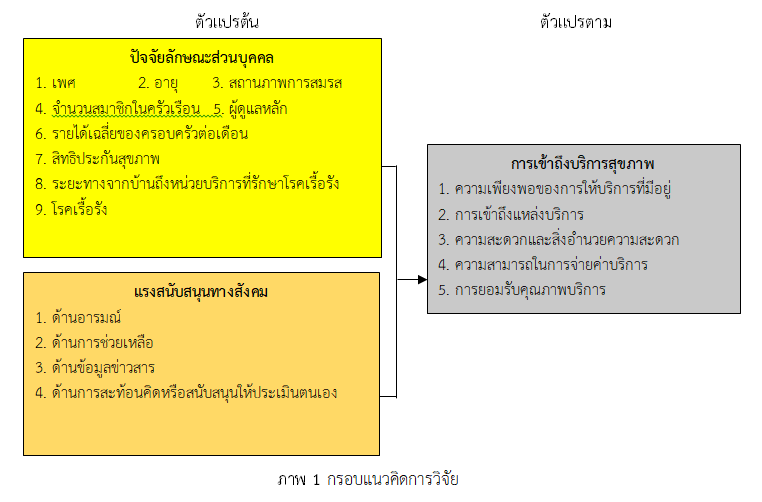
This cross-sectional study aimed to investigate factors associated with health service access among chronic disease patients during an outbreak of coronavirus disease in 2019 in Praprom district, Nakhon Si Thammarat province. The participants were 8,197 chronic disease patients living in Phra Phrom District. Determine the sample size by using the proportional estimation formula if the population is known, yielding a sample size of 441. Data was collected from June 1 to June 30, 2022, by using a questionnaire. Data analysis was performed using descriptive analysis, consisting of percentage, mean, standard deviation, maximum and minimum values, and inferential statistics, including odds ratio, 95% CI, and binary logistic regression.
The results showed that overall social support was at a high level and access to health services was at a good level. When considering each aspect, all aspects were average at a good level, except for the ability to pay for services, which was not at a good level. Factors associated with access to health services included: 1) distance from home to chronic disease service units, which distances between 6.01 and 9.00 kilometers were 3.26 times more likely to be able to access health services compared to distances between 0.00 and 3.00 kilometers; 2) patients with diabetes, high blood pressure, or cardiovascular disease had a 3.55 times higher chance of accessing health services compared to patients with stroke, chronic obstructive pulmonary disease, emphysema, or cancer; 3) a high level of emotional support had a 9.56 times better chance of accessing health services compared to low-moderate levels; 4) a high level of help support had a 11.34 times more likely to access health services compared to low-moderate levels; 5) a high level of information support had a 23.26 times better chance of accessing health services compared to a low-moderate level; and 6) a high level of reflection support or self-evaluation support had 9.86 times more likely to access health services compared to low-moderate levels.
Therefore, health service teams should develop and support factors that facilitate access to health services, especially for patients with cerebrovascular disease, obstructive pulmonary disease, emphysema, and cancer. In addition, communities and localities should develop factors that promote journeys, emotional management, assistance, and support in order to create opportunities for more effective access to health services for patients with chronic diseases during the outbreak of coronavirus disease 2019 or emerging infectious diseases.
References
Best, J. W. (1977). Research in education. (3nded). Englewod Cliffs: Prentice-Hall.
Chaimay, B. (2016). Sample size determination in descriptive study in public health sample size determination in descriptive study in public health. Thaksin Journal, 16(2), 9-18.
Chailak, P. & Sunongbua, A. (2021). The outcome of diabetic patients care during the prevention of COVID-19 pandemic situation at Mueang Chaiyaphum primary care unit, 2020. Chaiyaphum Medical Journal, 41(1), 111-121.
Department of Disease Control, Ministry of Public Health. (2021). The impact of COVID-19 on chronic non-communicable disease service systems. Nonthaburi. (in Thai)
House, J. S. (1981). Work stress and social support. Reading, MA: addison-wesley.
Nirarat, K. & Kidsom, A. (2017, December 7-8). Factors affecting access to health services for elderly in Bangkok. In The 14th National Academic Conference. Kasetsart University Kamphaeng Saen Campus, Nakorn Phatom. (in Thai)
Nopphonkrang, C., Siridhara, S., & Limanond, T. (2015). Analysis of accessibility index of primary healthcare service for diabetic patients: a case study in Chiang Mai. The Public Health Journal of Burapha University, 10(1), 77-86.
Penchansky, R. & Thomas, J. W. (1981). The concept of access: definition and relationship to consumer satisfaction. Medical Care, 19(2), 127-140.
Racha, P., Kongros, J., Sodchien, T. (2020). The development of nursing service system for chronic non–communicable diseases (NCDs) patients in the COVID-19 outbreak Situation. Region 4-5 Medical Journal, 39(3), 414-426.
Siripitayakunkit, A. (2010). Social support: an important factor to care for persons with diabetes mellitus. Rama Nursing Journal, 16(2), 309-323.
Thanwong, T., Pensiri, N., & Keraphong, P. (2016). Factors related to medical care usage of chronic disease patients at sub-district health promoting hospitals in Khao Yoi health network, Petchaburi province. Journal of Safety and Health, 9(31), 26-36
Downloads
Published
How to Cite
Issue
Section
License
Copyright (c) 2023 Boromarajonani College of Nursing, Nakhon Si Thammarat

This work is licensed under a Creative Commons Attribution-NonCommercial-NoDerivatives 4.0 International License.
บทความที่ได้รับการตีพิมพ์เป็นลิขสิทธิ์ของ วิทยาลัยพยาบาลบรมราชชนนี นครศรีธรรมราช
ข้อความที่ปรากฏในบทความแต่ละเรื่องในวารสารวิชาการเล่มนี้เป็นความคิดเห็นส่วนตัวของผู้เขียนแต่ละท่านไม่เกี่ยวข้องกับวิทยาลัยพยาบาลบรมราชชนนี นครศรีธรรมราช และบุคคลากรท่านอื่น ๆ ในวิทยาลัยฯ แต่อย่างใด ความรับผิดชอบองค์ประกอบทั้งหมดของบทความแต่ละเรื่องเป็นของผู้เขียนแต่ละท่าน หากมีความผิดพลาดใดๆ ผู้เขียนแต่ละท่านจะรับผิดชอบบทความของตนเองแต่ผู้เดียว