The Development of a Therapeutic Program for Psychiatric Patients with Negative Automatic Thoughts and Suicide Risk
Keywords:
Therapeutic Program, Psychiatric Patients, Negative Automatic Thoughts, Suicide RiskAbstract
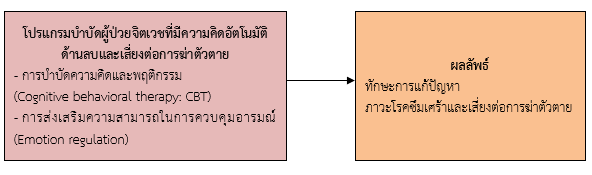
This research and development study aimed to 1) examine the current situation and related factors in the treatment of psychiatric patients with negative automatic thoughts and suicide risk; 2) develop a therapeutic program for these patients; and 3) evaluate the outcomes of the program's implementation. The study was conducted in three phases: Phase 1 involved data analysis, Phase 2 focused on program development, and Phase 3 involved implementation and evaluation. The research took place from April 2022 to February 2024. A purposive sample of 30 psychiatric patients with negative automatic thoughts and suicide risk was selected. The research instruments included a therapeutic program and a set of questionnaires, comprising a personal information form, a problem-solving skill assessment, the 9-item Depression Assessment Scale (PHQ-9), and the 8-item Suicide Risk Assessment Scale. Data were analyzed using mean, frequency, percentage, Paired t-test, and Wilcoxon signed-rank test.
The results revealed that the mean score for problem-solving skills assessment (PSI) before participating in the program was 34.67 (S.D.= 4.05), which increased significantly to 73.50 (S.D.= 5.44) after the program (p < 0.05). The mean score for depression assessment before participation was 23.73 (S.D.= 2.10), which significantly decreased to 4.57 (S.D.= 1.43) after participation (p < 0.05). Similarly, the mean score for suicide risk assessment decreased significantly from 40.23 (S.D.= 6.59) before the program to 3.20 (S.D.= 1.62) after the program (p < 0.05).
This therapeutic program is an individual-based intervention that emphasizes the involvement of close persons who serve as key sources of social support. It aims to enhance problem-solving skills and reduce suicidal thoughts and behaviors. The program offers an alternative approach for providing suicide prevention services among psychiatric patients in community hospitals and sub-district health promoting hospitals.
References
Brandt, P. A., & Weinert, C. (1985). Psychometric update [Unpublished manuscript], School of Nursing, University of Washington, Washington, DC.
Cohen, J. (1988). Statistical power analysis for the behavioral sciences (2nd ed.). Hillsdale, NJ: Lawrence Erlbaum Associates.
D’Zurilla, T. J., & Nezu, A. M. (2010). Problem-solving therapy. In K. S. Dobson (Ed.). Handbook of cognitive-behavioral therapies (pp. 197–225). New York: Guilford Press.
Fak Tha Hospital. (2021). Summary of psychiatric and substance abuse operations. Uttaradit: Fak Tha Hospital. (in Thai)
House, J. S. (1981). Work stress and social support. Reading, MA: Addison-Wesley.
Huaisai, T., Surinchompu, K., & Pongtrippat W. (2021). Negative automatic thoughts and suicide risk in psychiatric patients. Sakonnakhon Hospital Journal, 24(2), 49–57. (in Thai)
Kittirattanapaiboon, P. (2003). Training program on interviewing and scoring BPRS in the format of T-PANSS. In Lecture materials on psychiatric patient symptom assessment, Suan Prung Psychiatric Hospital. Chiang Mai: Suanprung Psychiatric Hospital. (in Thai)
Klinpiboon, A., Yodklang, O., Kaanacha, V., Kamchompoo, J., & Bupahouse, S. (2020). The development of problem-solving therapy program for psychiatric patients with suicidal ideations and behaviors (PST-PPS. Journal of Mental Health of Thailand, 28(1), 86–89. (in Thai)
Kongsuk, T., Arunpongpaisal, S., Janthong, S., Prukkanone, B., Sukhawaha, S., & Leejongpermpoon, J. (2018). Criterion-related validity of the 9 questions depression rating scale revised for Thai central dialect. Journal of the Psychiatric Association of Thailand, 63(4), 321–334. (in Thai)
Kosallavat, P., Thapinta, D., Patipatpakdee, H., & Leejongpermpoon, J. (2018). The development and effect of the problem solving therapy on depressive symptoms for major depressive disorders at Prasrimahabhodi Psychiatric Hospital. Journal of Psychiatric Nursing and Mental Health, 32(1), 49–65. (in Thai)
Nielsen, J. (2000). Why You Only Need to Test with 5 Users. Retrieved April 1, 2025 from https://www.nngroup.com/articles/why-you-only-need-to-test-with-5-users/
Polmeesak, J., Pansila, W., & Pakanon, P. (2015). Development of the participation model in the surveillance and care for people with depression and risk group of suicide: A case study, Tabtoa Village, Numkumyai Sub district, Mueang District, Yasothon Province. Mahasarakham Hospital Journal, 12(1), 31–39. (in Thai)
Robkob, W., Skulphan, S., & Sethabouppha, H. (2018). Depression, alcohol drinking behaviors, and suicidal risks of adolescents. Nursing Journal, 45(4), 144–158. (in Thai)
Sriwiset, S., Yubonpan, S., Kotrnara, I., Hatthapanom, W., & Bangsan, S. (2013). Problem solving therapy group in patients with depressive symptoms and suicidal risk. Journal of Mental Health of Thailand, 21(2), 98–109. (in Thai)
Suicide Prevention Surveillance Center, Khon Kaen Rajanagarindra Psychiatric Hospital. (2022). Suicide report. Retrieved April 1, 2025 from https://suicide.dmh.go.th/report/. (in Thai)
Uttaradit Provincial Public Health Office. (2021). Summary of public health performance, Uttaradit Province, 2021. Uttaradit: Uttaradit Provincial Public Health Office. (in Thai)
Van Ballegooijen, W., Rawee, J., Palantza, C., Miguel, C., Harrer, M., Cristea, L., et al. (2024). Suicidal ideation and suicide attempts after direct or indirect psychotherapy: A systematic review and meta-analysis. JAMA Psychiatry, 82(1), 31–37.
World Health Organization. (2016). International statistical classification of diseases and related health problems (10th revision). Geneva, Switzerland: World Health Organization.
World Health Organization. (2018). World health statistics 2018: monitoring health for the SDGs, sustainable development goals. Retrieved April 1, 2025 from https://www.who.int/publications/i/item/9789241565585
World Health Organization. (2019). World health statistics 2019: Monitoring health for the SDGs, sustainable development goals. Retrieved April 1, 2025 from https://www.who.int/.
Downloads
Published
How to Cite
Issue
Section
License
Copyright (c) 2025 Boromarajonani College of Nursing, Nakhon Si Thammarat

This work is licensed under a Creative Commons Attribution-NonCommercial-NoDerivatives 4.0 International License.
บทความที่ได้รับการตีพิมพ์เป็นลิขสิทธิ์ของ วิทยาลัยพยาบาลบรมราชชนนี นครศรีธรรมราช
ข้อความที่ปรากฏในบทความแต่ละเรื่องในวารสารวิชาการเล่มนี้เป็นความคิดเห็นส่วนตัวของผู้เขียนแต่ละท่านไม่เกี่ยวข้องกับวิทยาลัยพยาบาลบรมราชชนนี นครศรีธรรมราช และบุคคลากรท่านอื่น ๆ ในวิทยาลัยฯ แต่อย่างใด ความรับผิดชอบองค์ประกอบทั้งหมดของบทความแต่ละเรื่องเป็นของผู้เขียนแต่ละท่าน หากมีความผิดพลาดใดๆ ผู้เขียนแต่ละท่านจะรับผิดชอบบทความของตนเองแต่ผู้เดียว