การสร้างโปรแกรมบำบัดผู้ป่วยจิตเวชที่มีความคิดอัตโนมัติด้านลบและความเสี่ยงต่อการฆ่าตัวตาย
คำสำคัญ:
โปรแกรมบําบัด, ผู้ป่วยจิตเวช, ความคิดอัตโนมัติด้านลบ, ความเสี่ยงต่อการฆ่าตัวตายบทคัดย่อ
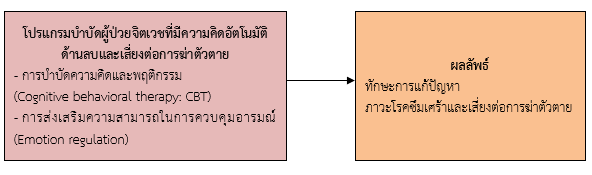
งานวิจัยและพัฒนานี้มีวัตถุประสงค์เพื่อ 1) ศึกษาสภาพการณ์ และปัจจัยที่เกี่ยวข้องการบำบัดรักษาผู้ป่วยจิตเวชที่มีความคิดอัตโนมัติด้านลบและความเสี่ยงต่อการฆ่าตัวตาย 2) พัฒนาโปรแกรมบำบัดผู้ป่วยจิตเวชที่มีความคิดอัตโนมัติด้านลบและความเสี่ยงต่อการฆ่าตัวตาย และ 3) ศึกษาผลการใช้โปรแกรมบำบัดผู้ป่วยจิตเวชที่มีความคิดอัตโนมัติด้านลบและความเสี่ยงต่อการฆ่าตัวตาย การวิจัยนี้แบ่งออกเป็น 3 ระยะ ได้แก่ ระยะที่ 1การวิเคราะห์ข้อมูล ระยะที่ 2 การพัฒนาโปรแกรมบำบัด และระยะที่ 3 การทดลองใช้โปรแกรมบำบัด โดยมีระยะเวลาศึกษาตั้งแต่เดือน เมษายน พ.ศ. 2565 – กุมภาพันธ์ พ.ศ. 2567 กลุ่มตัวอย่างคัดเลือก แบบเฉพาะเจาะจงจากผู้ป่วยจิตเวชที่มีความคิดอัตโนมัติด้านลบและความเสี่ยงต่อการฆ่าตัวตาย จำนวน 30 คน เครื่องมือที่ใช้ ประกอบด้วย 1) โปรแกรมบำบัดผู้ป่วยจิตเวชที่มีความคิดอัตโนมัติด้านลบและความเสี่ยงต่อการฆ่าตัวตาย 2) แบบสอบถามในการเก็บข้อมูล ได้แก่ ข้อมูลส่วนบุคคล แบบประเมินทักษะการแก้ปัญหา แบบประเมินโรคซึมเศร้า 9 คำถาม และแบบประเมินการฆ่าตัวตาย 8 คำถาม วิเคราะห์ข้อมูลด้วยค่าเฉลี่ย ความถี่ ร้อยละ Paired t-test และ Wilcoxon signed rank test
ผลการวิจัยพบว่า คะแนนเฉลี่ยการประเมินทักษะการแก้ไขปัญหา (PSI) ก่อนเข้าร่วมโปรแกรม เท่ากับ 34.67 (SD.= 4.05) หลังเข้าร่วมเท่ากับ 73.50 (SD.= 5.44) เมื่อเปรียบเทียบก่อนและหลังคะแนนเพิ่มขึ้นอย่างมีนัยสำคัญทางสถิติ (p < 0.05) คะแนนเฉลี่ยการประเมินภาวะซึมเศร้าก่อนเข้าร่วม เท่ากับ 23.73 (SD.= 2.10) หลังเข้าร่วม เท่ากับ 4.57 (SD.= 1.43) เมื่อเปรียบเทียบก่อนและหลังคะแนนลดลงอย่างมีนัยสำคัญทางสถิติ (p < 0.05) คะแนนเฉลี่ยการประเมินความเสี่ยงต่อการฆ่าตัวตายก่อนเข้าร่วม เท่ากับ 40.23 (SD.= 6.59) หลังเข้าร่วม เท่ากับ 3.20 (SD.= 1.62) เมื่อเปรียบเทียบก่อนและหลังคะแนนลดลงอย่างมีนัยสำคัญทางสถิติ (p < 0.05)
โปรแกรมบำบัดนี้ เป็นการบำบัดรายบุคคลโดยเน้นการมีส่วนร่วมของบุคคลใกล้ชิดซึ่งแหล่งสนับสนุนทางสังคมที่สำคัญ เพิ่มทักษะการแก้ปัญหา ลดความคิดและพฤติกรรมการฆ่าตัวตาย ซึ่งเป็นทางเลือกหนึ่งในการจัดบริการการป้องกันการฆ่าตัวตายในกลุ่มผู้ป่วยจิตเวชของโรงพยาบาลชุมชน และโรงพยาบาลส่งเสริมสุขภาพตำบล
เอกสารอ้างอิง
Brandt, P. A., & Weinert, C. (1985). Psychometric update [Unpublished manuscript], School of Nursing, University of Washington, Washington, DC.
Cohen, J. (1988). Statistical power analysis for the behavioral sciences (2nd ed.). Hillsdale, NJ: Lawrence Erlbaum Associates.
D’Zurilla, T. J., & Nezu, A. M. (2010). Problem-solving therapy. In K. S. Dobson (Ed.). Handbook of cognitive-behavioral therapies (pp. 197–225). New York: Guilford Press.
Fak Tha Hospital. (2021). Summary of psychiatric and substance abuse operations. Uttaradit: Fak Tha Hospital. (in Thai)
House, J. S. (1981). Work stress and social support. Reading, MA: Addison-Wesley.
Huaisai, T., Surinchompu, K., & Pongtrippat W. (2021). Negative automatic thoughts and suicide risk in psychiatric patients. Sakonnakhon Hospital Journal, 24(2), 49–57. (in Thai)
Kittirattanapaiboon, P. (2003). Training program on interviewing and scoring BPRS in the format of T-PANSS. In Lecture materials on psychiatric patient symptom assessment, Suan Prung Psychiatric Hospital. Chiang Mai: Suanprung Psychiatric Hospital. (in Thai)
Klinpiboon, A., Yodklang, O., Kaanacha, V., Kamchompoo, J., & Bupahouse, S. (2020). The development of problem-solving therapy program for psychiatric patients with suicidal ideations and behaviors (PST-PPS. Journal of Mental Health of Thailand, 28(1), 86–89. (in Thai)
Kongsuk, T., Arunpongpaisal, S., Janthong, S., Prukkanone, B., Sukhawaha, S., & Leejongpermpoon, J. (2018). Criterion-related validity of the 9 questions depression rating scale revised for Thai central dialect. Journal of the Psychiatric Association of Thailand, 63(4), 321–334. (in Thai)
Kosallavat, P., Thapinta, D., Patipatpakdee, H., & Leejongpermpoon, J. (2018). The development and effect of the problem solving therapy on depressive symptoms for major depressive disorders at Prasrimahabhodi Psychiatric Hospital. Journal of Psychiatric Nursing and Mental Health, 32(1), 49–65. (in Thai)
Nielsen, J. (2000). Why You Only Need to Test with 5 Users. Retrieved April 1, 2025 from https://www.nngroup.com/articles/why-you-only-need-to-test-with-5-users/
Polmeesak, J., Pansila, W., & Pakanon, P. (2015). Development of the participation model in the surveillance and care for people with depression and risk group of suicide: A case study, Tabtoa Village, Numkumyai Sub district, Mueang District, Yasothon Province. Mahasarakham Hospital Journal, 12(1), 31–39. (in Thai)
Robkob, W., Skulphan, S., & Sethabouppha, H. (2018). Depression, alcohol drinking behaviors, and suicidal risks of adolescents. Nursing Journal, 45(4), 144–158. (in Thai)
Sriwiset, S., Yubonpan, S., Kotrnara, I., Hatthapanom, W., & Bangsan, S. (2013). Problem solving therapy group in patients with depressive symptoms and suicidal risk. Journal of Mental Health of Thailand, 21(2), 98–109. (in Thai)
Suicide Prevention Surveillance Center, Khon Kaen Rajanagarindra Psychiatric Hospital. (2022). Suicide report. Retrieved April 1, 2025 from https://suicide.dmh.go.th/report/. (in Thai)
Uttaradit Provincial Public Health Office. (2021). Summary of public health performance, Uttaradit Province, 2021. Uttaradit: Uttaradit Provincial Public Health Office. (in Thai)
Van Ballegooijen, W., Rawee, J., Palantza, C., Miguel, C., Harrer, M., Cristea, L., et al. (2024). Suicidal ideation and suicide attempts after direct or indirect psychotherapy: A systematic review and meta-analysis. JAMA Psychiatry, 82(1), 31–37.
World Health Organization. (2016). International statistical classification of diseases and related health problems (10th revision). Geneva, Switzerland: World Health Organization.
World Health Organization. (2018). World health statistics 2018: monitoring health for the SDGs, sustainable development goals. Retrieved April 1, 2025 from https://www.who.int/publications/i/item/9789241565585
World Health Organization. (2019). World health statistics 2019: Monitoring health for the SDGs, sustainable development goals. Retrieved April 1, 2025 from https://www.who.int/.
ดาวน์โหลด
เผยแพร่แล้ว
รูปแบบการอ้างอิง
ฉบับ
ประเภทบทความ
สัญญาอนุญาต
ลิขสิทธิ์ (c) 2025 วิทยาลัยพยาบาลบรมราชชนนี นครศรีธรรมราช

อนุญาตภายใต้เงื่อนไข Creative Commons Attribution-NonCommercial-NoDerivatives 4.0 International License.
บทความที่ได้รับการตีพิมพ์เป็นลิขสิทธิ์ของ วิทยาลัยพยาบาลบรมราชชนนี นครศรีธรรมราช
ข้อความที่ปรากฏในบทความแต่ละเรื่องในวารสารวิชาการเล่มนี้เป็นความคิดเห็นส่วนตัวของผู้เขียนแต่ละท่านไม่เกี่ยวข้องกับวิทยาลัยพยาบาลบรมราชชนนี นครศรีธรรมราช และบุคคลากรท่านอื่น ๆ ในวิทยาลัยฯ แต่อย่างใด ความรับผิดชอบองค์ประกอบทั้งหมดของบทความแต่ละเรื่องเป็นของผู้เขียนแต่ละท่าน หากมีความผิดพลาดใดๆ ผู้เขียนแต่ละท่านจะรับผิดชอบบทความของตนเองแต่ผู้เดียว