Perceived Self-Efficacy of Nursing Students in Providing Contraceptive Services
Keywords:
Perceived Self-Efficacy, Nursing Students, Contraceptive ServicesAbstract
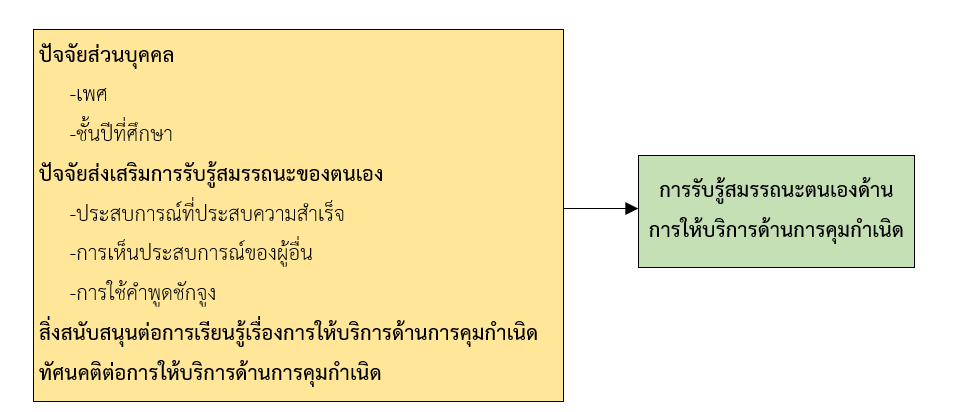
This descriptive study aimed to examine nursing students’ perceived self-efficacy in providing contraceptive services and to compare the mean self-efficacy scores between third-year and fourth-year students. The sample size was calculated using the G*Power program, yielding a total of 124 participants: 62 third-year and 62 fourth-year nursing students. Data were collected using three instruments: a contraception knowledge questionnaire, an attitude questionnaire toward providing contraceptive services, and a perceived self-efficacy questionnaire for providing contraceptive services. The Cronbach’s alpha coefficients were 0.78, 0.82, and 0.88, respectively. Data were analyzed using descriptive statistics and the independent t-test.
The results showed that the participants had a high level of perceived self-efficacy in providing contraceptive services (M= 3.02, SD= 0.95). Comparison of the mean self-efficacy scores between academic years indicated that fourth-year nursing students had a higher mean score than third-year students, although the difference was not statistically significant (M= 3.21, SD= 0.49; M= 3.03, SD= 0.62; p= 0.88).
Therefore, the findings indicate that nursing students’ perceived self-efficacy is influenced by factors consistent with Bandura’s theory, including mastery experiences, vicarious experiences, and verbal persuasion, all of which contribute to strengthening confidence in providing contraceptive services. Accordingly, teaching and learning approaches should be developed to enhance self-efficacy based on these factors, such as the use of virtual or simulated patients and the organization of observational learning activities in real clinical settings, in order to support the development of students’ skills and confidence.
References
Bandura, A., & Wessels, S. (1997). Self-efficacy. Cambridge: Cambridge University Press.
Bloom, B. S. (1956). Taxonomy of educational objectives: The classification of educational goals. Handbook I: Cognitive domain. New York: David McKay Company.
Chaiboonruang, T., & Yimyam, S. (2014). International Nursing Programme Students’ Pregnancy Care Efficacy. The Journal of Thailand Nursing and Midwifery Council, 28(3), 55-67. (in Thai)
Chirawatkul, S., Chinlumprasert, N., Songwatana, P., Deoisres, W., Fongkaew, W., & Rungreonkulkij, S. (2012). Nursing profession: A meaning in gender perspective. Thai Journal of Nursing Council, 26(2), 26–41. (in Thai)
Goggin, K., Hurley, E. A., Wagner, G. J., Staggs, V., Finocchario-Kessler, S., Beyeza-Kashesya, J., et al. (2018). Changes in providers’ self-efficacy and intentions to provide safer conception counseling over 24 months. AIDS and Behavior, 22, 2895-2905.
Intharaprasert, S., Phattachai, S., Phongkittilucka, M., Sangsiwong, S., Permpangpun, S., Poonkham, Y., et al. (2008). Family planning service manual for public health personnel. Bureau of Reproductive Health, Department of Health, Ministry of Public Health. (in Thai)
Jumneansuk, A., Arsa, R., Detboon, P., & Phoolawan, P. (2017). Attitudes Towards Birth Control Among Female Students of University in Pathum Thani Province. VRU Research and Development Journal Science and Technology, 12(3), 79-90. (in Thai)
Kim, A. (2024). The effects of traditional lecture-based instruction on nursing students’ ability to apply theoretical knowledge in clinical practice. Journal of Nursing Education and Practice, 14(2), 45–52.
Maddux, J. E. (1995). Self-efficacy theory: An introduction. In J. E. Maddux (Ed.), Self-efficacy, adaptation, and adjustment: Theory, research, and application (pp. 3–33).
Boston, MA: Springer. Maddux, J. E. (2013). Self-efficacy, adaptation, and adjustment: Theory, research, and application. New York: Springer Science & Business Media.
Phetcharak, k. (2021). The Effects of an Objective Structured Clinical Examination on Perceived Nursing Competencies and Clinical Skills Among Maternal and Child Nursing Students. The Journal of Faculty of Nursing Burapha University, 29(2), 3-10. (in Thai)
Shokebumroong, K., Wonggom, P., & Suwittawat, C. (2021). Self-perceived nursing competencies of the second-year nursing students in adult health nursing practice course I at the Faculty of Nursing, Khon Kaen University. Journal of Nursing Science & Health, 44(2), 74-84. (in Thai)
Sreeapan, P., Yimyam, S., Supavititpattana, B., & Chuto, P. (2016). The effect of cooperative learning on skills and self-efficacy in postpartum teaching among fourth-year nursing students. Nursing Journal, 42(2), 84–91. (in Thai)
Sulaiman, P., Suvanchatree, S., Patanapichai, S., & Cherajin, Y. (2023). Effect of developing training courses on improving contraceptive counseling ability of teachers' professional students. Nursing, Health, and Education Journal, 6(3), 58-68. (in Thai)
Zivlak, J., & Stojanac, N. (2019). Self-efficacy: Concept and its importance in education. Proceedings of the XXV Skup Trendovi Razvoja: Kvalitet Visokog Obrazovanja. Kopaonik, Serbia.
Downloads
Published
How to Cite
Issue
Section
License
Copyright (c) 2025 Boromarajonani College of Nursing, Nakhon Si Thammarat

This work is licensed under a Creative Commons Attribution-NonCommercial-NoDerivatives 4.0 International License.
บทความที่ได้รับการตีพิมพ์เป็นลิขสิทธิ์ของ วิทยาลัยพยาบาลบรมราชชนนี นครศรีธรรมราช
ข้อความที่ปรากฏในบทความแต่ละเรื่องในวารสารวิชาการเล่มนี้เป็นความคิดเห็นส่วนตัวของผู้เขียนแต่ละท่านไม่เกี่ยวข้องกับวิทยาลัยพยาบาลบรมราชชนนี นครศรีธรรมราช และบุคคลากรท่านอื่น ๆ ในวิทยาลัยฯ แต่อย่างใด ความรับผิดชอบองค์ประกอบทั้งหมดของบทความแต่ละเรื่องเป็นของผู้เขียนแต่ละท่าน หากมีความผิดพลาดใดๆ ผู้เขียนแต่ละท่านจะรับผิดชอบบทความของตนเองแต่ผู้เดียว