PREVALENCE, SYMPTOM SEVERITY, AND SYMPTOM MANAGEMENT OF DRY EYE IN OLDER PERSONS
N/A
Keywords:
Dry Eye Symptoms, Prevalence, Severity, Symptom Management, Older AdultsAbstract
This descriptive cross-sectional study aimed to investigate the prevalence, symptom severity, and symptom management of dry eye among older persons. With purposive sampling, a total of 185 older persons aged 60 years and over who met the inclusion criteria were recruited from the outpatient medical clinic of a tertiary hospital between November 2021 and May 2022. Research instruments included the 6CIT for cognitive screening, a demographic questionnaire, the Thai version of the Ocular Surface Disease Index (OSDI), and a dry eye symptom management questionnaire. Data were analyzed using descriptive statistics.
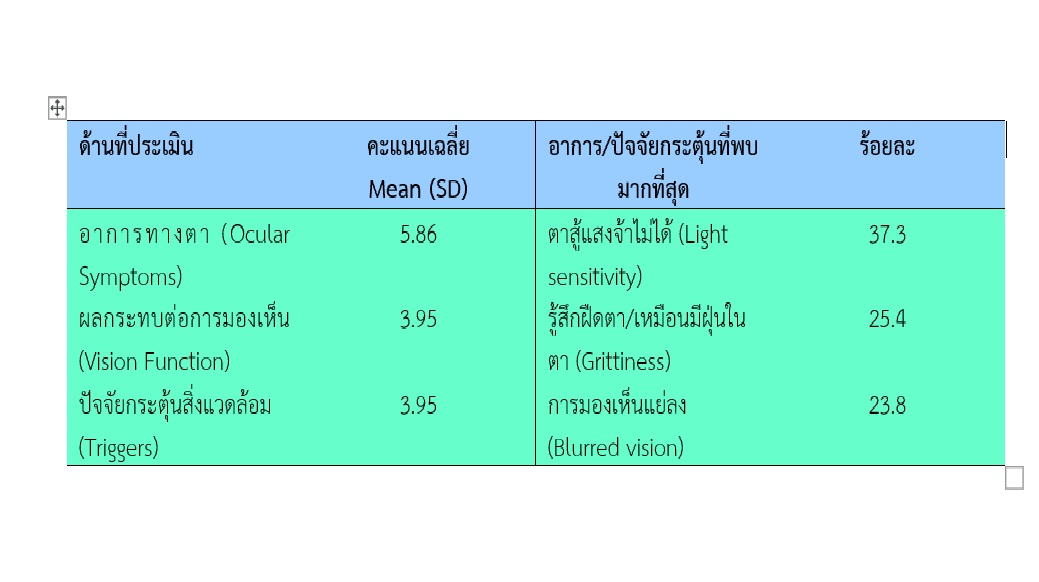
The results revealed that the prevalence of dry eye symptoms in older persons was 11.4% (n = 21). Females had higher dry eye symptoms compared to males (7.6% vs 3.8%). Symptom severity was mostly at a mild level (11.4%) with a mean OSDI score of 3.13 (SD = 4.18). The most common dry eye symptoms were light sensitivity (37.3%), grittiness (25.4%), and blurred vision (23.8%). The most common management strategy for dry eye symptoms was waiting for self-recovery (37.8%), followed by closing eyes (4.3%) and using artificial tears (1.1%). None of the participants sought medical consultation, performed warm compression, or practiced lid hygiene.
Nurses and other healthcare personnel should promote early screening for dry eye symptoms and provide proper education on symptom management, such as warm compression and proper blinking techniques. This proactive approach will help older persons receive appropriate treatment and prevent further visual complications.
References
Alanazi, S. A., Alomran, A. A., Abusharha, A., Fagehi, R., Al-Johani, N. J., & El-Hiti, G. A. (2019). An assessment of the ocular tear film in patients with thyroid disorders. Clinical Ophthalmology, 13, 1019-1026.
American Optometric Association. (2024). Low vision and vision rehabilitation. https://www.aoa.org/healthy-eyes/caring-for-your-eyes/low-vision-and-vision-rehab?sso=y
Arita, R., Kawashima, M., & Morishige, N. (2018). Clinical impression of the efficacy of eyelid warming or lid hygiene as treatment for meibomian gland dysfunction. Journal of Clinical and Experimental Ophthalmology, 9, 5-9.
Benítez-Del-Castillo, J., Labetoulle, M., Baudouin, C., Rolando, M., Akova, Y. A., Aragona, P., et al. (2017). Visual acuity and quality of life in dry eye disease: Proceedings of the OCEAN group meeting. Ocular Surface, 15(2), 169-178.
Bhandarkar, N. S., Shetty, K., Narendra, P., Kiran, A., Shetty, R., & Shetty, K. B. (2024). A review on drug-induced dry eye disease. Indian Journal of Ophthalmology, 72(10), 1412–1423.
Borrelli, M., Frings, A., Geerling, G., & Finis, D. (2021). Gender-specific differences in signs and symptoms of dry eye disease. Current Eye Research, 46(3), 294–301.
Bradley, J. L., Özer Stillman, I., Pivneva, I., Guerin, A., Evans, A. M., & Dana, R. (2019). Dry eye disease ranking among common reasons for seeking eye care in a large US claims database. Clinical Ophthalmology, 13, 225-232.
Chhadva, P., Goldhardt, R., & Galor, A. (2017). Meibomian gland disease: The role of gland dysfunction in dry eye disease. Ophthalmology, 124(11S).
Choi, J. H., Li, Y., Kim, S. H., Jin, R., Kim, Y. H., Choi, W., et al. (2018). The influences of smartphone use on the status of the tear film and ocular surface. PLoS One, 13(10), e0206541.
Craig, J. P., Nelson, J. D., Azar, D. T., Belmonte, C., Bron, A. J., Chauhan, S. K., et al. (2017). TFOS DEWS II Report Executive Summary. Ocular Surface, 15(4), 802-812.
Dana, R., Bradley, J. L., Guerin, A., Pivneva, I., Stillman, I. Ö., Evans, A. M., et al. (2019). Estimated prevalence and incidence of dry eye disease based on coding analysis of a large, all-age United States health care system. American Journal of Ophthalmology, 202, 47-54.
Gan, J., Wang, N., Li, S., Wang, B., Kang, M., Wei, S., et al. (2022). Effect of age and refractive error on local and global visual perception in Chinese children and adolescents. Frontiers in Human Neuroscience, 16, 1-8.
García Posadas, L., Contreras-Ruiz, L., Soriano-Romaní, L., Dartt, D. A., & Diebold, Y. (2016). Conjunctival goblet cell function: effect of contact lens wear and cytokines. Eye & Contact Lens, 42(2), 83-90.
Garg, P., Gupta, A., Tandon, N., & Raj, P. (2020). Dry eye disease after cataract surgery: study of its determinants and risk factors. Turkish Journal of Ophthalmology, 50(3), 133-142.
Golebiowski, B., Badarudin, N., Eden, J., You, J., Hampel, U., & Stapleton, F. (2017). Does endogenous serum oestrogen play a role in meibomian gland dysfunction in postmenopausal women with dry eye? British Journal of Ophthalmology, 101(2), 218-222.
Jones, L., Downie, L. E., Korb, D., Benitez-Del-Castillo, J. M., Dana, R., Deng, S. X., et al. (2017). TFOS DEWS II Management and therapy report. Ocular Surface, 15(3), 575-628.
Karakus, S., Mathews, P. M., Agrawal, D., Henrich, C., Ramulu, P. Y., & Akpek, E. K. (2018). Impact of dry eye on prolonged reading. Optometry and Vision Science, 95(12).
Kasetsuwan, N., Gorvanich, S., Erjongmanee, S., Thienprasiddhi, P., & Jitapunkul, S. (2012). Prevalence of dry eyes in elderly Thai population (the Romklao eye study). Asian Biomedicine, 6(6), 875-882.
Kim, K. I., Park, Y. S., Kim, R. H., & Kim, J. H. (2019). Factors associated with dry eye symptoms in elderly Koreans: the fifth Korea national health and nutrition examination survey 2010-2012. Korean Journal of Family Medicine, 40(1), 22-30.
Kitazawa, M., Sakamoto, C., Yoshimura, M., Kawashima, M., Inoue, S., Mimura, M., et al. (2018). The relationship of dry eye disease with depression and anxiety: A naturalistic observational study. Translational Vision Science & Technology, 7(6), 35.
Kojima, T. (2018). Contact lens-associated dry eye disease: recent advances worldwide and in Japan. Investigative Ophthalmology & Visual Science, 59(14).
Mathews, P. M., Ramulu, P. Y., Swenor, B. S., Utine, C. A., Rubin, G. S., & Akpek, E. K. (2017). Functional impairment of reading in patients with dry eye. British Journal of Ophthalmology, 101(4), 481.
Munjal, A., & Kaufman, E. J. (2023). Arcus senilis. In StatPearls [Internet]. StatPearls Publishing. https://www.ncbi.nlm.nih.gov/books/NBK554370/
Paiva, C. S. (2017). Effects of aging in dry eye. International Ophthalmology Clinics, 57(2), 47-64.
Perez, V. L., Chen, W., Craig, J. P., Dogru, M., Jones, L., Stapleton, F., et al. (2026). TFOS DEWS III: Executive Summary. American Journal of Ophthalmology, 282, 135-145.
Setten, G. V., Labetoulle, M., Baudouin, C., & Rolando, M. (2016). Evidence of seasonality and effects of psychrometry in dry eye disease. Acta Ophthalmologica, 94(5), 499-506.
Shanti, Y., Shehada, R., Bakkar, M. M., & Qaddumi, J. (2020). Prevalence and associated risk factors of dry eye disease in 16 northern west bank towns in Palestine: a cross-sectional study. BMC Ophthalmology, 20(1), 26.
Stang, A., Schmidt, B., Schramm, S., et al. (2024). Synergism between coexisting eye diseases and sex in increasing the prevalence of the dry eye syndrome. Scientific Reports, 14, 314.
Stapleton, F., Alves, M., Bunya, V. Y., Jalbert, I., Lekhanont, K., Malet, F., et al. (2017). TFOS DEWS II Epidemiology report. Ocular Surface, 15(3), 334-365.
Szczotka-Flynn, L. B., Maguire, M. G., Ying, G. S., Lin, M. C., Bunya, V. Y., Dana, R., et al. (2019). Impact of dry eye on visual acuity and contrast sensitivity: dry eye assessment and management study. Investigative Ophthalmology & Visual Science, 96(6), 387-396.
Tan, L. L., Morgan, P., Cai, Z. Q., & Straughan, R. A. (2015). Prevalence of and risk factors for symptomatic dry eye disease in Singapore. Clinical and Experimental Optometry, 98(1), 45-53.
TFOS DEWS III Digest Subcommittee. (2025). TFOS DEWS III: Digest. American Journal of Ophthalmology.
TFOS DEWS III Management and Therapy Subcommittee. (2025). TFOS DEWS III: Management and Therapy. American Journal of Ophthalmology.
Toda, I. (2018). Dry eye after LASIK. Investigative Ophthalmology & Visual Science, 59(14), 109-115.
Tunay, Z. O., Ozdemir, O., Acar, D. A., Cavkaytar, S., & Ersoy, E. (2016). Dry eye findings worsen with anticholinergic therapy in patients with urge incontinence. International Urogynecology Journal, 27(6), 919-922.
Wang, Y., Lv, H., Liu, Y., Jiang, X., Zhang, M., Li, X., et al. (2017). Characteristics of symptoms experienced by persons with dry eye disease while driving in China. Eye, 31(11), 1550-1555.
Wu, W.-L., & Chang, S.-W. (2022). Dermatochalasis aggravates meibomian gland dysfunction related dry eyes. Journal of Clinical Medicine, 11(9), 2379.
Yazdani, M., Elgstoen, K. B. P., & Utheim, T. P. (2022). Eye make-up products and dry eye disease: a mini review. Current Eye Research, 47(1), 1-11.
Yu, K., Bunya, V., Maguire, M., Asbell, P., & Ying, G. S. (2024). Association between systemic medication use and severity of dry eye signs and symptoms in the Dry eye assessment and management (DREAM) study. The Ocular Surface, 32, 13–25.
Downloads
Published
How to Cite
Issue
Section
License
Copyright (c) 2026 Boromarajonani College of Nursing, Nakhon Si Thammarat

This work is licensed under a Creative Commons Attribution-NonCommercial-NoDerivatives 4.0 International License.
บทความที่ได้รับการตีพิมพ์เป็นลิขสิทธิ์ของ วิทยาลัยพยาบาลบรมราชชนนี นครศรีธรรมราช
ข้อความที่ปรากฏในบทความแต่ละเรื่องในวารสารวิชาการเล่มนี้เป็นความคิดเห็นส่วนตัวของผู้เขียนแต่ละท่านไม่เกี่ยวข้องกับวิทยาลัยพยาบาลบรมราชชนนี นครศรีธรรมราช และบุคคลากรท่านอื่น ๆ ในวิทยาลัยฯ แต่อย่างใด ความรับผิดชอบองค์ประกอบทั้งหมดของบทความแต่ละเรื่องเป็นของผู้เขียนแต่ละท่าน หากมีความผิดพลาดใดๆ ผู้เขียนแต่ละท่านจะรับผิดชอบบทความของตนเองแต่ผู้เดียว