PREVALENCE, SYMPTOM SEVERITY, AN ความชุก ความรุนแรง และการจัดการอาการตาแห้งในผู้สูงอายุ
N/A
คำสำคัญ:
อาการตาแห้ง, ความชุก, ระดับความรุนแรง, การจัดการอาการ, ผู้สูงอายุบทคัดย่อ
การศึกษาเชิงพรรณนาแบบตัดขวางนี้มีวัตถุประสงค์เพื่อศึกษาความชุก ความรุนแรง และการจัดการอาการตาแห้งในผู้สูงอายุ ประชากรคือผู้ที่มีอายุ 60 ปีขึ้นไปที่เข้ารับบริการ ณ หน่วยตรวจโรคอายุรกรรมผู้ป่วยนอก โรงพยาบาลตติยภูมิในจังหวัดกรุงเทพมหานคร จำนวน 1 แห่ง ระหว่างเดือนพฤศจิกายน พ.ศ. 2564 ถึงเดือนพฤษภาคม พ.ศ. 2565 กลุ่มตัวอย่างจำนวน 185 ราย คำนวณขนาดตัวอย่างด้วยสูตรของ Cochran n₀ = Z²pq / e² โดยอ้างอิงสัดส่วนความชุกร้อยละ 14.2 (p = 0.142) และกำหนดความเชื่อมั่นที่ร้อยละ 95 ดำเนินการคัดเลือกแบบเฉพาะเจาะจงตามเกณฑ์คัดเข้า คือ สื่อสารภาษาไทยได้และไม่มีภาวะการรู้คิดบกพร่อง และเกณฑ์คัดออกคือผู้ที่มีภาวะตาบอดทั้งสองข้าง เก็บข้อมูลโดยการคัดกรองอาการตาแห้งด้วย 1) แบบประเมินสมรรถภาพการรู้คิด 6 ข้อ (6CIT) 2) แบบสัมภาษณ์ข้อมูลส่วนบุคคลและข้อมูลสุขภาพ (CVI = 0.9) 3) แบบประเมินอาการตาแห้ง (OSDI) ฉบับภาษาไทยที่ประเมิน 3 ด้าน ได้แก่ อาการทางตา ผลกระทบต่อการมองเห็น และปัจจัยกระตุ้น (Cronbach’s alpha = 0.92) และ 4) แบบสัมภาษณ์การจัดการอาการตาแห้ง (CVI = 0.9) วิเคราะห์ข้อมูลโดยการแจกแจงความถี่ ร้อยละ ค่าเฉลี่ย และส่วนเบี่ยงเบนมาตรฐาน
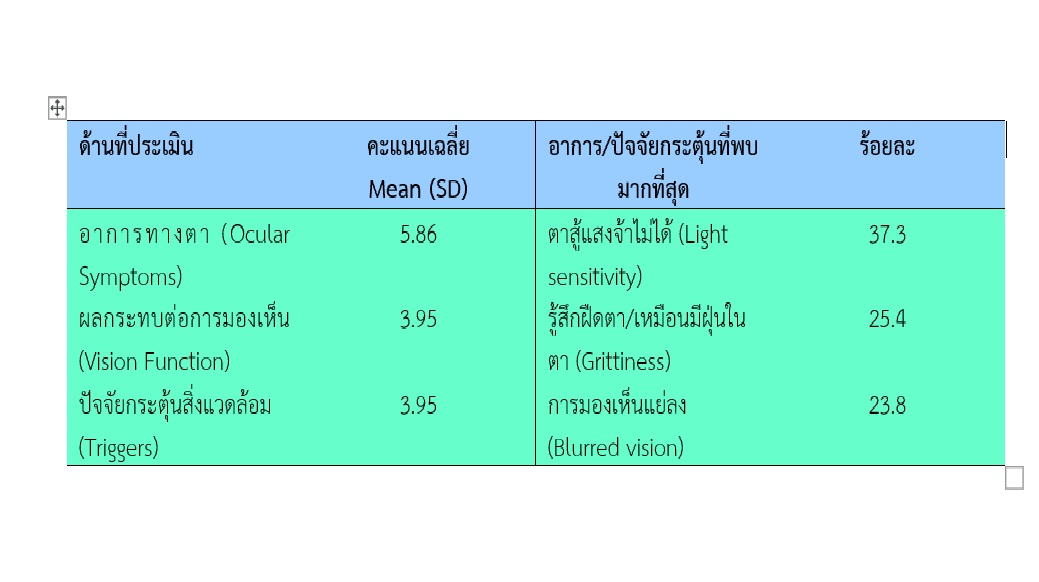
ผลการศึกษาพบความชุกของอาการตาแห้ง พบว่าในผู้สูงอายุร้อยละ 11.4 (n = 21) โดยพบในเพศหญิงมากกว่าเพศชายร้อยละ 7.6 และ 3.8 ตามลำดับ ความรุนแรงของอาการตาแห้งส่วนใหญ่อยู่ในระดับน้อยคิดเป็นร้อยละ 11.4 โดยมีคะแนน OSDI เฉลี่ย 13.8 (SD = 4) อาการที่พบมากที่สุดคือ ตาสู้แสงจ้า (ร้อยละ 37.3) รู้สึกฝืดตา (ร้อยละ 25.4) และรู้สึกว่าการมองเห็นแย่ลง (ร้อยละ 23.8) สำหรับการจัดการอาการตาแห้งที่พบมากที่สุดจะสอดคล้องกับระดับความรุนแรงตามเกณฑ์การจัดการอาการตาแห้ง คือ ไม่ได้ทำอะไรและรอให้อาการหายเอง (ร้อยละ 37.8) รองลงมาคือหลับตาเมื่อมีอาการ (ร้อยละ 4.3) และใช้น้ำตาเทียม (ร้อยละ 1.1) ตามลำดับ
จากผลการศึกษา พยาบาลและบุคลากรทางการแพทย์ควรให้ความสำคัญกับการคัดกรองผู้มีอาการตาแห้งในระยะแรก และให้คำแนะนำการดูแลจัดการอาการตาแห้งที่ถูกต้องเหมาะสม เช่น การประคบอุ่น และการกะพริบตาอย่างถูกวิธี เพื่อนำผู้สูงอายุเข้าสู่กระบวนการรักษาและป้องกันภาวะแทรกซ้อนที่อาจเกิดขึ้น
เอกสารอ้างอิง
Alanazi, S. A., Alomran, A. A., Abusharha, A., Fagehi, R., Al-Johani, N. J., & El-Hiti, G. A. (2019). An assessment of the ocular tear film in patients with thyroid disorders. Clinical Ophthalmology, 13, 1019-1026.
American Optometric Association. (2024). Low vision and vision rehabilitation. https://www.aoa.org/healthy-eyes/caring-for-your-eyes/low-vision-and-vision-rehab?sso=y
Arita, R., Kawashima, M., & Morishige, N. (2018). Clinical impression of the efficacy of eyelid warming or lid hygiene as treatment for meibomian gland dysfunction. Journal of Clinical and Experimental Ophthalmology, 9, 5-9.
Benítez-Del-Castillo, J., Labetoulle, M., Baudouin, C., Rolando, M., Akova, Y. A., Aragona, P., et al. (2017). Visual acuity and quality of life in dry eye disease: Proceedings of the OCEAN group meeting. Ocular Surface, 15(2), 169-178.
Bhandarkar, N. S., Shetty, K., Narendra, P., Kiran, A., Shetty, R., & Shetty, K. B. (2024). A review on drug-induced dry eye disease. Indian Journal of Ophthalmology, 72(10), 1412–1423.
Borrelli, M., Frings, A., Geerling, G., & Finis, D. (2021). Gender-specific differences in signs and symptoms of dry eye disease. Current Eye Research, 46(3), 294–301.
Bradley, J. L., Özer Stillman, I., Pivneva, I., Guerin, A., Evans, A. M., & Dana, R. (2019). Dry eye disease ranking among common reasons for seeking eye care in a large US claims database. Clinical Ophthalmology, 13, 225-232.
Chhadva, P., Goldhardt, R., & Galor, A. (2017). Meibomian gland disease: The role of gland dysfunction in dry eye disease. Ophthalmology, 124(11S).
Choi, J. H., Li, Y., Kim, S. H., Jin, R., Kim, Y. H., Choi, W., et al. (2018). The influences of smartphone use on the status of the tear film and ocular surface. PLoS One, 13(10), e0206541.
Craig, J. P., Nelson, J. D., Azar, D. T., Belmonte, C., Bron, A. J., Chauhan, S. K., et al. (2017). TFOS DEWS II Report Executive Summary. Ocular Surface, 15(4), 802-812.
Dana, R., Bradley, J. L., Guerin, A., Pivneva, I., Stillman, I. Ö., Evans, A. M., et al. (2019). Estimated prevalence and incidence of dry eye disease based on coding analysis of a large, all-age United States health care system. American Journal of Ophthalmology, 202, 47-54.
Gan, J., Wang, N., Li, S., Wang, B., Kang, M., Wei, S., et al. (2022). Effect of age and refractive error on local and global visual perception in Chinese children and adolescents. Frontiers in Human Neuroscience, 16, 1-8.
García Posadas, L., Contreras-Ruiz, L., Soriano-Romaní, L., Dartt, D. A., & Diebold, Y. (2016). Conjunctival goblet cell function: effect of contact lens wear and cytokines. Eye & Contact Lens, 42(2), 83-90.
Garg, P., Gupta, A., Tandon, N., & Raj, P. (2020). Dry eye disease after cataract surgery: study of its determinants and risk factors. Turkish Journal of Ophthalmology, 50(3), 133-142.
Golebiowski, B., Badarudin, N., Eden, J., You, J., Hampel, U., & Stapleton, F. (2017). Does endogenous serum oestrogen play a role in meibomian gland dysfunction in postmenopausal women with dry eye? British Journal of Ophthalmology, 101(2), 218-222.
Jones, L., Downie, L. E., Korb, D., Benitez-Del-Castillo, J. M., Dana, R., Deng, S. X., et al. (2017). TFOS DEWS II Management and therapy report. Ocular Surface, 15(3), 575-628.
Karakus, S., Mathews, P. M., Agrawal, D., Henrich, C., Ramulu, P. Y., & Akpek, E. K. (2018). Impact of dry eye on prolonged reading. Optometry and Vision Science, 95(12).
Kasetsuwan, N., Gorvanich, S., Erjongmanee, S., Thienprasiddhi, P., & Jitapunkul, S. (2012). Prevalence of dry eyes in elderly Thai population (the Romklao eye study). Asian Biomedicine, 6(6), 875-882.
Kim, K. I., Park, Y. S., Kim, R. H., & Kim, J. H. (2019). Factors associated with dry eye symptoms in elderly Koreans: the fifth Korea national health and nutrition examination survey 2010-2012. Korean Journal of Family Medicine, 40(1), 22-30.
Kitazawa, M., Sakamoto, C., Yoshimura, M., Kawashima, M., Inoue, S., Mimura, M., et al. (2018). The relationship of dry eye disease with depression and anxiety: A naturalistic observational study. Translational Vision Science & Technology, 7(6), 35.
Kojima, T. (2018). Contact lens-associated dry eye disease: recent advances worldwide and in Japan. Investigative Ophthalmology & Visual Science, 59(14).
Mathews, P. M., Ramulu, P. Y., Swenor, B. S., Utine, C. A., Rubin, G. S., & Akpek, E. K. (2017). Functional impairment of reading in patients with dry eye. British Journal of Ophthalmology, 101(4), 481.
Munjal, A., & Kaufman, E. J. (2023). Arcus senilis. In StatPearls [Internet]. StatPearls Publishing. https://www.ncbi.nlm.nih.gov/books/NBK554370/
Paiva, C. S. (2017). Effects of aging in dry eye. International Ophthalmology Clinics, 57(2), 47-64.
Perez, V. L., Chen, W., Craig, J. P., Dogru, M., Jones, L., Stapleton, F., et al. (2026). TFOS DEWS III: Executive Summary. American Journal of Ophthalmology, 282, 135-145.
Setten, G. V., Labetoulle, M., Baudouin, C., & Rolando, M. (2016). Evidence of seasonality and effects of psychrometry in dry eye disease. Acta Ophthalmologica, 94(5), 499-506.
Shanti, Y., Shehada, R., Bakkar, M. M., & Qaddumi, J. (2020). Prevalence and associated risk factors of dry eye disease in 16 northern west bank towns in Palestine: a cross-sectional study. BMC Ophthalmology, 20(1), 26.
Stang, A., Schmidt, B., Schramm, S., et al. (2024). Synergism between coexisting eye diseases and sex in increasing the prevalence of the dry eye syndrome. Scientific Reports, 14, 314.
Stapleton, F., Alves, M., Bunya, V. Y., Jalbert, I., Lekhanont, K., Malet, F., et al. (2017). TFOS DEWS II Epidemiology report. Ocular Surface, 15(3), 334-365.
Szczotka-Flynn, L. B., Maguire, M. G., Ying, G. S., Lin, M. C., Bunya, V. Y., Dana, R., et al. (2019). Impact of dry eye on visual acuity and contrast sensitivity: dry eye assessment and management study. Investigative Ophthalmology & Visual Science, 96(6), 387-396.
Tan, L. L., Morgan, P., Cai, Z. Q., & Straughan, R. A. (2015). Prevalence of and risk factors for symptomatic dry eye disease in Singapore. Clinical and Experimental Optometry, 98(1), 45-53.
TFOS DEWS III Digest Subcommittee. (2025). TFOS DEWS III: Digest. American Journal of Ophthalmology.
TFOS DEWS III Management and Therapy Subcommittee. (2025). TFOS DEWS III: Management and Therapy. American Journal of Ophthalmology.
Toda, I. (2018). Dry eye after LASIK. Investigative Ophthalmology & Visual Science, 59(14), 109-115.
Tunay, Z. O., Ozdemir, O., Acar, D. A., Cavkaytar, S., & Ersoy, E. (2016). Dry eye findings worsen with anticholinergic therapy in patients with urge incontinence. International Urogynecology Journal, 27(6), 919-922.
Wang, Y., Lv, H., Liu, Y., Jiang, X., Zhang, M., Li, X., et al. (2017). Characteristics of symptoms experienced by persons with dry eye disease while driving in China. Eye, 31(11), 1550-1555.
Wu, W.-L., & Chang, S.-W. (2022). Dermatochalasis aggravates meibomian gland dysfunction related dry eyes. Journal of Clinical Medicine, 11(9), 2379.
Yazdani, M., Elgstoen, K. B. P., & Utheim, T. P. (2022). Eye make-up products and dry eye disease: a mini review. Current Eye Research, 47(1), 1-11.
Yu, K., Bunya, V., Maguire, M., Asbell, P., & Ying, G. S. (2024). Association between systemic medication use and severity of dry eye signs and symptoms in the Dry eye assessment and management (DREAM) study. The Ocular Surface, 32, 13–25.
ดาวน์โหลด
เผยแพร่แล้ว
รูปแบบการอ้างอิง
ฉบับ
ประเภทบทความ
สัญญาอนุญาต
ลิขสิทธิ์ (c) 2026 วิทยาลัยพยาบาลบรมราชชนนี นครศรีธรรมราช

อนุญาตภายใต้เงื่อนไข Creative Commons Attribution-NonCommercial-NoDerivatives 4.0 International License.
บทความที่ได้รับการตีพิมพ์เป็นลิขสิทธิ์ของ วิทยาลัยพยาบาลบรมราชชนนี นครศรีธรรมราช
ข้อความที่ปรากฏในบทความแต่ละเรื่องในวารสารวิชาการเล่มนี้เป็นความคิดเห็นส่วนตัวของผู้เขียนแต่ละท่านไม่เกี่ยวข้องกับวิทยาลัยพยาบาลบรมราชชนนี นครศรีธรรมราช และบุคคลากรท่านอื่น ๆ ในวิทยาลัยฯ แต่อย่างใด ความรับผิดชอบองค์ประกอบทั้งหมดของบทความแต่ละเรื่องเป็นของผู้เขียนแต่ละท่าน หากมีความผิดพลาดใดๆ ผู้เขียนแต่ละท่านจะรับผิดชอบบทความของตนเองแต่ผู้เดียว