Effects of the Health Literacy Program on Health Literacy and Self-Care Behaviors of School-aged Children with Nephrotic Syndrome
Keywords:
Health Literacy, Self-Care Behaviors, School-Aged Children with Nephrotic SyndromeAbstract
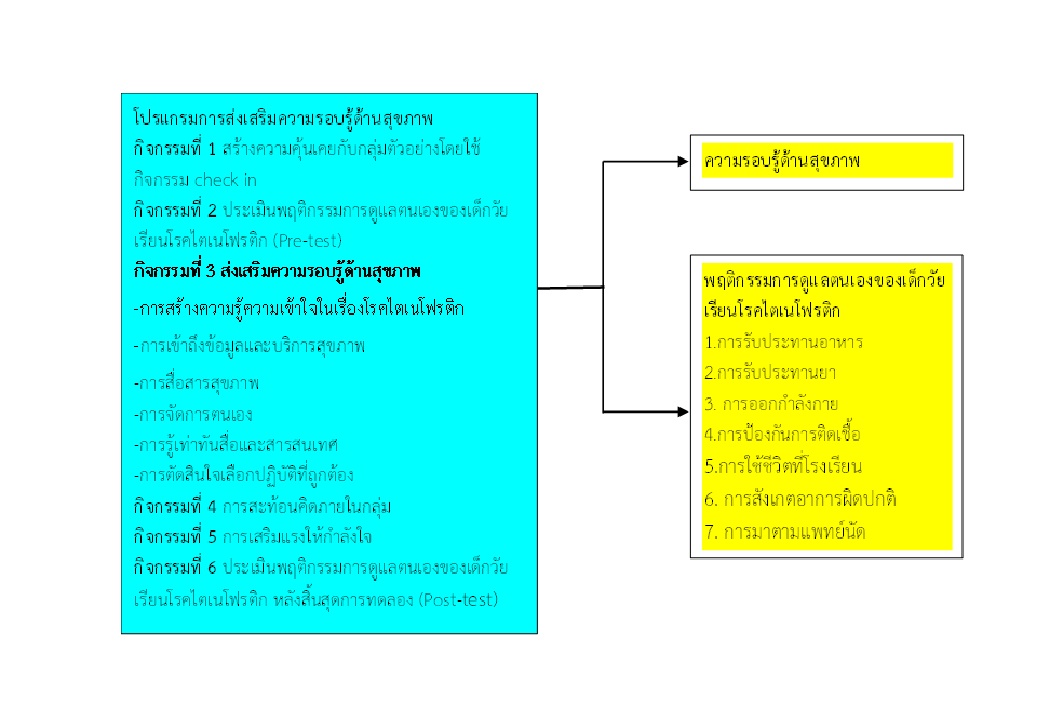
This quasi-experimental study, using a two-group pretest–posttest design, aimed to compare the mean scores of health literacy and self-care behaviors among school-age children with nephrotic syndrome in the experimental group before and after receiving a health literacy promotion program.The sample consisted of 42 school-age pediatric patients diagnosed with nephrotic syndrome, both male and female, receiving treatment at Trang Hospital, Trang Province. The participants were equally divided into an experimental group (n = 21) and a control group (n = 21). Simple random sampling was used, and group equivalence was controlled for gender, age, educational level, and duration of illness with nephrotic syndrome. The control group received standard health education regarding nephrotic syndrome awareness, while the experimental group participated in a health literacy promotion program for 8 weeks. Data collection instruments consisted of three parts: a demographic questionnaire, a health literacy questionnaire, and a self-care behavior questionnaire for school-age children with nephrotic syndrome. Content validity was established, and reliability testing yielded a Cronbach’s alpha coefficient of .80. and .82 Data were analyzed using frequency, percentage, mean, standard deviation, and paired t-test
The results revealed that after receiving the health literacy promotion program, the mean health literacy score of the experimental group (M = 112.19, SD = 4.73) was significantly higher than before the intervention (M = 105.90, SD = 3.61) and higher than that of the control group (M = 81.66, SD = 3.18), at a significance level of .05. Similarly, the mean self-care behavior score of the experimental group after the intervention (M = 67.28, SD = 2.98) was significantly higher than before the intervention (M = 61.57, SD = 3.48) and higher than that of the control group (M = 56.95, SD = 2.95), at the .05 level. The health literacy promotion program significantly improved both health literacy and self-care behaviors among school-age children with nephrotic syndrome (p < .05)
These findings suggest that this program should be applied to school-age children with nephrotic syndrome and parents to enhance self-care behaviors, motivate continuous self-care, prevent complications, leading to long-term positive health outcomes.
References
กองส่งเสริมสุขภาพ กรมอนามัย. (2561). แนวทางการจัดกิจกรรมส่งเสริมสุขภาพสำหรับเด็ก. กรมอนามัย กระทรวงสาธารณสุข.https://ssjnonthaburi.moph.go.th/nont/administrator/32ae084812e7127c39c5f56490608544/20240220152401-db51ffe25337f85b1e458fb912af0549.pdf
เบญจพร แก้วขอนแก่น, พิชชาดา ประสิทธิ์โชค, และอังศินันท์ อินทรกำแหง.(2568). ผลของโปรแกรมการพัฒนาความรอบรู้ด้านสุขภาพต่อพฤติกรรมการดูแลสุขภาพตนเองของผู้ป่วยหลังผ่าตัดลิ้นหัวใจ. วารสารการวิจัยและนวัตกรรมด้านสาธารณสุข, 3(2), 15–27.
พิทยา ไพบูลย์ศิริ.(2561). ความรอบรู้ด้านสุขภาพและพฤติกรรมสุขภาพ 3อ 2ส ของผู้บริหารภาครัฐ จังหวัดพระนครศรีอยุธยา. วารสารสมาคมเวชศาสตร์ป้องกันแห่งประเทศไทย, 8(1), 97–107.
พรทิพย์ ศิริบูรณ์พิพัฒนา. (2565). การพยาบาลเด็กเล่ม2 (พิมพ์ครั้งที่ 6). สถาบันพระบรมราชชนก.
วัชราพร เชยสุวรรณ.(2560). ความรอบรู้ด้านสุขภาพ: แนวคิดและการประยุกต์ใช้ในการปฏิบัติการพยาบาล.วารสารแพทย์ทหารบก, 44(3), 183–197.
สมรัตน์ แดงสกุล, สุธิศา ล่ามช้าง, และศรีพรรณ กันธวัง.(2558). ปัจจัยที่มีอิทธิพลต่อพฤติกรรมการรับประทานอาหารของวัยรุ่นที่เป็นโรคไตเนโฟรติก. วารสารพยาบาล, 42(2), 62–71.
สมาคมโรคไตเด็กแห่งประเทศไทย. (2563). แนวทางเวชปฏิบัติสำหรับโรคไตเนโฟรติกในเด็ก.https://thaipna.org
สุวิดา ลิ่มเริ่มสกุล, จงจิต เสน่หา, ดวงรัตน์ วัฒนกิจไกรเลิศ, และปฏิณัฐ บูรณะทรัพย์ขจรลิ้มเริมสกุล.(2565). ผลของโปรแกรมการพัฒนาความรอบรู้ด้านสุขภาพต่อพฤติกรรมการดูแลตนเองของผู้สูงอายุที่เป็นโรคเบาหวานชนิดที่ 2. วารสารพยาบาลศาสตร์, 40(1), 84–98.
เสาวลักษณ์ ชาญกัน, และชลิดา ธนัฐธีรกุล. (2563). ผลของโปรแกรมพัฒนาสมรรถนะแห่งตนต่อสมรรถนะแห่งตนและพฤติกรรมการดูแลตนเองในผู้ป่วยเด็กวัยเรียนโรคไตกลุ่มอาการเนโฟรติก. วารสารพยาบาลศาสตร์และสุขภาพ, 43(2), 74–84.
อลิสา บัวทอง.(2567). ผลของโปรแกรมส่งเสริมความรอบรู้ด้านสุขภาพต่อพฤติกรรมสุขภาพของผู้ป่วยโรคเบาหวานชนิดที่ 2 ที่ควบคุมไม่ได้ในอำเภอพระพรหม จังหวัดนครศรีธรรมราช. วารสารศาสตร์สุขภาพและการศึกษา, 5(1), 1–13.
เอื้อจิต สุขพูล, ชลดา กิ่งมาลา, ภาวิณี แพงสุข, ธวัชชัย ยืนยาว, และวัชรีวงศ์ หวังมั่น.(2563). ประสิทธิผลของโปรแกรมการพัฒนาความรอบรู้ด้านสุขภาพและพฤติกรรมสุขภาพสำหรับประชาชนวัยทำงาน. วารสารวิทยาศาสตร์สุขภาพ, 29(3), 419–429.
Davin, J.C., & Rutjes, N. W. (2011). Nephrotic syndrome in children: From bench to treatment. International Journal of Nephrology, 2011, Article 372304. https://doi.org/10.4061/2011/372304
Nutbeam, D. (2008). Defining, measuring and improving health literacy. Health Evaluation andPromotion, 35(4), 447–455.
Seigneux, R., & Martin, P.Y. (2009). Management of patients with nephrotic syndrome. Swiss Medical Weekly, 139(29–30), 416–422.
Downloads
Published
How to Cite
Issue
Section
License
Copyright (c) 2026 Boromarajonani College of Nursing, Nakhon Si Thammarat

This work is licensed under a Creative Commons Attribution-NonCommercial-NoDerivatives 4.0 International License.
บทความที่ได้รับการตีพิมพ์เป็นลิขสิทธิ์ของ วิทยาลัยพยาบาลบรมราชชนนี นครศรีธรรมราช
ข้อความที่ปรากฏในบทความแต่ละเรื่องในวารสารวิชาการเล่มนี้เป็นความคิดเห็นส่วนตัวของผู้เขียนแต่ละท่านไม่เกี่ยวข้องกับวิทยาลัยพยาบาลบรมราชชนนี นครศรีธรรมราช และบุคคลากรท่านอื่น ๆ ในวิทยาลัยฯ แต่อย่างใด ความรับผิดชอบองค์ประกอบทั้งหมดของบทความแต่ละเรื่องเป็นของผู้เขียนแต่ละท่าน หากมีความผิดพลาดใดๆ ผู้เขียนแต่ละท่านจะรับผิดชอบบทความของตนเองแต่ผู้เดียว