Early Identification of Respiratory Failure During High-Flow Nasal Cannula Therapy in Pediatric Patients: A Scoping Review
Keywords:
High-Flow Nasal Cannula, HFNC Treatment Failure, Early Warning Signs, Pediatric Patients, Scoping ReviewAbstract
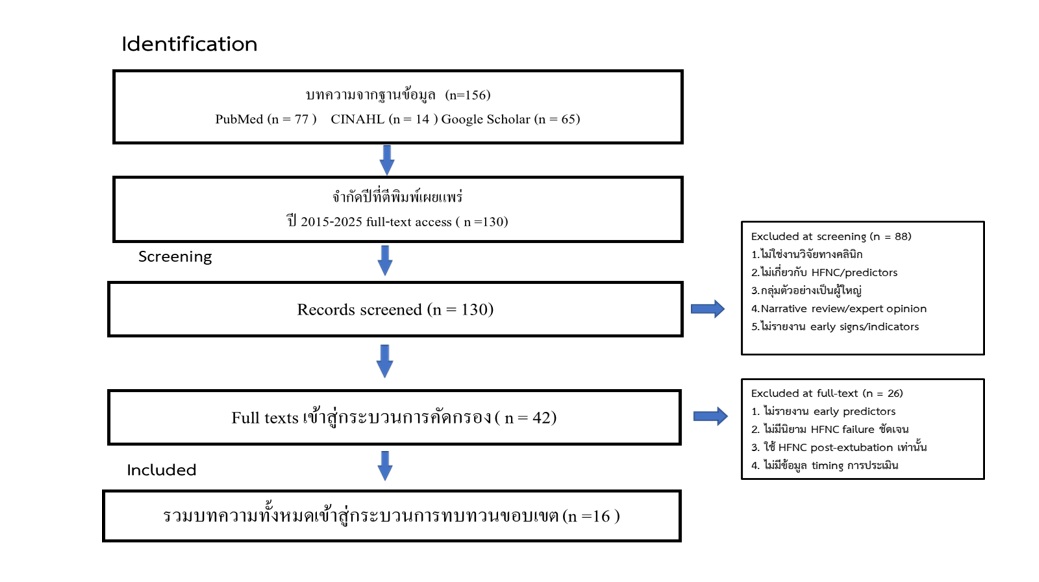
High-flow nasal cannula failure occurs in approximately 10–30% of pediatric patients, and delayed escalation of respiratory support is associated with increased morbidity and mortality. However, evidence on early warning signs and standardized nursing assessment criteria remains fragmented. Objectives: To (1) map and categorize early signs predictive of HFNC failure in pediatric patients, and (2) identify clinical tools, scoring systems, and physiological indices used to assess those signs. A scoping review was conducted following the Joanna Briggs Institute (JBI) framework (Peters et al., 2020) and reported according to PRISMA extension for Scoping Reviews (PRISMA-ScR; Tricco et al., 2018). Three electronic databases — PubMed (MEDLINE), CINAHL, and SCOPUS — were searched in December 2025, covering publications from 2015 to 2025, using a Population–Concept–Context (PCC) search strategy. Two independent reviewers screened articles with inter-rater reliability assessed by Cohen's Kappa.
Of 156 records identified, 16 studies met inclusion criteria, involving pediatric patients aged 0–18 years across PICU, general pediatric ward, and emergency department settings. HFNC failure rates ranged from 11% to 23%, with most failures occurring within the first 24 hours. Four categories of early warning signs were identified: gas exchange indices (SpO₂/FiO₂ ratio and ROX index failing to improve within 1–4 hours); vital sign response (HR and RR reduction of less than 20% within 1–2 hours); clinical severity scores (CRS, Wood–Downes–Ferrés, and p-HACOR demonstrating high accuracy at 1 and 12 hours); and baseline risk factors (age under 3 months, prematurity, congenital heart disease, non-respiratory pathology, and FiO₂ requirement exceeding 0.6).
High-flow nasal cannula failure in pediatric patients can be predicted early through integrated assessment of physiological indices, clinical severity scores, and baseline risk factors. The first 1–2 hours post-initiation represent a critical "early warning window" requiring intensive monitoring. These findings provide an evidence base for developing standardized nursing assessment protocols to reduce delayed intubation and improve patient safety.
References
Arksey, H., & O'Malley, L. (2005). Scoping studies: towards a methodological framework. International Journal of Social Research Methodology, 8(1), 19–32. https://doi.org/10.1080/1364557032000119616
Aydın, O., Aydın, E. A., Birbilen, A. Z., & Tekşam, O. (2021). Predictive factors of high-flow nasal cannula oxygen therapy failure in children with respiratory distress treated in a pediatric emergency department. The Turkish Journal of Pediatrics, 63(6), 1012–1019.
https://doi.org/10.24953/turkjped.2021.06.009
Demir, S., Anıl, M., Yalçın, G., Bardak, S., Demir, G., Berksoy, E., Gökalp, G., Kamit, F., Yılmaz, S. B., & Anıl, A. B. (2022). Early predictors of high-flow nasal cannula oxygen treatment failure in patients with respiratory distress admitted to the pediatric emergency department. The Turkish Journal of Pediatrics, 64(4), 648–657. https://doi.org/10.24953/turkjped.2020.587
Joanna Briggs Institute. (2020). JBI manual for evidence synthesis. https://doi.org/10.46658/JBIMES-20-01
Kim, G. E., Choi, S. H., Park, M., Jung, J. H., Lee, M., Kim, S. Y., Kim, M. J., Kim, Y. H., Kim, K. W., & Sohn, M. H. (2021). SpO2/FiO2 as a predictor of high flow nasal cannula outcomes in children with acute hypoxemic respiratory failure. Scientific Reports, 11(1), Article
https://doi.org/10.1038/s41598-021-92893-7
Kwon, J. W. (2020). High-flow nasal cannula oxygen therapy in children: a clinical review. Clinical and Experimental Pediatrics, 63(1), 3–7. https://doi.org/10.3345/kjp.2019.00626
Landis, J. R., & Koch, G. G. (1977). The measurement of observer agreement for categorical data. Biometrics, 33(1), 159–174. https://doi.org/10.2307/2529310
Le Pallec, C., Cerasuolo, D., Cauvin, J. C., Agossah, C., Milesi, C., Savy, N., & Brossier, D. W. (2025). Infants with bronchiolitis with high-flow nasal cannula in the paediatric ward: Is there a role for the ROXi (respiratory rate–oxygenation index) in predicting failure of
high-flow nasal cannula? European Journal of Pediatrics, 184, Article 396. https://doi.org/10.1007/s00431-025-06206-5
Liu, J., Li, D., Luo, L., Liu, Z., Li, X., & Qiao, L. (2022). Analysis of risk factors for the failure of respiratory support with high-flow nasal cannula oxygen therapy in children with acute respiratory dysfunction: A case-control study. Frontiers in Pediatrics, 10, Article 979944.
https://doi.org/10.3389/fped.2022.979944
Miake-Lye, I. M., Hempel, S., Shanman, R., & Shekelle, P. G. (2016). What is an evidence map A systematic review of published evidence maps and their definitions, methods, and products. Systematic Reviews, 5, 28. https://doi.org/10.1186/s13643-016-0204-x
Mikalsen, I. B., Davis, P., & Oymar, K. (2016). High flow nasal cannula in children: a literature review. Scandinavian Journal of Trauma, Resuscitation and Emergency Medicine, 24, 93. https://doi.org/10.1186/s13049-016-0278-4
Miura, S., Michihata, N., Isogai, T., Matsui, H., Fushimi, K., & Yasunaga, H. (2024). Early predictors of unfavorable outcomes in pediatric acute respiratory failure. Journal of Intensive Care, 12(1), 50. https://doi.org/10.1186/s40560-024-00763-x
Nascimento, M. S., Quinto, D. E. R., Zamberlan, G. C., Santos, A. Z., Rebello, C. M., & do Prado, C. (2021). High-flow nasal cannula failure: Can clinical outcomes determine early interruption Einstein (São Paulo), 19, eAO5846.
https://doi.org/10.31744/einstein_journal/2021AO5846
Nascimento, M. S., Zólio, B. A., Vale, L. A. P. A., Silva, P. A. L., Souza, T. S., Gonçalves, L. H. R., Fascina, L. P., & do Prado, C. (2024). ROX index as a predictor of failure of high-flow nasal cannula in infants with bronchiolitis. Scientific Reports, 14(1), Article 389.
https://doi.org/10.1038/s41598-024-51214-4
Onur, D., Atakul, G., & Işgüder, R. (2025). Predictive factors for failure of high-flow nasal cannula therapy in pediatric intensive care unit. Journal of Dr. Behcet Uz Children's Hospital, 15(2), 84–94. https://doi.org/10.4274/jbuch.galenos.2025.42800
Peters, M. D. J., Marnie, C., Tricco, A. C., Pollock, D., Munn, Z., Alexander, L., McInerney, P., Godfrey, C. M., & Khalil, H. (2020). Updated methodological guidance for the conduct of scoping reviews. JBI Evidence Synthesis, 18(10), 2119–2126.
https://doi.org/10.11124/JBIES-20-00167
Popay, J., Roberts, H., Sowden, A., Petticrew, M., Arai, L., Rodgers, M., Britten, N., Roen, K., & Duffy, S. (2006). Guidance on the conduct of narrative synthesis in systematic reviews: A product from the ESRC methods programme. ESRC.
Saelim, K., Thirapaleka, B., Ruangnapa, K., Prasertsan, P., & Anuntaseree, W. (2022). Predictors of high-flow nasal cannula failure in pediatric patients with acute respiratory distress. Clinical and Experimental Pediatrics, 65(12), 595–601. https://doi.org/10.3345/cep.2022.00241
Santos, A. C. E. Z., Caiado, C. M., Lopes, A. G. D., França, G. C., Valerio, C. A., Oliveira, D. B. L., de Araujo, O. R., & de Carvalho, W. B. (2024). Comparative analysis of predictors of failure for high-flow nasal cannula in bronchiolitis. PLOS ONE, 19(11), e0309523.
https://doi.org/10.1371/journal.pone.0309523
Sitthikarnkha, P., Uppala, R., Thiraratananukulchai, A., Sirikarn, P., Techasatian, L., Saengnipanthkul, S., & Niamsanit, S. (2025). Predictive factors for failure of high flow nasal cannula among children with lower respiratory tract infection: A single center
retrospective observational study. PLOS ONE, 20(7), e0328442. https://doi.org/10.1371/journal.pone.0328442
Sunkonkit, K., Kungsuwan, S., Seetaboot, S., & Reungrongrat, S. (2022). Factors associated with
failure of using high flow nasal cannula in children. The Clinical Respiratory Journal,16(11), 732–739. https://doi.org/10.1111/crj.13533
Tricco, A. C., Lillie, E., Zarin, W., O’Brien, K. K., Colquhoun, H., Levac, D., Moher, D., Peters, M. D. J., Horsley, T., Weeks, L., Hempel, S., Akl, E. A., Chang, C., McGowan, J., Stewart, L., Hartling, L., Aldcroft, A., Wilson, M. G., Garritty, C., Straus, S. E. (2018). PRISMA
extension for scoping reviews (PRISMA-ScR): Checklist and explanation. Annals of Internal Medicine, 169(7), 467–473. https://doi.org/10.7326/M18-0850
Vora, H., Sarangi, B. U., & Walimbe, A. (2025). Early Prediction of High-flow Nasal Cannula Failure Using Pediatric-modified HACOR Score in Children with Acute Hypoxemic Respiratory Distress: A Prospective Observational Study. Indian Journal of Critical Care Medicine:
Peer-Reviewed, Official Publication of Indian Society of Critical Care Medicine, 29(11), 902–906. https://doi.org/10.5005/jp-journals-10071-25082
Westphal, P. J., Teixeira, C., Krauzer, J. R. M., Bueno, M. H., Pereira, P. A., Hostyn, S. V., Vieira, M. D., Durante, C., & Bündchen, C. (2025). Predictive factors for high-flow nasal cannula failure in patients with acute viral bronchiolitis admitted to the pediatric intensive care
unit. Critical Care Science, 37, e20250161. https://doi.org/10.62675/2965-2774.20250161
Yildizdas, D., Yontem, A., Iplik, G., Horoz, O. O., & Ekinci, F. (2021). Predicting nasal high-flow therapy failure by pediatric respiratory rate-oxygenation index and pediatric respiratory rate-oxygenation index variation in children. European Journal of Pediatrics, 180(4),
–1106. https://doi.org/10.1007/s00431-020-03861-2
Yuniar, I., Pudjiadi, A. H., Dewi, R., Prawira, Y., Puspaningtyas, N. W., Tartila, T., & Fulki, S. (2024). Respiratory rate oxygenation (ROX) index as predictor of high flow nasal cannula in pediatric patients in pediatric intensive care unit. BMC Pulmonary Medicine, 24, Article
Downloads
Published
How to Cite
Issue
Section
License
Copyright (c) 2026 Boromarajonani College of Nursing, Nakhon Si Thammarat

This work is licensed under a Creative Commons Attribution-NonCommercial-NoDerivatives 4.0 International License.
บทความที่ได้รับการตีพิมพ์เป็นลิขสิทธิ์ของ วิทยาลัยพยาบาลบรมราชชนนี นครศรีธรรมราช
ข้อความที่ปรากฏในบทความแต่ละเรื่องในวารสารวิชาการเล่มนี้เป็นความคิดเห็นส่วนตัวของผู้เขียนแต่ละท่านไม่เกี่ยวข้องกับวิทยาลัยพยาบาลบรมราชชนนี นครศรีธรรมราช และบุคคลากรท่านอื่น ๆ ในวิทยาลัยฯ แต่อย่างใด ความรับผิดชอบองค์ประกอบทั้งหมดของบทความแต่ละเรื่องเป็นของผู้เขียนแต่ละท่าน หากมีความผิดพลาดใดๆ ผู้เขียนแต่ละท่านจะรับผิดชอบบทความของตนเองแต่ผู้เดียว