การประเมินสัญญาณเริ่มต้นของภาวะหายใจล้มเหลวระหว่างการใช้อุปกรณ์ให้ออกซิเจนอัตราไหลสูงผ่านสายสวนจมูกในผู้ป่วยเด็ก: การทบทวนวรรณกรรมแบบกำหนดขอบเขต
คำสำคัญ:
การให้ออกซิเจนอัตราไหลสูง, ภาวะล้มเหลวของการรักษาด้วย HFNC, สัญญาณเตือนเริ่มต้น, ผู้ป่วยเด็ก, การทบทวนวรรณกรรมแบบกำหนดขอบเขตบทคัดย่อ
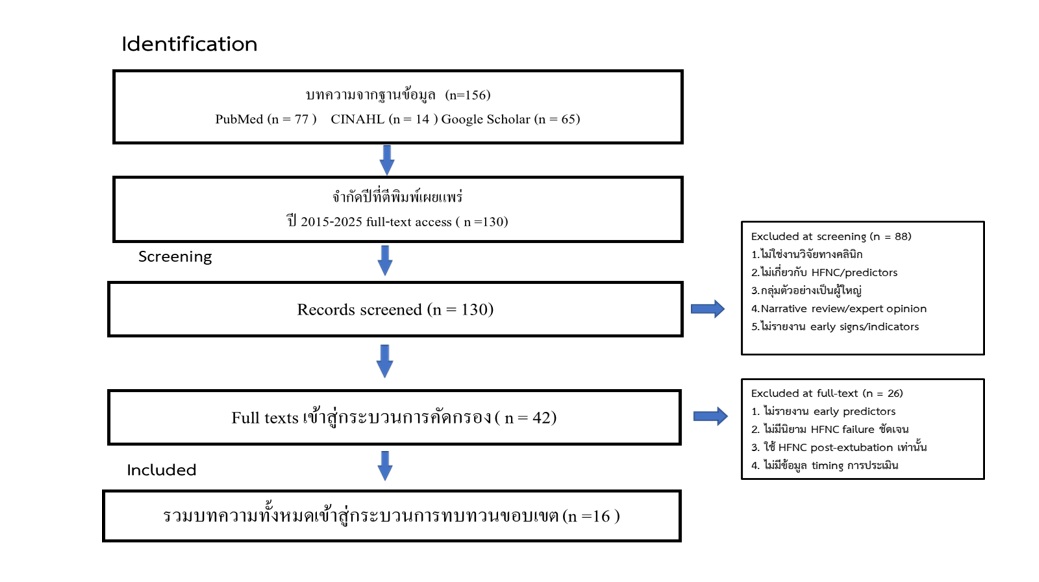
ภาวะล้มเหลวของการรักษาด้วยอุปกรณ์ให้ออกซิเจนอัตราไหลสูงพบได้ร้อยละ 10–30 ในผู้ป่วยเด็ก การล่าช้าในการยกระดับการรักษาส่งผลต่ออัตราการเจ็บป่วยและเสียชีวิต ปัจจุบันยังขาดการจัดระบบองค์ความรู้ด้านสัญญาณเตือนเริ่มต้นและเกณฑ์มาตรฐานสำหรับการประเมินทางการพยาบาล วัตถุประสงค์ เพื่อ (1) จัดหมวดหมู่สัญญาณเริ่มต้นที่ทำนายภาวะล้มเหลวดังกล่าวในผู้ป่วยเด็ก และ (2) ระบุเครื่องมือ คะแนนทางคลินิก และตัวชี้วัดทางสรีรวิทยาที่ใช้ประเมินสัญญาณเหล่านั้น การทบทวนวรรณกรรมแบบกำหนดขอบเขตตามกรอบ Joanna Briggs Institute รายงานตามแนวทาง PRISMA-ScR สืบค้นเดือนธันวาคม พ.ศ. 2568 จาก PubMed (MEDLINE), CINAHL (EBSCOhost) และ SCOPUS ครอบคลุมงานวิจัย ค.ศ. 2015–2025 ใช้กรอบ Population–Concept–Context ผู้วิจัยสองท่านคัดกรองอย่างอิสระ ประเมินความสอดคล้องด้วย Cohen's Kappa
จากบทความที่ค้นพบ 156 รายการ ผ่านเกณฑ์คัดเข้า 16 บทความ ครอบคลุมผู้ป่วยเด็กอายุ 0–18 ปี ในหอผู้ป่วยวิกฤต หอผู้ป่วยเด็กสามัญ และแผนกฉุกเฉิน อัตราภาวะล้มเหลวอยู่ที่ร้อยละ 11–23 ส่วนใหญ่เกิดภายใน 24 ชั่วโมงแรก สัญญาณเตือนจำแนกได้ 4 กลุ่ม ได้แก่ ตัวชี้วัดการแลกเปลี่ยนก๊าซ (SpO₂/FiO₂ ratio และ ROX index ที่ไม่ดีขึ้นใน 1–4 ชั่วโมงแรก) การตอบสนองของสัญญาณชีพ (อัตราการเต้นของหัวใจและอัตราการหายใจลดลงน้อยกว่าร้อยละ 20 ใน 1–2 ชั่วโมงแรก) คะแนนความรุนแรงทางคลินิก (CRS, Wood–Downes–Ferrés และ p-HACOR) และปัจจัยเสี่ยงพื้นฐาน (อายุน้อยกว่า 3 เดือน คลอดก่อนกำหนด โรคหัวใจพิการแต่กำเนิด พยาธิสภาพนอกระบบทางเดินหายใจ และ FiO₂ มากกว่า 0.6) เครื่องมือที่มีประสิทธิภาพสูงสุด คือ p-HACOR score ที่ 1 ชั่วโมง (AUC = 0.951) ROX index (AUC = 0.716–0.90) และ Clinical Respiratory Score ≥ 6 ที่ 12 ชั่วโมง (AUC > 0.90)
ภาวะล้มเหลวของการรักษาสามารถคาดการณ์ได้ตั้งแต่ระยะเริ่มต้น ผ่านการบูรณาการสัญญาณเตือน 4 กลุ่ม โดยเฉพาะในช่วง 1–2 ชั่วโมงแรก ผลการศึกษาสนับสนุนการพัฒนาแนวทางการประเมินทางการพยาบาลที่เป็นมาตรฐาน
เอกสารอ้างอิง
Arksey, H., & O'Malley, L. (2005). Scoping studies: towards a methodological framework. International Journal of Social Research Methodology, 8(1), 19–32. https://doi.org/10.1080/1364557032000119616
Aydın, O., Aydın, E. A., Birbilen, A. Z., & Tekşam, O. (2021). Predictive factors of high-flow nasal cannula oxygen therapy failure in children with respiratory distress treated in a pediatric emergency department. The Turkish Journal of Pediatrics, 63(6), 1012–1019.
https://doi.org/10.24953/turkjped.2021.06.009
Demir, S., Anıl, M., Yalçın, G., Bardak, S., Demir, G., Berksoy, E., Gökalp, G., Kamit, F., Yılmaz, S. B., & Anıl, A. B. (2022). Early predictors of high-flow nasal cannula oxygen treatment failure in patients with respiratory distress admitted to the pediatric emergency department. The Turkish Journal of Pediatrics, 64(4), 648–657. https://doi.org/10.24953/turkjped.2020.587
Joanna Briggs Institute. (2020). JBI manual for evidence synthesis. https://doi.org/10.46658/JBIMES-20-01
Kim, G. E., Choi, S. H., Park, M., Jung, J. H., Lee, M., Kim, S. Y., Kim, M. J., Kim, Y. H., Kim, K. W., & Sohn, M. H. (2021). SpO2/FiO2 as a predictor of high flow nasal cannula outcomes in children with acute hypoxemic respiratory failure. Scientific Reports, 11(1), Article
https://doi.org/10.1038/s41598-021-92893-7
Kwon, J. W. (2020). High-flow nasal cannula oxygen therapy in children: a clinical review. Clinical and Experimental Pediatrics, 63(1), 3–7. https://doi.org/10.3345/kjp.2019.00626
Landis, J. R., & Koch, G. G. (1977). The measurement of observer agreement for categorical data. Biometrics, 33(1), 159–174. https://doi.org/10.2307/2529310
Le Pallec, C., Cerasuolo, D., Cauvin, J. C., Agossah, C., Milesi, C., Savy, N., & Brossier, D. W. (2025). Infants with bronchiolitis with high-flow nasal cannula in the paediatric ward: Is there a role for the ROXi (respiratory rate–oxygenation index) in predicting failure of
high-flow nasal cannula? European Journal of Pediatrics, 184, Article 396. https://doi.org/10.1007/s00431-025-06206-5
Liu, J., Li, D., Luo, L., Liu, Z., Li, X., & Qiao, L. (2022). Analysis of risk factors for the failure of respiratory support with high-flow nasal cannula oxygen therapy in children with acute respiratory dysfunction: A case-control study. Frontiers in Pediatrics, 10, Article 979944.
https://doi.org/10.3389/fped.2022.979944
Miake-Lye, I. M., Hempel, S., Shanman, R., & Shekelle, P. G. (2016). What is an evidence map A systematic review of published evidence maps and their definitions, methods, and products. Systematic Reviews, 5, 28. https://doi.org/10.1186/s13643-016-0204-x
Mikalsen, I. B., Davis, P., & Oymar, K. (2016). High flow nasal cannula in children: a literature review. Scandinavian Journal of Trauma, Resuscitation and Emergency Medicine, 24, 93. https://doi.org/10.1186/s13049-016-0278-4
Miura, S., Michihata, N., Isogai, T., Matsui, H., Fushimi, K., & Yasunaga, H. (2024). Early predictors of unfavorable outcomes in pediatric acute respiratory failure. Journal of Intensive Care, 12(1), 50. https://doi.org/10.1186/s40560-024-00763-x
Nascimento, M. S., Quinto, D. E. R., Zamberlan, G. C., Santos, A. Z., Rebello, C. M., & do Prado, C. (2021). High-flow nasal cannula failure: Can clinical outcomes determine early interruption Einstein (São Paulo), 19, eAO5846.
https://doi.org/10.31744/einstein_journal/2021AO5846
Nascimento, M. S., Zólio, B. A., Vale, L. A. P. A., Silva, P. A. L., Souza, T. S., Gonçalves, L. H. R., Fascina, L. P., & do Prado, C. (2024). ROX index as a predictor of failure of high-flow nasal cannula in infants with bronchiolitis. Scientific Reports, 14(1), Article 389.
https://doi.org/10.1038/s41598-024-51214-4
Onur, D., Atakul, G., & Işgüder, R. (2025). Predictive factors for failure of high-flow nasal cannula therapy in pediatric intensive care unit. Journal of Dr. Behcet Uz Children's Hospital, 15(2), 84–94. https://doi.org/10.4274/jbuch.galenos.2025.42800
Peters, M. D. J., Marnie, C., Tricco, A. C., Pollock, D., Munn, Z., Alexander, L., McInerney, P., Godfrey, C. M., & Khalil, H. (2020). Updated methodological guidance for the conduct of scoping reviews. JBI Evidence Synthesis, 18(10), 2119–2126.
https://doi.org/10.11124/JBIES-20-00167
Popay, J., Roberts, H., Sowden, A., Petticrew, M., Arai, L., Rodgers, M., Britten, N., Roen, K., & Duffy, S. (2006). Guidance on the conduct of narrative synthesis in systematic reviews: A product from the ESRC methods programme. ESRC.
Saelim, K., Thirapaleka, B., Ruangnapa, K., Prasertsan, P., & Anuntaseree, W. (2022). Predictors of high-flow nasal cannula failure in pediatric patients with acute respiratory distress. Clinical and Experimental Pediatrics, 65(12), 595–601. https://doi.org/10.3345/cep.2022.00241
Santos, A. C. E. Z., Caiado, C. M., Lopes, A. G. D., França, G. C., Valerio, C. A., Oliveira, D. B. L., de Araujo, O. R., & de Carvalho, W. B. (2024). Comparative analysis of predictors of failure for high-flow nasal cannula in bronchiolitis. PLOS ONE, 19(11), e0309523.
https://doi.org/10.1371/journal.pone.0309523
Sitthikarnkha, P., Uppala, R., Thiraratananukulchai, A., Sirikarn, P., Techasatian, L., Saengnipanthkul, S., & Niamsanit, S. (2025). Predictive factors for failure of high flow nasal cannula among children with lower respiratory tract infection: A single center
retrospective observational study. PLOS ONE, 20(7), e0328442. https://doi.org/10.1371/journal.pone.0328442
Sunkonkit, K., Kungsuwan, S., Seetaboot, S., & Reungrongrat, S. (2022). Factors associated with
failure of using high flow nasal cannula in children. The Clinical Respiratory Journal,16(11), 732–739. https://doi.org/10.1111/crj.13533
Tricco, A. C., Lillie, E., Zarin, W., O’Brien, K. K., Colquhoun, H., Levac, D., Moher, D., Peters, M. D. J., Horsley, T., Weeks, L., Hempel, S., Akl, E. A., Chang, C., McGowan, J., Stewart, L., Hartling, L., Aldcroft, A., Wilson, M. G., Garritty, C., Straus, S. E. (2018). PRISMA
extension for scoping reviews (PRISMA-ScR): Checklist and explanation. Annals of Internal Medicine, 169(7), 467–473. https://doi.org/10.7326/M18-0850
Vora, H., Sarangi, B. U., & Walimbe, A. (2025). Early Prediction of High-flow Nasal Cannula Failure Using Pediatric-modified HACOR Score in Children with Acute Hypoxemic Respiratory Distress: A Prospective Observational Study. Indian Journal of Critical Care Medicine:
Peer-Reviewed, Official Publication of Indian Society of Critical Care Medicine, 29(11), 902–906. https://doi.org/10.5005/jp-journals-10071-25082
Westphal, P. J., Teixeira, C., Krauzer, J. R. M., Bueno, M. H., Pereira, P. A., Hostyn, S. V., Vieira, M. D., Durante, C., & Bündchen, C. (2025). Predictive factors for high-flow nasal cannula failure in patients with acute viral bronchiolitis admitted to the pediatric intensive care
unit. Critical Care Science, 37, e20250161. https://doi.org/10.62675/2965-2774.20250161
Yildizdas, D., Yontem, A., Iplik, G., Horoz, O. O., & Ekinci, F. (2021). Predicting nasal high-flow therapy failure by pediatric respiratory rate-oxygenation index and pediatric respiratory rate-oxygenation index variation in children. European Journal of Pediatrics, 180(4),
–1106. https://doi.org/10.1007/s00431-020-03861-2
Yuniar, I., Pudjiadi, A. H., Dewi, R., Prawira, Y., Puspaningtyas, N. W., Tartila, T., & Fulki, S. (2024). Respiratory rate oxygenation (ROX) index as predictor of high flow nasal cannula in pediatric patients in pediatric intensive care unit. BMC Pulmonary Medicine, 24, Article
ดาวน์โหลด
เผยแพร่แล้ว
รูปแบบการอ้างอิง
ฉบับ
ประเภทบทความ
สัญญาอนุญาต
ลิขสิทธิ์ (c) 2026 วิทยาลัยพยาบาลบรมราชชนนี นครศรีธรรมราช

อนุญาตภายใต้เงื่อนไข Creative Commons Attribution-NonCommercial-NoDerivatives 4.0 International License.
บทความที่ได้รับการตีพิมพ์เป็นลิขสิทธิ์ของ วิทยาลัยพยาบาลบรมราชชนนี นครศรีธรรมราช
ข้อความที่ปรากฏในบทความแต่ละเรื่องในวารสารวิชาการเล่มนี้เป็นความคิดเห็นส่วนตัวของผู้เขียนแต่ละท่านไม่เกี่ยวข้องกับวิทยาลัยพยาบาลบรมราชชนนี นครศรีธรรมราช และบุคคลากรท่านอื่น ๆ ในวิทยาลัยฯ แต่อย่างใด ความรับผิดชอบองค์ประกอบทั้งหมดของบทความแต่ละเรื่องเป็นของผู้เขียนแต่ละท่าน หากมีความผิดพลาดใดๆ ผู้เขียนแต่ละท่านจะรับผิดชอบบทความของตนเองแต่ผู้เดียว