Amphetamine Exposure in Pregnant Women and Hypertensive Disorders of Pregnancy: A Scoping Review
Keywords:
Pregnant Women, Amphetamine Use, Hypertensive Disorders of PregnancyAbstract
This study aimed to explore, identify, and synthesize the evidence regarding the
association between amphetamine use during pregnancy and hypertensive disorders of pregnancy (HDP). A scoping review methodology was conducted following the Joanna Briggs Institute (JBI) framework and reported in accordance with the Preferred Reporting Items for Systematic Reviews and Meta-Analyses Extension for Scoping Reviews (PRISMA-ScR) guidelines. Quantitative primary studies published in Thai and English between 2015 and 2025 were included. Literature searches were performed in three electronic databases: CINAHL, PubMed, and Thai Journals Online (Thai JO). The Population–Exposure–Comparison–Outcome (PECO) framework was used to formulate the review question. Study selection, quality appraisal, and data extraction were conducted independently according to JBI guidelines. Data were analyzed descriptively and synthesized using thematic synthesis.
A total of 197 records were identified through database searching, of which 10 studies
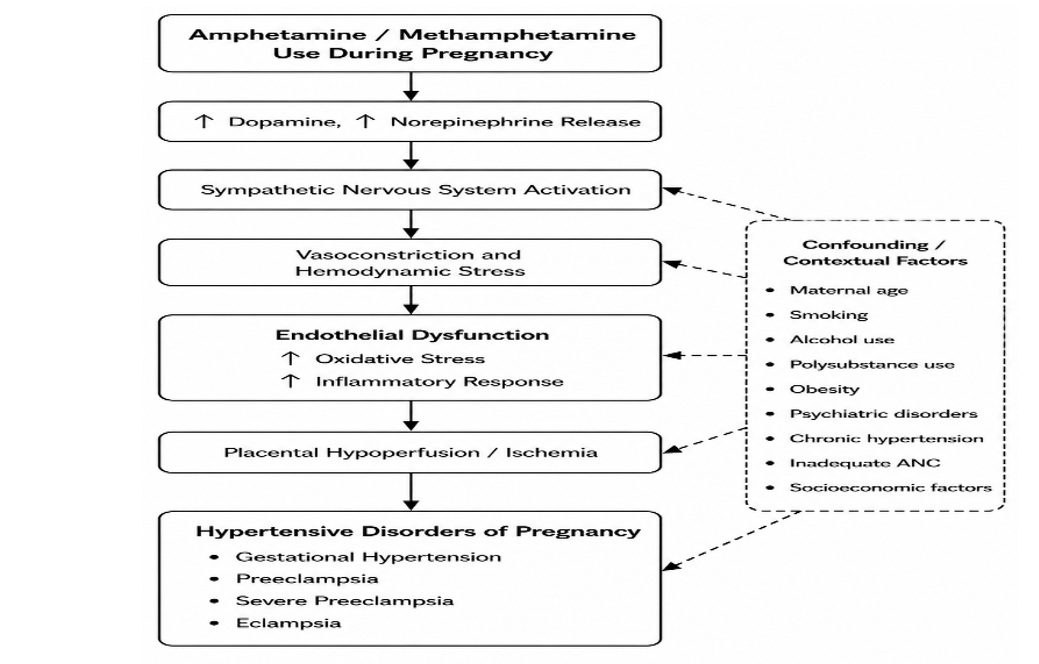
met the inclusion criteria. The findings indicated that methamphetamine or amphetamine use during pregnancy was associated with an increased risk of hypertensive disorders of pregnancy, including gestational hypertension and preeclampsia. In addition, stimulant exposure was associated with other adverse obstetric outcomes, such as placental abruption and severe maternal morbidity. However, most of the available evidence was derived from retrospective studies and was limited by potential confounding factors, inadequate assessment of dosage and duration of substance use
The findings of this review suggest that amphetamine and methamphetamine use
during pregnancy are associated with an increased risk of hypertensive disorders of pregnancy and adverse maternal outcomes. Therefore, routine substance use screening during antenatal care, close monitoring of pregnancy complications, and multidisciplinary care approaches are essential to reduce these risks. Future research should focus on prospective cohort studies and long-term follow-up to strengthen the existing evidence base.
Keywords: Pregnant Women, Amphetamine Exposure, Hypertensive disorders of pregnancy
References
กรมอนามัย กระทรวงสาธารณสุข. (2568). กรมอนามัยเดินหน้าระบบเฝ้าระวัง คัดกรอง และดูแลการใช้สารเสพติดในหญิงตั้งครรภ์แบบบูรณาการ เน้นการดูแลโดยไม่ตีตราและเคารพสิทธิ. เว็บไซต์กรมอนามัย กระทรวงสาธารณสุข
ไพศิษฐ์ เพชรมะลิ. (2568). ผลลัพธ์ทางสูติกรรมของมารดาและทารกในมารดาเสพสารแอมเฟตามีนที่มาคลอดโรงพยาบาลท่าศาลา. วารสารวิชาการแพทย์เขต 11, 39(1), 55–68.
อดิศักดิ์ ไวเขตการณ์. (2564). ผลลัพธ์การตั้งครรภ์ของมารดาและทารกในสตรีตั้งครรภ์ที่เสพสารเมทแอมเฟตามีนระหว่างตั้งครรภ์. วารสารโรงพยาบาลมหาสารคาม, 18(2), 105–112.
หรรษา เรืองศิริปิยะกุล. (2569). ผลกระทบจากการใช้สารเมทแอมเฟตามีนของมารดาขณะตั้งครรภ์และภาวะถอนยาของทารกแรกเกิดในโรงพยาบาลสิรินธร จังหวัดขอนแก่น. วารสารสำนักงานสาธารณสุขจังหวัดขอนแก่น, 8(1), e280743.
Admon, L. K., Bart, G., Kozhimannil, K. B., Richardson, C. R., Dalton, V. K., & Winkelman, T. N. A. (2019). Amphetamine- and opioid-affected births: Incidence, outcomes, and costs, United States, 2004–2015. American Journal of Public Health, 109(1), 148–154. https://doi.org/10.2105/AJPH.2018.304771
Arksey, H., & O'Malley, L. (2005). Scoping studies: Towards a methodological framework. International Journal of Social Research Methodology, 8(1), 19–32. https://doi.org/10.1080/1364557032000119616
Chomchai, C., & Manaboriboon, B. (2012). Stimulant methamphetamine and dextromethorphan use among Thai adolescents: Implications for health of women and children. Journal of Medical Toxicology, 8, 291–294. https://doi.org/10.1007/s13181-012-0228-0
Cohen, J. M., Hernández-Díaz, S., Bateman, B. T., Park, Y., Desai, R. J., Gray, K. J., Patorno, E., Mogun, H., & Huybrechts, K. F. (2017). Placental complications associated with psychostimulant use in pregnancy. Obstetrics & Gynecology, 130(6), 1192–1201. https://doi.org/10.1097/AOG.0000000000002362
Garovic, V. D., Dechend, R., Karumanchi, S. A., Baird, S. M., Easterling, T., Magee, L. A., Rana, S., Vermunt, J. V., & August, P. (2022). Hypertension in pregnancy: Diagnosis, blood pressure goals, and pharmacotherapy: A scientific statement from the American Heart Association. Hypertension, 79(2), e21–e41. https://doi.org/10.1161/HYP.0000000000000208
Hayer, S., Garg, B., Wallace, J., Prewitt, K. C., Lo, J. O., & Caughey, A. B. (2024). Prenatal methamphetamine use increases risk of adverse maternal and neonatal outcomes. American Journal of Obstetrics and Gynecology, 231(3), 356.e1–356.e15. https://doi.org/10.1016/j.ajog.2024.05.033
Homsup, P., Phaloprakarn, C., Tangjitgamol, S., & Manusirivithaya, S. (2018). Maternal characteristics and pregnancy outcomes among illicit drug-using women in an urban setting. Taiwanese Journal of Obstetrics and Gynecology, 57(1), 83–88. https://doi.org/10.1016/j.tjog.2017.12.014
Newport, D. J., Hostetter, A. L., Juul, S. H., Porterfield, S. M., Knight, B. T., & Stowe, Z. N. (2016). Prenatal psychostimulant and antidepressant exposure and risk of hypertensive disorders of pregnancy. The Journal of Clinical Psychiatry, 77(11), 1538–1545. https://doi.org/10.4088/JCP.15m10506
Peters, M. D. J., Godfrey, C., McInerney, P., Munn, Z., Tricco, A. C., & Khalil, H. (2020). Chapter 11: Scoping reviews. In E. Aromataris & Z. Munn (Eds.), JBI manual for evidence synthesis. Joanna Briggs Institute. https://doi.org/10.46658/JBIMES-20-12
Pippard, N. S., Bandoli, G., & Baer, R. J. (2024). Trends and adverse pregnancy and birth outcomes associated with stimulant-related disorder diagnosis. Addiction, 119(11), 2006–2014. https://doi.org/10.1111/add.16636
Premchit, S., Orungrote, N., Prommas, S., Smanchat, B., Bhamarapravatana, K., & Suwannarurk, K. (2021). Maternal and neonatal complications of methamphetamine use during pregnancy. Obstetrics and Gynecology International, 2021, Article 8814168. https://doi.org/10.1155/2021/8814168
Roberts, J. M., & Hubel, C. A. (2009). The two-stage model of preeclampsia: Variations on the theme. Placenta, 30(Suppl. A), S32–S37. https://doi.org/10.1016/j.placenta.2008.11.009
Roloff, K. A., Stepanyan, G., & Valenzuela, G. (2015). Methamphetamine use increases chances of preeclampsia. Journal of Family Medicine and Disease Prevention, 1(3), Article 011. https://doi.org/10.23937/2469-5793/1510011
Russell, D. J., Wyrwoll, C. S., Preen, D. B., & Kelty, E. (2024). Investigating maternal and neonatal health outcomes associated with continuing or ceasing dexamphetamine treatment for women with attention-deficit hyperactivity disorder during pregnancy: A retrospective cohort study. Archives of Women's Mental Health, 27(5), 785–794. https://doi.org/10.1007/s00737-024-01450-4
Tricco, A. C., Lillie, E., Zarin, W., O'Brien, K. K., Colquhoun, H., Levac, D., Moher, D., Peters, M. D. J., Horsley, T., Weeks, L., Hempel, S., Akl, E. A., Chang, C., McGowan, J., Stewart, L., Hartling, L., Aldcroft, A., Wilson, M. G., Garritty, C., ... Straus, S. E. (2018). PRISMA extension for scoping reviews (PRISMA-ScR): Checklist and explanation. Annals of Internal Medicine, 169(7), 467–473. https://doi.org/10.7326/M18-0850
United Nations Office on Drugs and Crime. (2022). Synthetic drugs in East and Southeast Asia: Latest developments and challenges 2022. United Nations Office on Drugs and Crime.
United Nations Office on Drugs and Crime. (2025). World drug report 2025: Special points. United Nations Office on Drugs and Crime.
Downloads
Published
How to Cite
Issue
Section
License
Copyright (c) 2026 Boromarajonani College of Nursing, Nakhon Si Thammarat

This work is licensed under a Creative Commons Attribution-NonCommercial-NoDerivatives 4.0 International License.
บทความที่ได้รับการตีพิมพ์เป็นลิขสิทธิ์ของ วิทยาลัยพยาบาลบรมราชชนนี นครศรีธรรมราช
ข้อความที่ปรากฏในบทความแต่ละเรื่องในวารสารวิชาการเล่มนี้เป็นความคิดเห็นส่วนตัวของผู้เขียนแต่ละท่านไม่เกี่ยวข้องกับวิทยาลัยพยาบาลบรมราชชนนี นครศรีธรรมราช และบุคคลากรท่านอื่น ๆ ในวิทยาลัยฯ แต่อย่างใด ความรับผิดชอบองค์ประกอบทั้งหมดของบทความแต่ละเรื่องเป็นของผู้เขียนแต่ละท่าน หากมีความผิดพลาดใดๆ ผู้เขียนแต่ละท่านจะรับผิดชอบบทความของตนเองแต่ผู้เดียว