ปัจจัยที่มีความสัมพันธ์ต่อระยะเวลาการมารับการรักษาของผู้ป่วยโรคหลอดเลือดสมองในระยะเฉียบพลัน งานอุบัติเหตุฉุกเฉิน โรงพยาบาลเชียรใหญ่
คำสำคัญ:
โรคหลอดเลือดสมองในระยะเฉียบพลัน, การรับรู้, ระยะเวลามาถึงโรงพยาบาลบทคัดย่อ
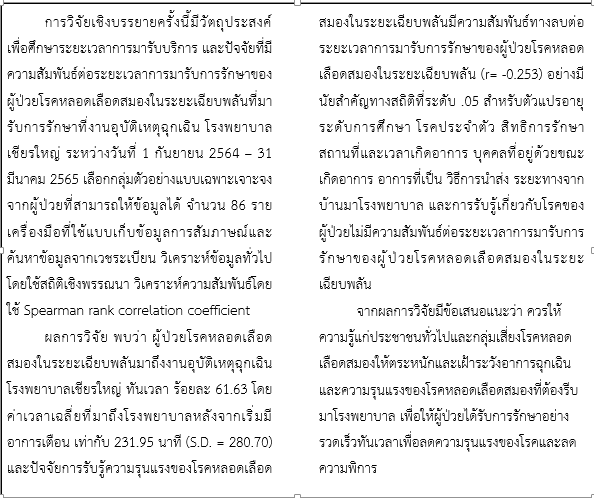
การวิจัยเชิงบรรยายครั้งนี้มีวัตถุประสงค์ เพื่อศึกษาระยะเวลาการมารับบริการ และปัจจัยที่มีความสัมพันธ์ต่อระยะเวลาการมารับการรักษาของผู้ป่วยโรคหลอดเลือดสมองในระยะเฉียบพลันที่มารับการรักษาที่งานอุบัติเหตุฉุกเฉิน โรงพยาบาลเชียรใหญ่ ระหว่างวันที่ 1 กันยายน 2564 – 31 มีนาคม พ.ศ. 2565 เลือกกลุ่มตัวอย่างแบบเฉพาะเจาะจงจากผู้ป่วยที่สามารถให้ข้อมูลได้ จำนวน 86 ราย เครื่องมือที่ใช้แบบเก็บข้อมูลการสัมภาษณ์และค้นหาข้อมูลจากเวชระเบียน วิเคราะห์ข้อมูลทั่วไปโดยใช้สถิติเชิงพรรณนา วิเคราะห์ความสัมพันธ์โดยใช้ Spearman rank correlation coefficient
ผลการวิจัย พบว่า ผู้ป่วยโรคหลอดเลือดสมองในระยะเฉียบพลันมาถึงงานอุบัติเหตุฉุกเฉิน โรงพยาบาลเชียรใหญ่ ทันเวลา ร้อยละ 61.63 โดยค่าเวลาเฉลี่ยที่มาถึงโรงพยาบาลหลังจากเริ่มมีอาการเตือน เท่ากับ 231.95 นาที (S.D.= 280.70) และปัจจัยการรับรู้ความรุนแรงของโรคหลอดเลือดสมองในระยะเฉียบพลันมีความสัมพันธ์ทางลบต่อระยะเวลาการมารับการรักษาของผู้ป่วยโรคหลอดเลือดสมองในระยะเฉียบพลัน (r= -0.253) อย่างมีนัยสำคัญทางสถิติที่ระดับ .05 สำหรับตัวแปรอายุ ระดับการศึกษา โรคประจำตัว สิทธิการรักษา สถานที่และเวลาเกิดอาการ บุคคลที่อยู่ด้วยขณะเกิดอาการ อาการที่เป็น วิธีการนำส่ง ระยะทางจากบ้านมาโรงพยาบาล และการรับรู้เกี่ยวกับโรคของผู้ป่วยไม่มีความสัมพันธ์ต่อระยะเวลาการมารับการรักษาของผู้ป่วยโรคหลอดเลือดสมองในระยะเฉียบพลัน
จากผลการวิจัยมีข้อเสนอแนะว่า ควรให้ความรู้แก่ประชาชนทั่วไปและกลุ่มเสี่ยงโรคหลอดเลือดสมองให้ตระหนักและเฝ้าระวังอาการฉุกเฉินและความรุนแรงของโรคหลอดเลือดสมองที่ต้องรีบมาโรงพยาบาล เพื่อให้ผู้ป่วยได้รับการรักษาอย่างรวดเร็วทันเวลาเพื่อลดความรุนแรงของโรคและลดความพิการ
เอกสารอ้างอิง
American Stroke Association. (2012). Latest news about stroke. Retrieved from http://www. stroke.org.
Best, J. W. (1977). Research in education. (3nded). Englewod Cliffs: Prentice-Hall.
Binthaisong, T. (2013). Factors related to the time of arrival at the hospital after the onset of symptoms of acute stroke patients. Kuakarun Journal, 20(1), 15-29.
Butsingh, N. (2019). Nursing care of patients with acute stroke. Journal of the Nursing Council, 34(3), 15-29.
Chaiyo, S. (2014). Factors predicting the visiting time in patients with acute ischemic stroke. Master of nursing science thesis in adult nursing, Graduate school, Khon Kaen University. (in Thai)
Division of Non-communicable Diseases. (2021). Office of risk communication department of disease control. Retrieved from http:// thaincd.com/information-statistic/non-communicable-disease=data.php. (in Thai)
Hansuthiwetkul, N., Chenthanakij, B., & Chamnankul, B. (2012). Why do people in Chiang Mai so do not call for emergency medical services when an emergency or an accident. Research Journal Public Health Systems, 6(2), 268-277.
Institute of Neurology. (2015). Stroke nursing guidelines for general nurses (Complete edition). Bangkok: Institute of Neurology.
Jayaphong, S., Sritumsuk, W., Charoensan, P., Chamnongchit, S., Munsil, J., & Pansri, S. (2020). A study of violence, perceived severity of disease in relation to hospital arrival times of acute stroke patients. Journal of the Royal Thai Army Nurses, 21(2), 273-285.
Khantichit, P., Sanchaisuriya, P., & Thepwan, P. (2015). The period of treatment of ischemic stroke patients in Ubon Ratchathani Province. Journal of Health Systems Research, 10(3), 227-228
Khammak, U. & Sindhu, S. (2015). Duration of fibrinolytic drugs on neurological recovery in acute ischemic stroke patients. Thammasat University Hospital. Royal Thai Army Nursing Journal, 16(2), 106-112.
Khamsareeruk, J. & Jitpanya, C. (2019). Factors related to the duration of treatment of patients with acute ischemic stroke. Journal of the Police Nurses, 7(2), 106-119.
Panyachum, P. (2016). Factors related to hospital admission using expressway network system for acute stroke patients. Master of nursing science program thesis. Adult nursing faculty of nursing Thammasat University. (in Thai)
Panyaprachoom, P. (2016). The Factors related to seeking treatment at a hospital using a stroke fast track referral network system with acute stroke patients. A Thesis submitted in partial fulfillment of the requirements for the degree of master of nursing science department of adult nursing faculty of nursing, Thammasat University. (in Thai)
Powwattana A, Kalampakorn S, Lagampan S, Amnatsatsue, K. (2012). Health promotion and disease prevention in community: an application of concepts and theories to practice. 2nd ed. Khonkaen: Klungnana Vitthaya Printing House. (in Thai)
Phokham, S. (2000). Stroke expressway perceived in acute ischemic stroke patients SomdejPhrayuparajKranuan Hospital KhonKaen Province. North-Eastern Thai Journal of Neuroscience, 15(4), 66 -75.
Pilit, D. F. & Hungler, B. P. (1999). Nursing research: pricipleand method. (6th ed.). Philadelphia: Lippincott.
Rattanaprapha, Y. (2016). Factors related to treatment duration of stroke patients acute ischemic Chum Phae Hospital KhonKaen Province. North-Eastern Thai Journal of Neuroscience, 13(4), 13-27.
Sawangmongkol, W., Masingbun, K., & Kunsongkiat, W. (2020). Delay in hospitalization of relatives of acute stroke patients. Faculty of Nursing Journal Burapha University, 28(3), 90-101.
Srila, P., Baotun, R., Prakphon, P. & Chanpen, U. (2019). Factors related to the time to hospital arrival after the onset of acute stroke patients. Phraphutthabat Hospital Journal of Clinical Medicine Education Center Phrapokklao Hospital, 30(1), 7-15.
Sukpongthai, S. (2017). Caring for acute stroke patients entering the expressway Deparat Hospital NakhonRatchasima. Medicine MaharajNakhonRatchasima Hospital, 39(1) 31-38.
ดาวน์โหลด
เผยแพร่แล้ว
รูปแบบการอ้างอิง
ฉบับ
ประเภทบทความ
สัญญาอนุญาต
ลิขสิทธิ์ (c) 2022 วิทยาลัยพยาบาลบรมราชชนนี นครศรีธรรมราช

อนุญาตภายใต้เงื่อนไข Creative Commons Attribution-NonCommercial-NoDerivatives 4.0 International License.
บทความที่ได้รับการตีพิมพ์เป็นลิขสิทธิ์ของ วิทยาลัยพยาบาลบรมราชชนนี นครศรีธรรมราช
ข้อความที่ปรากฏในบทความแต่ละเรื่องในวารสารวิชาการเล่มนี้เป็นความคิดเห็นส่วนตัวของผู้เขียนแต่ละท่านไม่เกี่ยวข้องกับวิทยาลัยพยาบาลบรมราชชนนี นครศรีธรรมราช และบุคคลากรท่านอื่น ๆ ในวิทยาลัยฯ แต่อย่างใด ความรับผิดชอบองค์ประกอบทั้งหมดของบทความแต่ละเรื่องเป็นของผู้เขียนแต่ละท่าน หากมีความผิดพลาดใดๆ ผู้เขียนแต่ละท่านจะรับผิดชอบบทความของตนเองแต่ผู้เดียว