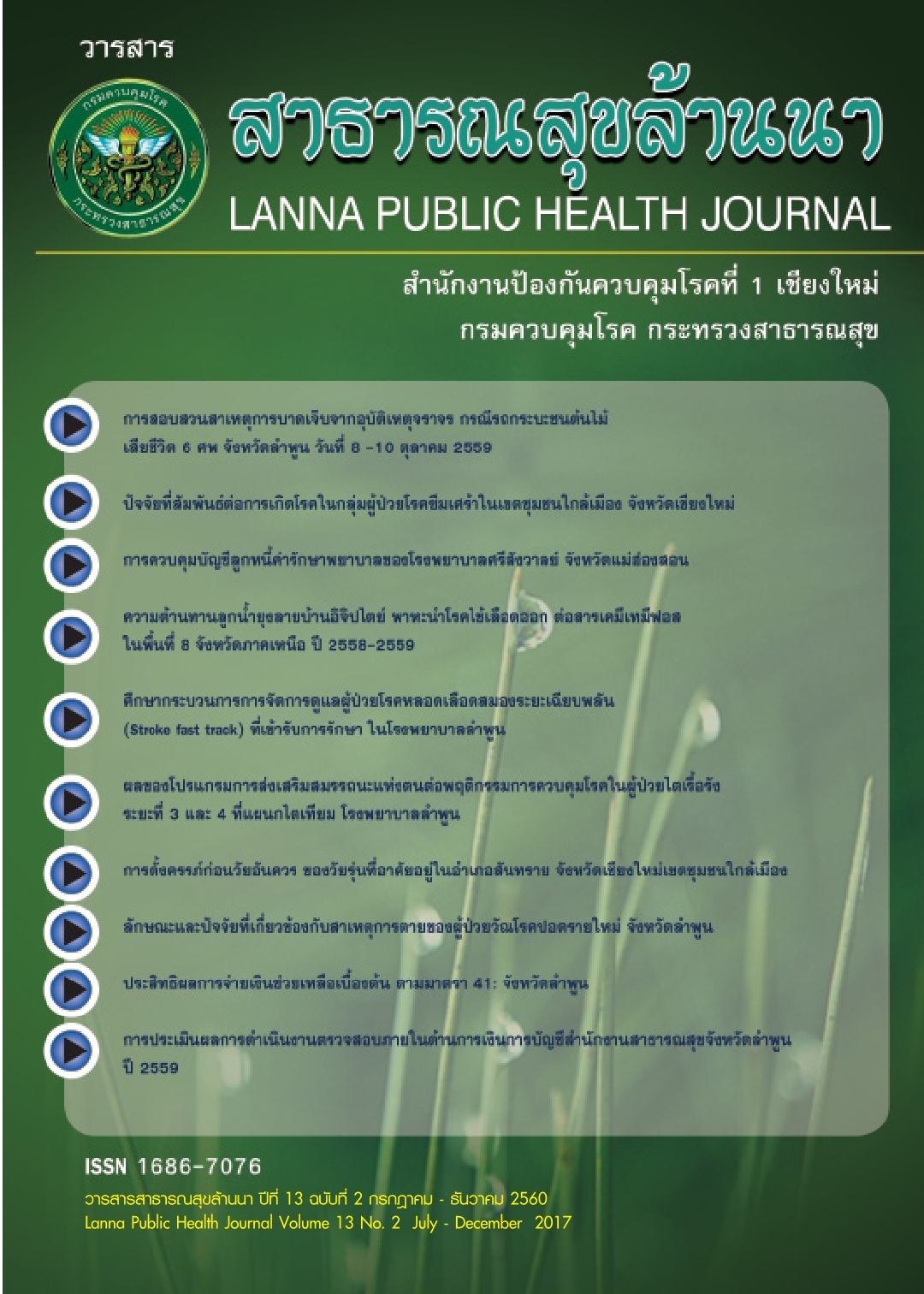
Patients’ characteristic and factors related to causes of death in new pulmonary Tuberculosis Patients in Lamphun Province
Keywords:
วัณโรค, สาเหตุการตาย, ปัจจัยที่เกี่ยวข้องAbstract
Tuberculosis is still a serious public health problem in Thailand. In 2015, the World Health Organization declared Thailand as one of 14 countries with severe TB problem. The success rate of treatment in new pulmonary tuberculosis patients in Lamphun province is proportionally low due to number of mortalities during treatment. This study aims to determine the factors related mortality in new TB cases. The Data from TB-Clinic management (TBCM) were electronically explored retrospectively, 2012-2016. New pulmonary TB cases who registered at TB clinic Lamphun hospital were recruited to this study. Univariate analysis and Odd Ratios were applied to identify the risk factors associated with fatal outcome with 95 % Confidence Interval (CI). A total 806 of new TB cases enrolled in this study, male was higher than female (3.1: 1), of these 508/806 (63.0%) were age over 50 years, 52/806 (6.5%) had co-HIV infection, and 203/806 (25.2%) had co-morbidity diseases. TB treatment outcomes, 105/806 (13.0%). reported deaths. The risk factors associated with death were patients with co-morbidity diseases 20.2% (OR 2.1, 95% CI 1.4-3.3) followed by patient age over 50 years 17.3% (OR 3.5, 95% CI 2.0-5.9). The co-morbidity diseases between survival and death were classified into renal disease 42.9) (OR 5.1, 95% CI 1.1-23.2, p<0.05), cancer 37.5% (OR 4.1, 95% CI 1.0-17.4, p<0.05), COPD 33.3% (OR 3.7, 95%CI 1.9-7.3,p<0.05), and hypertension 23.5%,(OR 2.4, 95% CI 1.4-4.0,p<0.05) respectively. Moreover, patients dying during the first 2 months was 2.6 time higher than the last 4 months. We concluded that the highest risk factors of dying during tuberculosis treatment were a co-morbidity diseases and aging. Managing TB as well as underlying co-morbidities in a multidisciplinary approach is essential to improve the outcome of patient in an aging population.
References
2.จิตติพร มากเมือง, เบญจวรรณ ตาแก้ว, รุ้งอุษา นาคคงคำ, และคณะ. (2559). ปัจจัยเกี่ยวเนื่องการเสียชีวิตในผู้ป่วยวัณโรค ณ โรงพยาบาลพะเยา. เชียงรายเวชสาร. 8(1); 53-59.
3.เจริญศรี แซ่ตั้ง. (2560). ลักษณะของผู้ป่วยวัณโรคและปัจจัยเสี่ยงที่สัมพันธ์กับการเสียชีวิตระหว่างการรักษา ของผู้ป่วยวัณโรคปอดรายใหม่ในภาคเหนือตอนบน ปี 2005-2014. วารสารควบคุมโรค. 43(4):436-447.
4.พรพิศ ตรีบุพชาติสกุล. (2559). การเสียชีวิตของผู้ป่วยวัณโรคที่ติดเชื้อเอชไอวี และอุปสรรคของความต่อ เนื่องในระบบบริการดูแลรักษาเอชไอวี. วารสารวัณโรค โรคทรวงอกและเวชบำบัดวิกฤต. 36(1): 8-18.
5.พัฒนา โพธิ์แก้ว, อภิญญา เชื้อสุวรรณ, วรรัตน์ อิ่มสงวน และคณะ. (2556). การศึกษาสาเหตุการเสียชีวิตของผู้ป่วยวัณโรครายใหม่ในพื้นที่เขตภาคเหนือตอนบน. วารสารวัณโรค โรคทรวงอกและเวชบำบัดวิกฤติ. 34 (2): 51-62.
6.ภัทรินี ไตรสถิตย์, พัฒนา โพธแก้ว และสุคนธ์ ประสิทธิ์วัฒนเสรี. (2550). การวิเคราะห์ปัจจัยเสี่ยงของการดื้อยา และการเสียชีวิตในผู้ป่วยวัณโรคปอดและการศึกษาเปรียบเทียบการรักษาหายของผู้ป่วยวัณโรคปอด จำแนกตามประเภทของพี่เลี้ยงในการรักษาด้วย ระบบยาระยะสนภายใต้การสังเกตตรง. รายงานการวิจัยฉบับสมบูรณ์:สำนักงานคณะกรรมการวิจัยแห่งชาติ. หน้า 53-71.
7.ราเมศ คนสมศักดิ์. (2560). ปัจจัยที่สัมพันธ์ต่อการเสียชีวิตของผู้ป่วยวัณโรคปอดเสมหะพบเชื้อ โรงพยาบาลพระสมเด็จพระญาณสังวร จังหวัดเชียงราย. เชียงรายเวชสาร. 9(1). 19-27.
8.สำนักงานสาธารณสุขจังหวัดลำพูน. จำนวนผู้ป่วยที่ขึ้นทะเบียนรักษาวัณโรคทุกประเภทและจำนวนผู้ป่วยเสียชีวิตระหว่างการรักษา จังหวัดลำพูน ปี 2550-2559. รายงานประจำปี 2559.
9.สำนักวัณโรค กรมควบคุมโรค กระทรวงสาธารณสุข. แนวทางการดำเนินงานควบคุมวัณโรคแห่งชาติ พ.ศ.2556. พิมพ์ครั้งที่ 2. กรุงเทพมหานคร: สำนักกิจการโรงพิมพ์ องค์การสงเคราะห์ทหารผ่านศึกในพระบรมราชูปถัมภ์, 2556.
10. Chou-Han Lin, Chou-Jui Lin, Yao-Wen Kuo, et al. (2014). Tuberculosis mortality: patient characteristics and causes. BMC Infectious Diseases. 14(5): 1-8.
11.Elsa Zerbini, Adriana Greco, Silvia Estrada, et al. (2017). Risk factors associated with tuberculosis mortality in adults in six provinces of Argentina. Medicina (B Aires). 77(4): 267-273.
12.N. Lefebvre and D. Falzon. (2008). Risk factors for death among tuberculosis cases: analysis of European surveillance data. Eur Respir J. 31(6): 1256-60.
13.P. M. Arguin, H. Kiryanova, N. V. Kondroshova, et al. (2004). Risk factors for death during tuberculosis treatment in Orel, Russia. INT J TUBERC LUNG DIS. 8(5): 598–602.
14.Saiyud Moolphate, Myo Nyein Aung, Oranuch Nampaisan, et al. (2011). Time of highest tuberculosis death risk and associated factors: an observation of 12 years in Northern Thailand. Int J Gen Med. 4: 181–190.
15.WHO Global tuberculosis report 2014. Available from: http://www.who.int/tb/publications/global_report/en/
16.WHO Global tuberculosis report 2017. Available from: http://www.who.int/tb/publications/global_report/en/