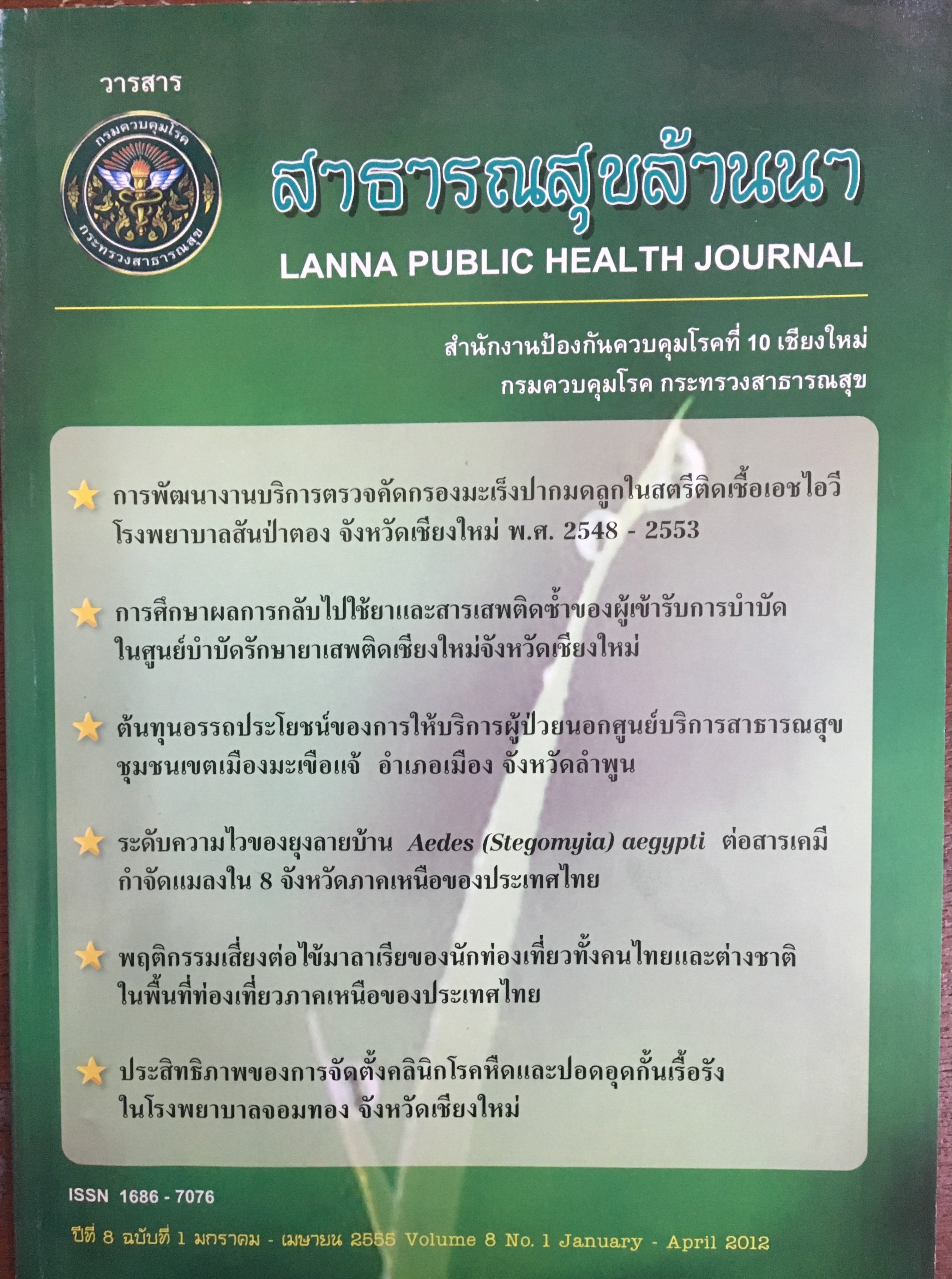
Malaria Risk Behaviors among Thai and Foreign Tourists in Endemic Malaria Areas, Northern Thailand
Keywords:
Risk behavior, Malaria, Tourist, Endemic malaria areasAbstract
A cross-sectional study of malaria preventive behaviors of tourists in Thailand was carried out in 10 tourist places, where malaria are (is still) endemic in Chiang Mai and Mae Hong Son Provinces, between January and June 2009. This survey collected information using a haphazard sampling from the 162 (43.4%) Thai and 211 (56.6%) foreign tourists by interviews with a self-administrative questionnaire providing dual languages of Thai and English. The univariate and multiple logistic regression analyses showed that a high proportion of the tourists (66.6%) received malaria information before coming to Chiang Mai or Mae Hong Son province. Of which, 43.2% reported that they knew malaria from physicians. Only 12.9% had experienced with self - administrative preventive medicine bought from a drug store while the rest did not take any chemoprophylaxis (87.1%). Malaria knowledge level was significantly related to tourist ethnicity, hearing about medicine, and taking medicine for prevention. Thais had a better knowledge level than that of the foreigners (p < 0.05). The tourists who had ever heard about malaria medicine gained a better knowledge level (p < 0.05) and who had a better knowledge level would not take preventive drugs before arriving Chiang Mai or Mae Hong Son(p < 0.05). Multivariate analyses using multiple logistic regression revealed that malaria risk behaviors had significant relationships to age, ethnic, and occupation. Findings indicated Thais had greater risky behaviors than foreigners (Adjusted OR = 2.08, 95% CI = 1.08 - 4.03). The advantages of the study suggest the concerning health sectors to develop mass communication and health education campaigns for tourists before entering the malaria risk places.
References
การท่องเที่ยวแห่งประเทศไทย. รายงานประจำปี 2549 การท่องเที่ยวแห่งประเทศไทย. กรุงเทพฯ: การท่องเที่ยวแห่งประเทศไทย, 2549.
การท่องเที่ยวแห่งประเทศไทย. แผนปฏิบัติการท่องเที่ยวเชิงนิเวศแห่งชาติ. กรุงเทพฯ: โรงพิมพ์อัลซา, 2544.
สำนักโรคติดต่อนำโดยแมลง กรมควบคุมโรค กระทรวงสาธารณสุข. คู่มือการรักษาไข้มาลาเรียชนิดไม่มีภาวะแทรกซ้อน ฉบับ พ.ศ. 2551. กรุงเทพฯ: บริษัท 21 เซ็นจูรี่ จำกัด, 2551.
Asking HH, Nilsson J, Tegnell A, Janzon R, Ekdahl. Malaria Risk in Travelers. Emerging Infectious Disease 2005; 11 (3): 436 - 41.
Behrens RH, Curtis CF. Malaria in Travelers: Epidemiology and Prevention. British Medical Bulletin 1993; 49 (2): 363 - 81.
Butraporn P, Prasittisuk C, Krachaiklin S, Chareonjai P. Behaviors in self-prevention of malaria amongmobile population in East Thailand. Southeast Asian J Trop Med Public Health 1995; 26: 213 - 8.
Butraporn P, Sornmani S, Hungsapruek T. Social behavioral, housing factors and their interactiveeffects associated with malaria occurrence in east Thailand. Southeast
Asian J Trop MedPublic Health 1986; 17: 386 - 92.
Castelli E, Matteelli A, Caligaris S, Gulletta M, El-Hamad I, Scolari C, Malaria in Migrants.1999; 41: 261- 65.
Center of Disease Control (CDC). Health Information for International Health, 2005-2006.
Department of Health and Human Service, Public health Service, Georgia, USA., 2005.
Childs DZ, Cattadori IM, Suwonkerd W, Prajakwong S, Boots M. Spatiotemporal patterns of malariaincidence in northern Thailand. Trans R Soc Trop Med Hyg 2006: 100; 523 - 31.
Freedman DO, Weld LH, Kozarsky PE, Fisk T, Robins R, von Sonnenburg F, Keystone JS, Pandey P, and Cetron MS. Spectrum of disease and relation to place of exposure
among Illreturned travelers. N Engl J Med. 2006 Jan 12; 354 (2): 119 - 30.
Hamer DH, and Coner BA. Travel Health Knowledge, Attitudes and Practices among United StatesTravelers 2004; 11: 23-26.
Health Protection Agency. Guidelines for malaria prevention in travelers from the United Kingdom.: Chlorine-free paper, 2007.
Lemeshow S, Hosmer DW, Klar J,and Lwanga SK. Adequacy of Sample Size in Health Studies. World Helth Orgamization. John Willey and Sons Ltd., 1990.
Orem, DE. Nursing Concepts of Practise. 3rded. New York : McGrew HillCo., 1985.
Overgaard H, Tsuda Y, Suwonkerd W, and Takagi M. Characteristic of Anopheles minimus Theobald (Diptera: Culicidae) larval habitats in northern Thailand. Environmental
Entomology2002; 31 (1): 134 - 41.
Phillips-HowardP. A., Radalowicz A., Mitchell J. and Bradley D. J. Risk of malaria in British residents returning from malarious areas. BMJ 1990: 300(6723); 499-503.
Piyaphanee W, Krudsood S, Silachamroon U, Pornpininworakij K, Danwiwatdecha P, ChamnachananS, Wilairatana P, and Looareesuwan S. Travelers’ malaria among
foreigners at the Hospital forTropical Disease, Bangkok, Thailand– a 6-year review (2000-2005) 2006; 3: 229 - 32.
Piyaphanee W, Wattanagoon Y, Silachamroon U, Mansanguan C, Wichianprasat P, Walker E.Knowledge, attitudes, and practices among foreign backpackers toward malaria risk in southeast Asia. J Travel Med 2009; 16 (2): 101-6.
Somboon P, Aramrattana A, Lines JD, and Webber R. Entomological and epidemiological investigations of transmission in relation to population movements in forest areas of north-west Thailand. Southeast Asian J Trop Med Public Health 1998; 29 (1): 3-9.
Steffen R, Heusser R, Mächler R, Bruppacher R, Naef U, Chen D, et al. Malariachemoprophylaxis among European tourists in tropical Africa: use, adverse
reactions, and efficacy. Bulletin of the World Health Organization 1990; 68(3): 313-22.
Suwonkerd W, Overgaard H, Tsuda Y, Prajakwong S, and Takagi M. Malaria densities in transmission and non-transmission areas during 23 years and land use in Chiang Mai province, Northern Thailand. Basic and Applied Ecology. 2002; 3 (3): 197- 207.
Suwonkerd W, Tsuda Y, Overgaard HJ, et al. Changes in Malaria Vector Densities over a Twenty-Three Year Period in Mea Hong Son Province, Northern Thailand. Southeast Asian J Trop Med Public Health 2004: 35 (2); 316 - 24.
U.S.Department of Health and Human Services. “Recommendations for the Prevention of Malaria among Travelers”in Morbidity and Mortality Weekly Report. The
Massachusetts Medical Society, 1990. p.1-10.
Van Benthem BHB, Khantikul N, Panart K, Somboon P, and Oskam L. Knowledge and use of prevention measures against malaria in endemic and non-endemic villages in northern Thailand. Asian J Trop Med Public Health 2006; 37 (2): 243-9.
Van Herck K, Van Damme P, Castelli F, Zuckerman J, Nothdurft H, Dahlgren AL, et al. Knowledge, attitudes andpractices in travel-related infectious diseases: the European
airport survey. J Travel Med 2004; 11 (1): 3-8.
Wetsteyn J.C.F.M. and Geus DA. Chloroquineresistant falciparum malaria imported into theNetherlands. Bulletin of the World Health Organization 1985; 63 (1): 101-08.
Wernsdorfer WH. The development and spread of drug-resistant malaria. Parasitology today 1991; 7 (11): 297-303.
Wilder-Smith A, Khairullah NS, Song JH, Chen CY, and Torresi J. Travel health knowledge,attitudes and practices among Australasian travelers. J Travel Med 2004; 11 (1): 9-15.
World Health Organization. The world health report 2002 - Reducing Risks, Promoting Healthy Life. Available from: URL:http://www.who.int/whr/2002/en. Accessed on
January 25, 2009.
World Health Organization. World Malaria Report 2008. World Health Organization and UNICEP, Geneva. 2005. http://malaria.who.int/wmr2008/malaria 2008.pdf. Accessed
on January 25, 2009.