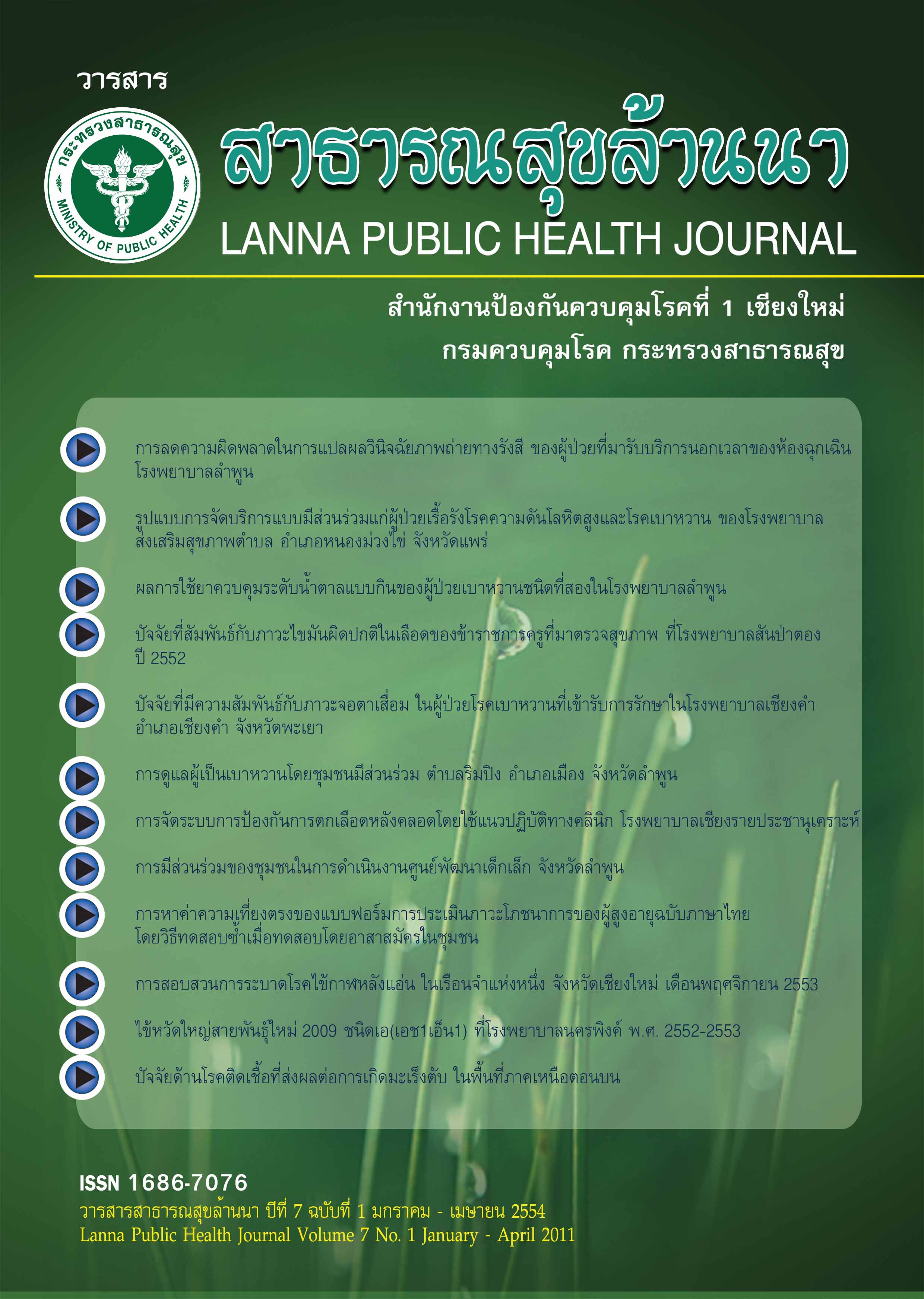
Novel Influenza A(H1N1) 2009 at Nakornping Hospital in 2009-2010
Keywords:
ไข้หวัดใหญ่สายพันธุ์ใหม่ 2009 ชนิดเอ(เอช1เอ็น1), โรงพยาบาลนครพิงค์Abstract
Novel Influenza A(H1N1) 2009 had spread in Thailand since midyear of 2009. Nakornping hospital, as a provincial hospital of Chiang Mai, had treated a lot of influenza patients and other respiratory diseases. The purpose of this study was to describe the novel Influenza A(H1N1) 2009 situation at Nakornping hospital during 2009 – 2010. This study was a retrospective descriptive study done by using secondary data from hospital database and from the influenza surveillance and investigation reports, then analyzed in frequencies or percentages and presented in graphs and table. The results indicated the increasing numbers of patients with respiratory diseases, influenza-liked illness, influenza diagnosis, and confirmed influenza A(H1N1) 2009, moreover, the numbers of cases collected throat swab specimen to confirm H1N1 virus, and the using of Oseltamivir also increased, especially during three waves of epidemic; in June to September 2009, January to February, and September to October 2010. Most symptoms among the influenza A(H1N1) 2009 cases were fever(95.4%), cough(88.8%), and sore throat(54.6%). About three fourth were patients under 25 years old, most were 10 – 14, 15 – 19, 5 – 9, 20 – 24, and 0 – 4 years old in order. So we should make the surveillance system for cluster outbreak among under 25 years age group, and promptly control the epidemic to prevent community spreading. The antiviral drug should be provided only among the patients in risk groups or patients that have developed severe symptoms to avoid the overusing of antiviral drug.
References
Kilbourne ED. Influenza pandemics of the 20th century. Emerg Infect Dis [serial on the internet].2006 Jan; 12(1): [11 screens]. Available from: http://www.cdc.gov/ncidod/EID/vol12no01/05-1254.htm. Accessed September 2, 2009.
Taubenberger JK, Morens DM. 1918 influenza: the mother of all pandemics. Emerg Infect Dis [serial on the internet]. 2006 Jan; 12(1): [14 screens]. Available from: http://www.cdc.gov/ncidod/EID/vol12no01/05-0979.htm. Accessed September 2,2009.
Padilla RP, Zamboni DR, Leon SP, et al. Pneumonia and respiratory failure from swine-origin influenza A(H1N1) in Mexico. N Engl J Med 2009; 361: 680-689.
Zhang H, Chen L. Possible origin of current influenza A H1N1 viruses. Lancet 2009; 9: 456-457.
Novel swine-origin influenza A(H1N1) virus investigation team. Emergence of a novel swineorigin influenza A(H1N1) virus in humans. N Engl J Med 2009; 360: 2605-2615.
Trifonov V, Khiabanian H, Rabadan R. Geographic dependence, surveillance, and origins of the 2009 influenza A(H1N1) virus. N Engl J Med 2009; 361: 115-119.
Chan M. Influenza A(H1N1). Statement by WHO Director-General [serial online]. 2009 Apr: [2 screens].
Available from: http://www.who.int/mediacentre/news/statements/2009/h1n1_20090429/en/index.html. Accessed September 7, 2009.
Chan M. World now at the start of 2009 influenza pandemic. Statement by WHO Director-General [serial
online]. 2009 Jun: [3 screens]. Available from: http://www.who.int/mediacentre/news/statements/2009/h1n1_pandemic_ phase6_20090611 /en/index.html. Accessed September 7, 2009.
สำนักโรคติดต่ออุบัติใหม่ กรมควบคุมโรค กระทรวงสาธารณสุข. การเฝ้าระวังโรคไข้หวัดใหญ่สายพันธุ์ใหม่ ชนิด A(H1N1).(ระบบออนไลน์). แหล่งที่มา:http://beid.ddc.moph.go.th/th/images/news/situationh1n1/thai/flu130552.pdf.
สำนักโรคติดต่ออุบัติใหม่ กรมควบคุมโรค กระทรวงสาธารณสุข. การเฝ้าระวังโรคไข้หวัดใหญ่สายพันธุ์ใหม่ ชนิด A(H1N1).(ระบบออนไลน์). แหล่งที่มา:http://203.157.15.4/Flu/situation/y52/flu_200907221608.pdf.
ศูนย์ข่าวเชียงใหม่. เชียงใหม่พบผู้ป่วยไข้หวัดใหญ่สายพันธุ์ใหม่รายแรก. ASTVผู้จัดการออนไลน์ 14 มิถุนายน 2552. (ระบบออนไลน์). แหล่งที่มา: http://www.manager.co.th/Local/ViewNews.aspx?NewsID=9520000067084.
Chan M. H1N1 in post-pandemic period. Statement by WHO Director-General [serial online]. 2010 Aug: [3 screens]. Available from: http://www.who.int/mediacentre/news/statements/2010/h1n1_vpc_20100810/en/ index.html. Accessed January 21, 2011.
Hancock K, Veguilla V, Lu X, et al. Cross-reactive antibody responses to the 2009 pandemic H1N1 influenza virus. N Engl J Med 2009; 361: 1945-52.
Ison MG, Lee N. Influenza 2010-2011: Lessons from the 2009 pandemic. Cleve Clin J Med 2010; 77(11): 812-820.
Tang JW, Tambya PA, Lai FY, et al. Differing symptom patterns in early pandemic vs seasonal influenza infections. Arch Intern Med 2010; 170(10): 861-867.
Writing committee of the WHO consultation on clinical aspects of pandemic(H1N1) 2009 influenza. Clinical aspects of pandemic 2009 influenza A(H1N1) virus infection. N Engl J Med 2010; 362: 1708-19.
Centers for disease control and prevention(CDC). Oseltamivir-resistant novel influenza A(H1N1) virus infection in two immunosuppressive patients--- Seattle, Washington, 2009. MMWR Morb Mortal Wkly Rep 2009; 58(Dispatch): 1-4.