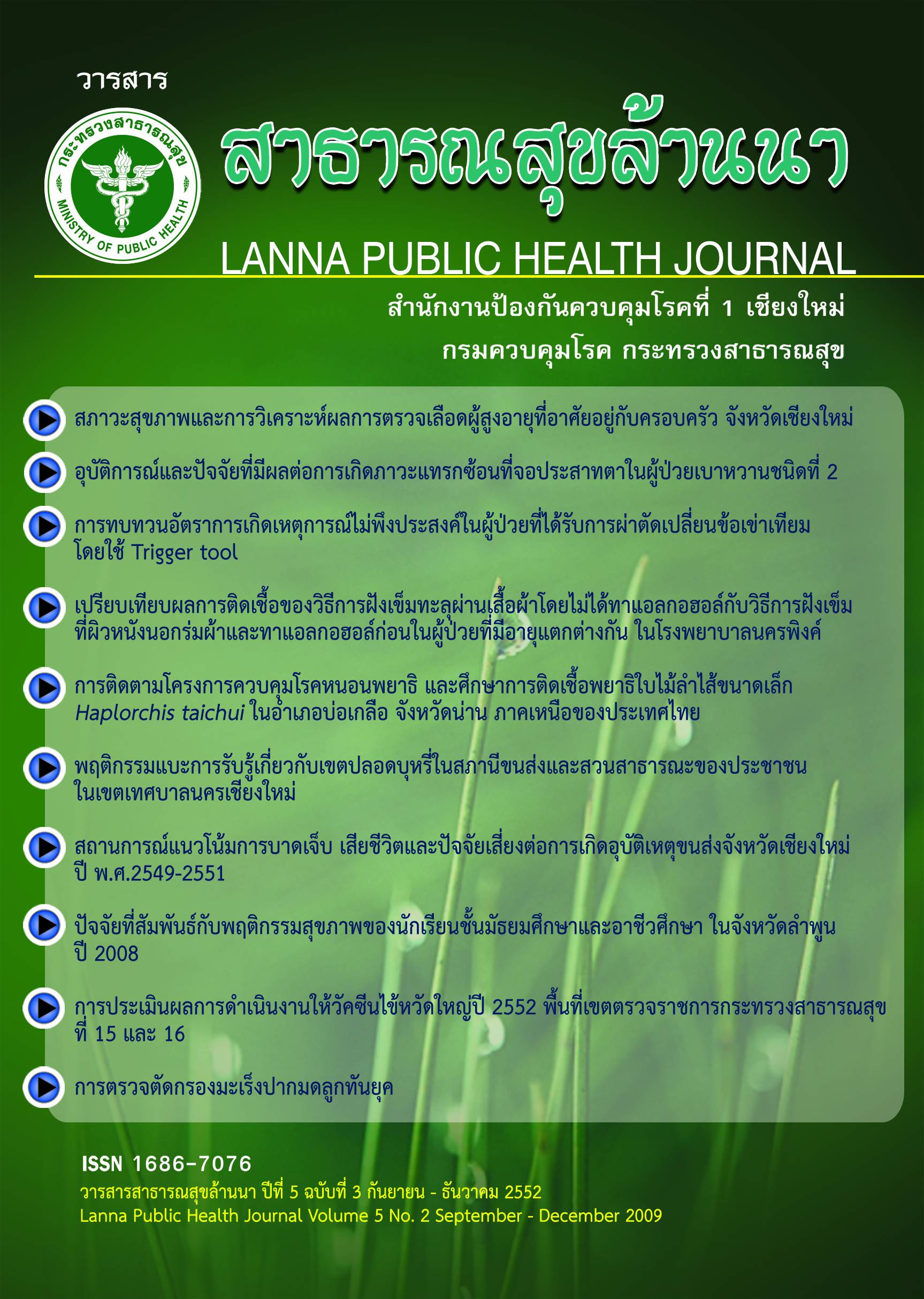
Monitoring of Helminthiasis Control Program and Haplorchis taichui infecection in Bo Klue District, Nan Province, Northern of Thailand
Keywords:
โครงการควบคุมโรคนั้นพยาธิพยาธิใบไม้ตับพยาธิใบไม้ลำไส้หรือขนาดเล็กการติดเชื้อพยาธิวิธีคาโด้Abstract
The purpose of this study was to monitor the helminthiasis control program and to study trematode infection in the people in Bo Kluea District, Nan Province, from September to October 2009. The program was checked by monitoring the acton to operate the proram in the District Public Health Office and the health sevices, and the study of trmatode infection was done by performing stool examinations. A village in in Bo Lluea Tai sub-district was randomly selected for he study and 50 subjects. Woho already reported the positive results for Opisthorchid liver fluk’s eggs by kato’s thick smear, were enrolled. The stool examinations were repeated again to identify the types of the liver flukes via examination fo the eggs charatersitics under light micriscropy; the slides were prepared by kato’s thick smaer และ Formalin-ether concentration techniqu .the sujects whose fecal samples were positive trematode egge were selected and given praziquatel 40 mg/kg. the Samoles were repeatedly asked in normal saline solution by sedimentation method.
According to the monitoring of the prog4ram in Bo Kluea Disttricts, Nan Province n 2009, the results of stool examinations were obtained from children in sursery. Chil’s age 2-4 ปีyears old., the students in no-formal education, and general adults in the communities; the total member of the subjects was 8348 cases(67.45%of the goal coverage), the 2700 ( 34.64%) specimens were positive for helminth. The infection rate of helminth in each the group raged between 22.3-18.21 percentages. The kinds of the helminth infections were presented as follows; Hookworm 4.9 % (range 1.47 -22.90), Ascaris 12.13% (range 5.76- 48.51) , Trichuris 5.22% (range 4.48 - 23.13),smaill-sized trematode eggs 11.38% (range 0- 15.71) , Taenia1.04% (range 0- 7.4, trongyloides 0.14% (range 0- 3.19), Enterobius 0.16% (range 0-1.49) and mixed infection helminth 2.73% (ragne 1.06-22.39)
According to the study of the 50 positive stool examinations, all samples were repeated by under light microscopy by kato’s thick smaer and 100% was postivive for smaill-sizeed treamatode (50/ 50) . the results of the fecal samoles, which were of them were negative ffor opisthorchid liver fluke eggs. All 50 people who were positive for smaill-sized trematode eggs were selected, and stool smoles were collected after giving the treatment and purgative. The sediments were examined, adult worms were collected from 39 subjects; 11 sample did not be found. The infection was identified as follows: Haplorchis taichui in 37 subjects (adult worms rage 5-1,250, mean 62), Taenia saginata in 7 subjects, Enterobius vermicularis in 1 subject and mixed infection adult worms n 8 subjects.
The results revealed a heminthic infection rate in different areas in Bo Kluca District Nan province. Parasitological monitoring is important in the control program. This study emphasizes the need for improved environmental hygiene, clean water supplies and enhaced sanitation, in the affected communities, Health promotion, by means of a school-based educational approach is recommended; regular cherk-ups should be implemented, and a continuous program of treatment should be considered. According to the examination by Kato thick smear methods, the differentiation of the eggs of the tiny sized intestinal flukes and the opisthorchid liver flukes is not possible detected. Therfore, stool examination of egg parasite opisthorchid liver flukes by kato or modified Kato method should be carefully reprted. An examiner should provisional report opisthorchis-like eggs, or uses formalin-ether concentration technique for identifying he type of the flukes.
References
Tesana S, Srisawangwonk T, Kaewkes S, Sithithawom P, Kanla P, Arunyanart c. eggshell morphology of ghe small eggs of human tratodes in Thailand Southeast AsianJTrop Med Public Health 1991; 22-631-6
Katro K, Miura M. one the comparison of mime stool examination methods. Jpn J parasitol. 1954;3:35.
Katz N, Chaves A, Pellegrino J. A simple device for quantitative stool thick-smear technique in schistosomiasis mansoni. Rev Inst Med Trop Sao Paulo 1972; 14: 397-400.