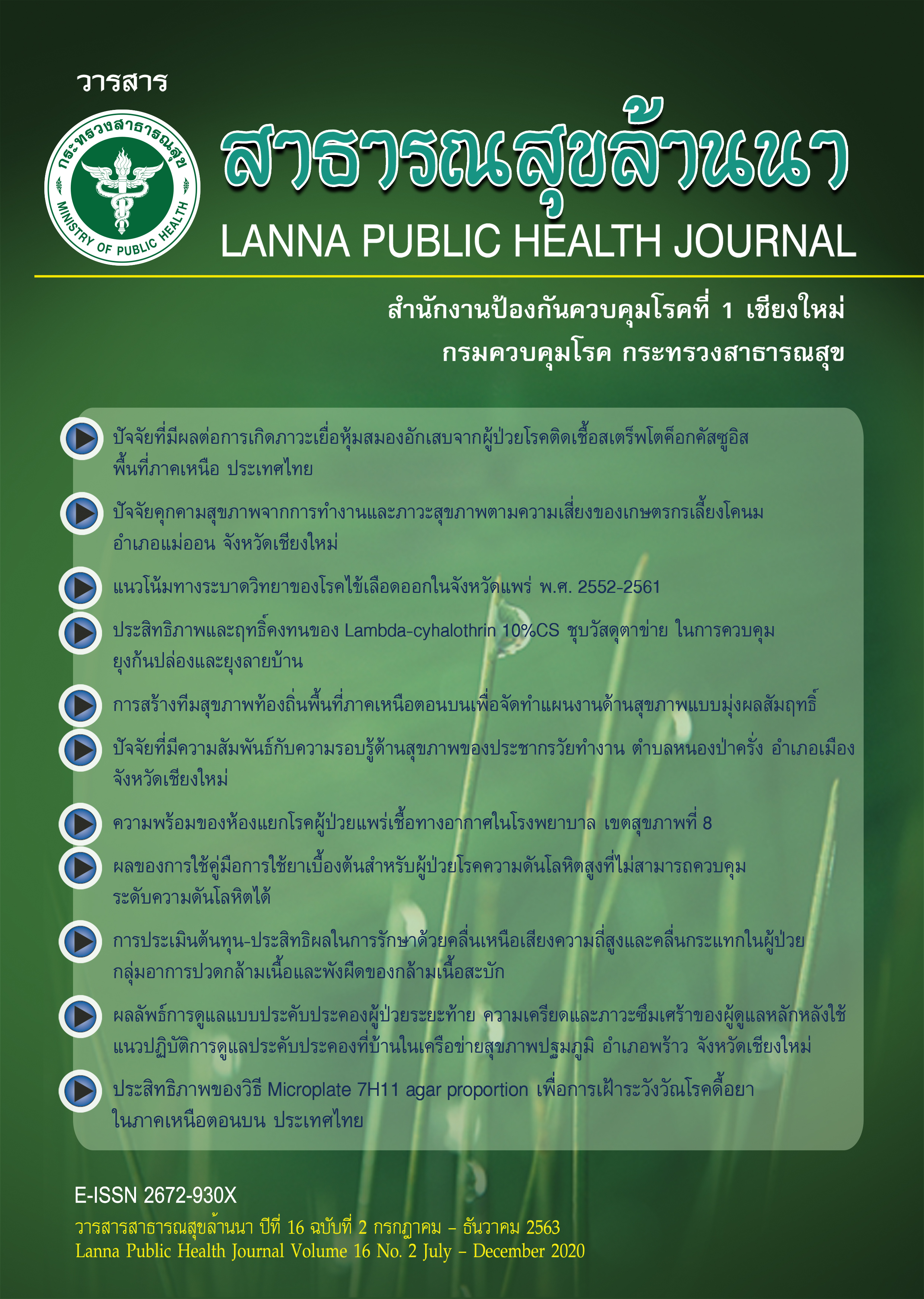
Factors Associated with Health Literacy among Working Population, Nong Pa Krang Subdistrict, Mueang District, Chiang Mai Province
Keywords:
Health literacy, Working population, Nong Pa Krang SubdistrictAbstract
This research aimed to study health literacy situations among the working population of Nong Pa Krang Subdistrict, Mueang District, Chiang Mai Province. The sample size was estimated using Krejcie and Morgan's tables. The 343 samples were working population, aged 18 to 59 years old. Purposive sampling method was used for data collection. A health literacy questionnaire included 55 items with two choices: yes or no. The Content Validity Index (CVI]) of the instrument was 0.98 and Cronbach’s alpha coefficient reliability was 0.85. Data were collected from April to May 2019 using the questionnaire. Data was analyzed using descriptive statistics, including frequency and percentage, and contingency coefficient. The results of this study shows that most individuals in the sample (88.60%) had a high level of health literacy. There are no correlation between gender, age, marriage status, and educational level, and health literacy. However, health literacy had statistically significant correlation with occupation and health status (p<0.05). Health care providers should allocate the appropriate health information for working population with different occupation and health status.
References
กองโรคไม่ติดต่อ. (2559). จำนวนและอัตราผู้ป่วยในโรคไม่ติดต่อ ประจำปีปฏิทิน พ.ศ. 2558 [online] [สืบค้นเมื่อ 18 ส.ค. 2562]; แหล่งข้อมูล: URL: http://www.thaincd.com/2016/mission/documents.php?tid=32&gid=1-020&searchText=&pn=2
กองโรคไม่ติดต่อ. (2562). จำนวนและอัตราตายโรคไม่ติดต่อ ปี 2559-2561 (รวม 4 โรค/ความดันโลหิตสูง/เบาหวาน/หัวใจขาดเลือด/หลอดเลือดสมอง/หลอดลมอักเสบ/ถุงลมโป่งพอง) [online] [สืบค้นเมื่อ 10 พ.ย. 2563]; แหล่งข้อมูล: URL: http://www.thaincd.com/2016/mission/documents-detail.php?id=13653&tid=32&gid=1-020
กองสุขศึกษา กรมสนับสนุนบริการสุขภาพ กระทรวงสาธารณสุข. (2561). เกณฑ์ให้คะแนนจำแนกความรอบรู้ด้านสุขภาพและพฤติกรรมสุขภาพตาม 3อ.2ส. ของประชาชนที่มีอายุ 15 ปีขึ้นไป ฉบับปรับปรุง ปี 2561 [online] [สืบค้นเมื่อ 17 พ.ย. 2563]; แหล่งข้อมูล: URL: http://www.hed.go.th/linkHed/333
เบญจวรรณ สอนอาจ. (2562). แนวทางการสร้างความรอบรู้ด้านสุขภาพเพื่อส่งเสริมพฤติกรรมสุขภาพของประชากรวัยทำงานในเขตกรุงเทพมหานครและปริมณฑล [online] [สืบค้นเมื่อ 10 พ.ย. 2563]; แหล่งข้อมูล: URL: http://ithesis-ir.su.ac.th/dspace/bitstream/123456789/2756/1/61260304.pdf
มารยาท โยทองยศ และปราณีสวัสดิสรรพ์. (มปป.). การกำหนดขนาดของกลุ่มตัวอย่างเพื่อการวิจัย [online] [สืบค้นเมื่อ 15 ส.ค. 2562]; แหล่งข้อมูล: URL: http://www.fsh.mi.th/km/wp-content/uploads/2014/04/resch.pdf
ยุพยง หมั่นกิจ และกติกา สระมณีอินทร์. (2561). การศึกษาอาการปวดเมื่อยโครงร่างและกล้ามเนื้อของพ่อค้าส่งผลไม้ ตลาดเจริญศรี อำเภอวารินชำราบ จังหวัดอุบลราชธานี. วารสารวิทยาศาสตร์และเทคโนโลยี มหาวิทยาลัยอุบลราชธานี, 20(3), 180-188. [online] [สืบค้นเมื่อ 16 พ.ย. 2563]; แหล่งข้อมูล: URL: https://www.ubu.ac.th/web/files_up/08f2018121315220020.pdf
โรงพยาบาลเทศบาลตำบลหนองป่าครั่ง. (2562). ปัญหาสุขภาพ การเข้าถึงบริการสุขภาพ (ข้อมูล 1 ตุลาคม 2560 – 11 ตุลาคม 2561). เอกสารอัดสำเนา.
วรรณรัตน์ รัตนวรางค์ และวิทยา จันทร์ทา. (2561). ความฉลาดทางสุขภาพด้านพฤติกรรมการดูแลตนเองกับการควบคุมระดับน้ำตาลในเลือดของผู้ป่วยเบาหวานชนิดที่ 2 จังหวัดชัยนาท. วารสารวิทยาลัยพยาบาลบรมราชชนนี นครราชสีมา, 24(2), 34-51. [online] [สืบค้นเมื่อ 10 พ.ย. 2563]; แหล่งข้อมูล: URL: http://journal.knc.ac.th/pdf/24-2-2561-3.pdf
วิมล โรมา และสายชล คล้อยเอี่ยม. (2561). การสำรวจความรอบรู้ด้านสุขภาพของประชาชนไทย อายุ 15 ปี ขึ้นไป. เอกสารอัดสำเนา.
สำนักงานกองทุนเงินทดแทน สำนักงานประกันสังคม. (2556). รายงานประจำปี 2556 กองทุนเงินทดแทน [online] [สืบค้นเมื่อ 10 พ.ย. 2563]; แหล่งข้อมูล: URL: https://www.sso.go.th/wpr/assets/upload/files_storage/sso_th/e13af7d808ea7941addda331a452014d.pdf
สำนักงานสถิติแห่งชาติ. (2553). ภาวะสุขภาพของแรงงานไทย. [online] [สืบค้นเมื่อ 10 พ.ย. 2563]; แหล่งข้อมูล: URL: http://service.nso.go.th/nso/nsopublish/pubs/pubsfiles/LaborHealty.pdf
แสงโฉม ศิริพานิช. (2554). การพัฒนาระบบเฝ้าระวังโรคจากการประกอบอาชีพและสิ่งแวดล้อมแบบเชิงรับ(506/2) [online] [สืบค้นเมื่อ 10 พ.ย. 2563]; แหล่งข้อมูล: URL: https://drive.google.com/file/d/1gDCH2BTm4CCmOhBp1JOm4rJlJuV6l8gp/view
อารีย์ แร่ทอง. (2562). ความรอบรู้ด้านสุขภาพและพฤติกรรมสุขภาพ 3อ.2ส. ของอาสาสมัครสาธารณสุขประจำหมู่บ้าน กรณีศึกษาตำบลหินตก อำเภอร่อนพิบูลย์ จังหวัดนครศรีธรรมราช. วารสารวิชาการ กรมสนับสนุนบริการสุขภาพ, 15(3), 62-70.
Burns, N., & Grove, S. K. (2005). The practice of nursing research: Conduct, critique, and utilization. (5th ed.). Missouri: Elsevier Saunders.
Chahardah-Cherik, S., Gheibizadeh, M., Jahani, S., & Cheraghian, B. (2018). The relationship between health literacy and health promoting behaviors in patients with type 2 diabetes. International journal of community based nursing and midwifery, 6(1), 65-75.
Kim, S. H. (2009). Health literacy and functional health status in Korean older adults. Journal of Clinical Nursing, 18(16), 2337-2343.
Kim, S. H., & Yu, X. (2010). The mediating effect of self-efficacy on the relationship between health literacy and health status in Korean older adults: A short report. Aging and Mental Health, 14(7), 870-873.
Lynn, M. R. (1986). Determination and quantification of content validity. Nursing Research, 35(6), 382-385.
Nutbeam, D. (2000). Health literacy as a public health goal: A challenge for contemporary health education and communication strategies into the 21st century. Health Promotion International, 15(3), 259-267.
Nutbeam, D. (2008). The evolving concept of health literacy. Social Science & Medicine, 67(12), 2072-2078.
Polit, D. F., & Beck, C. T. (2006). The content validity index: Are you sure you know what’s being reported? Critique and recommendations. Research in Nursing & Health, 29(5), 489-497.
Protheroe, J., Whittle, R., Bartlam, B., Estacio, E. V., Clark, L., & Kurth, J. (2017). Health literacy, associated lifestyle and demographic factors in adult population of an English city: a cross-sectional survey. Health Expectation, 20(1), 112–119.
Sorensen, K., Broucke, S. V., Fullam, J. et al. (2012). Health literacy and public health: a systematic review and integration of definitions and models. BMC public health, 12(80), 1-13.
World Health Organization. (2016). The mandate for health literacy. [cited 2019 August]; Available from: URL: https://www.who.int/healthpromotion/conferences/9gchp/health-literacy/en/
World Health Organization. (2019). Hypertension. [cited 2020 November]; Available from: URL: https://www.who.int/news-room/fact-sheets/detail/hypertension