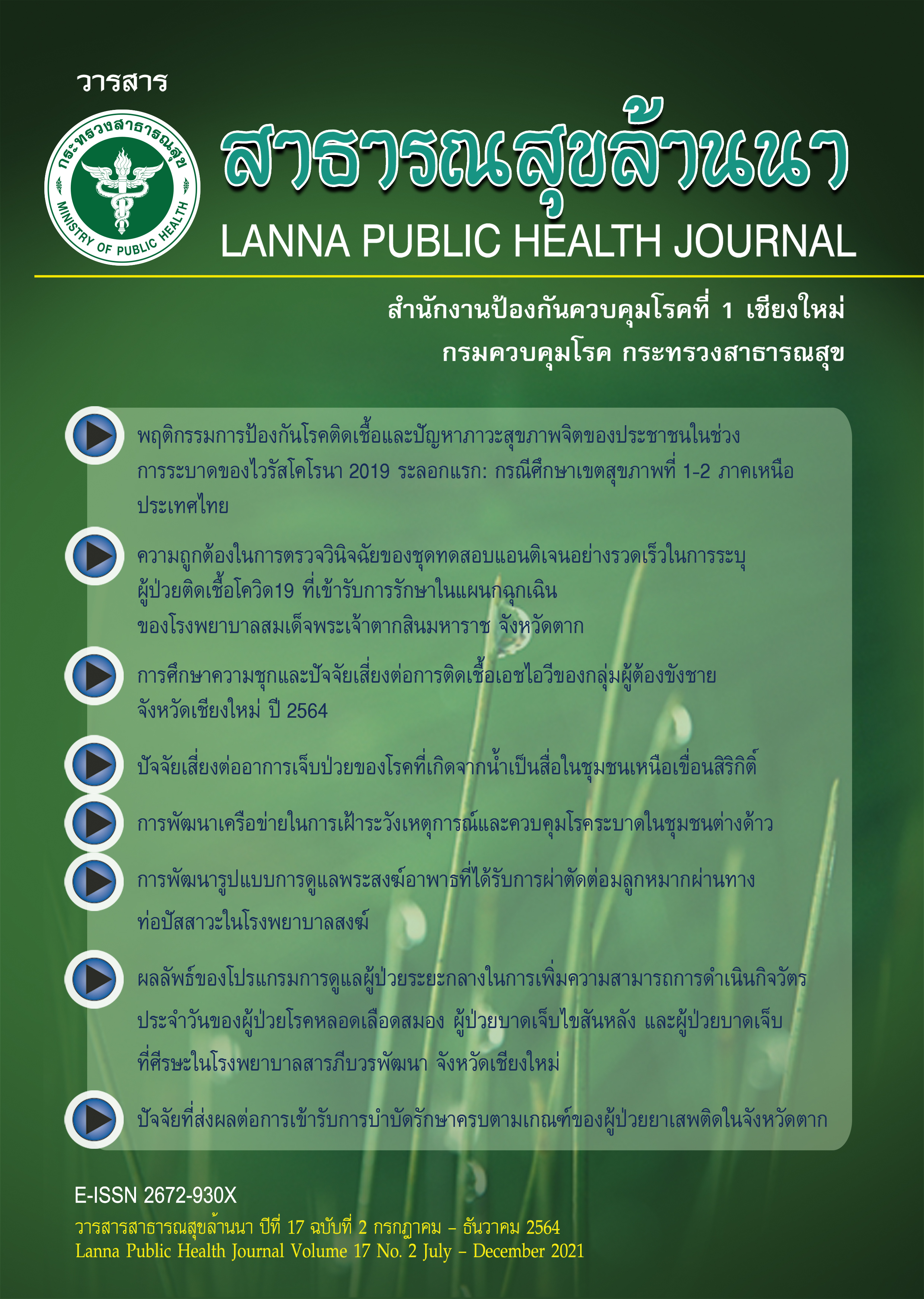
Accuracy of a Rapid Antigen Test Kit for Identifying Covid-19 infected Patients in the Emergency Department of Somdejphrajaotaksin Maharaj Hospital, Tak Province
Keywords:
Rapid antigen test kit, SARS-CoV-2, COVID-19, Emergency departmentAbstract
Due to a significant serge of COVID-19 in communities and workplaces, the use of antigen test kits (ATK) to identify COVID-19 patients was therefore initiated in Thailand. This observational analytical study aimed to assess the performance of using ATK to identify SARS-CoV-2 infections in ED patients with and without symptoms, as compared to the gold standard reverse transcription polymerase chain reaction (RT-PCR). The study was conducted using data compiled from the hospital’s electronic database of outpatient medical records. Sensitivity and specificity of the ATK were calculated overall and also according to the patient symptoms. Assay sensitivity was assessed according to the cycle threshold (Ct) values. From September 1st, to October 31st, 2021, there were 382 ED patients screened by using both ATK and RT-PCR through nasopharyngeal swab. The ATK’s sensitivity was detected at 72.22% (95%CI=46.52-90.31) while the specificity was 99.18% (95%CI=97.61-99.83). The values of sensitivity and specificity in detecting SARS-CoV-2 using ATK in symptomatic versus asymptomatic patients were similar. The ATK’s sensitivity value rose to 100% when Ct values were less than or equal to 20 and fell to 20.00-33.33% when Ct values were greater than 30. In conclusion, the use of ATK benefited a COVID-19 screening among ED patients as it yielded high specificity values, making immediate isolation of COVID-19 infected patients possible. The limitation of using this ATK was found when patients had low viral loads in the upper respiratory tract (or patients with a high Ct values). The ATK might not be able to sufficiently identify SARs-CoV-2 infection in this group of patients.
References
กรมควบคุมโรค. (2564). แนวทางการเฝ้าระวังและสอบสวนโรคติดเชื้อโคโรนาไวรัส 2019 ฉบับวันที่ 11 สิงหาคม 2564 [ออนไลน์]. [สืบค้นเมื่อ 18 พฤศจิกายน 2564]; แหล่งข้อมูล: URL: https://ddc.moph.go.th/viralpneumonia/file/g_srrt/g_srrt_110864.pdf
กระทรวงสาธารณสุข.(2564). แนวปฏิบัติการตรวจคัดกรองด้วย Antigen test kit (ATK) และการตรวจหาเชื้อโควิด 19 [ออนไลน์]. [สืบค้นเมื่อ 18 พฤศจิกายน 2564]; แหล่งข้อมูล: URL: https://ddc.moph.go.th/viralpneumonia/file/g_health_care/antigen_test_kit_130764.pdf
บริษัท บีซีซี เมดดิคอลกรุ๊ป. (2564). การตรวจ SARS-CoV-2 ด้วยเทคนิค quantitative reverse transcription PCR (RT-qPCR) โดยใช้ detection kit for 2019-nCoV (PCR-Fluorescence) version 1/1 บริษัท Da An Gene. (เอกสารอัดสำเนา).
บริษัทเฟิร์มเมอร์. (2564). ระเบียบวิธีปฏิบัติ ชุดทดสอบ Lifotronic SARS-CoV-2 antigen (GICA).(เอกสารอัดสำเนา).
เอกวัฒน์ ผสมทรัพย์, อังสนา ภู่เผือกรัตน์, กิ่งกาญจน์ รักมณี, รุจิกรณ์กัลยาณดลกิตติ์ และปารีณา จันทร์ชมภู. (2564). การประเมินประสิทธิภาพชุดตรวจแอนติเจนของเชื้อไวรัสโคโรน่า 2019 จากตัวอย่างทางคลินิก [ออนไลน์]. สืบค้นเมื่อ 26 พฤศจิกายน 2564]; แหล่งข้อมูล: URL: https://thaipublica.org/wp-content/uploads/2021/08/ผลการทดสอบคุณภาพผลิตภัณฑ์จากรามาฯ.pdf
Caruana, G., Croxatto, A., Kampouri, E., et al. (2021). ImplemeNting SARS-CoV-2 Rapid antigen testing in the Emergency wArd of a Swiss univErsity hospital: The INCREASE study. Microorganisms, 9(4), 798.
Chaimayo, C., Kaewnaphan, B., Tanlieng, N., et al. (2020). Rapid SARS-CoV-2 antigen detection assay in comparison with real-time RT-PCR assay for laboratory diagnosis of COVID-19 in Thailand. Virology journal, 17(1), 1-7.
Hanson, E. K., Caliendo, M. A., Arias, A. C., et al. (2021). The Infectious Diseases Society of America Guidelines on the Diagnosis of COVID-19: Molecular Diagnostic Testing. Clinical Infectious Diseases, 1-38.
Lee, L. Y., Rozmanowski, S., Pang, M., et al. (2021). SARS-CoV-2 infectivity by viral load, S gene variants and demographic factors and the utility of lateral flow devices to prevent transmission. Clinical Infectious Diseases, 1-20.
Lynch, B. J., Davitkov P., Anderson J. D., et al. (2020). Infectious diseases society of America guidelines on infection prevention for healthcare personnel caring for patients with suspected or known Coronavirus disease 2019. Clinical Infectious Diseases, 1-17.
Möckel, M., Corman, V. M., Stegemann, M. S., et al. (2021). SARS-CoV-2 antigen rapid immunoassay for diagnosis of COVID-19 in the emergency department. Biomarkers, 26(3), 213-220.
Mungomklang, A., Trichaisri, N., Jirachewee, J., Sukprasert, J., Tulalamba, W., & Viprakasit, V. (2021). Limited Sensitivity of a Rapid SARS-CoV-2 Antigen Detection Assay for Surveillance of Asymptomatic Individuals in Thailand. The American Journal of Tropical Medicine and Hygiene, 105(6), 1505-1509.
MedCalc software Ltd. (2021). Diagnostic test evaluation calculator (Version 20.015) [online]. [cited 26 November 2021]. Available from: URL: https://www.medcalc.org/calc/diagnostic_test.php
Smith, R. D., Johnson, J. K., Clay, C., et al. (2021). Clinical evaluation of Sofia Rapid Antigen Assay for detection of severe acute respiratory syndrome coronavirus 2 (SARS-CoV-2) among emergency department to hospital admissions. Infection Control & Hospital Epidemiology, 1-6.
Turcato, G., Zaboli, A., Pfeifer, N., et al. (2021). Rapid antigen test to identify COVID-19 infected patients with and without symptoms admitted to the Emergency Department. The American Journal of Emergency Medicine, 51, 92-97.
World Health Organization. (2020). COVID-19 target product profiles for priority diagnostics to support response to the COVID-19 pandemic v.1.0 [online]. [cited 18 November 2021]. Available from: URL: https://www.who.int/publications/m/item/covid-19-target-product-profiles-for-priority-diagnostics-to-support-response-to-the-covid-19-pandemic-v.0.1