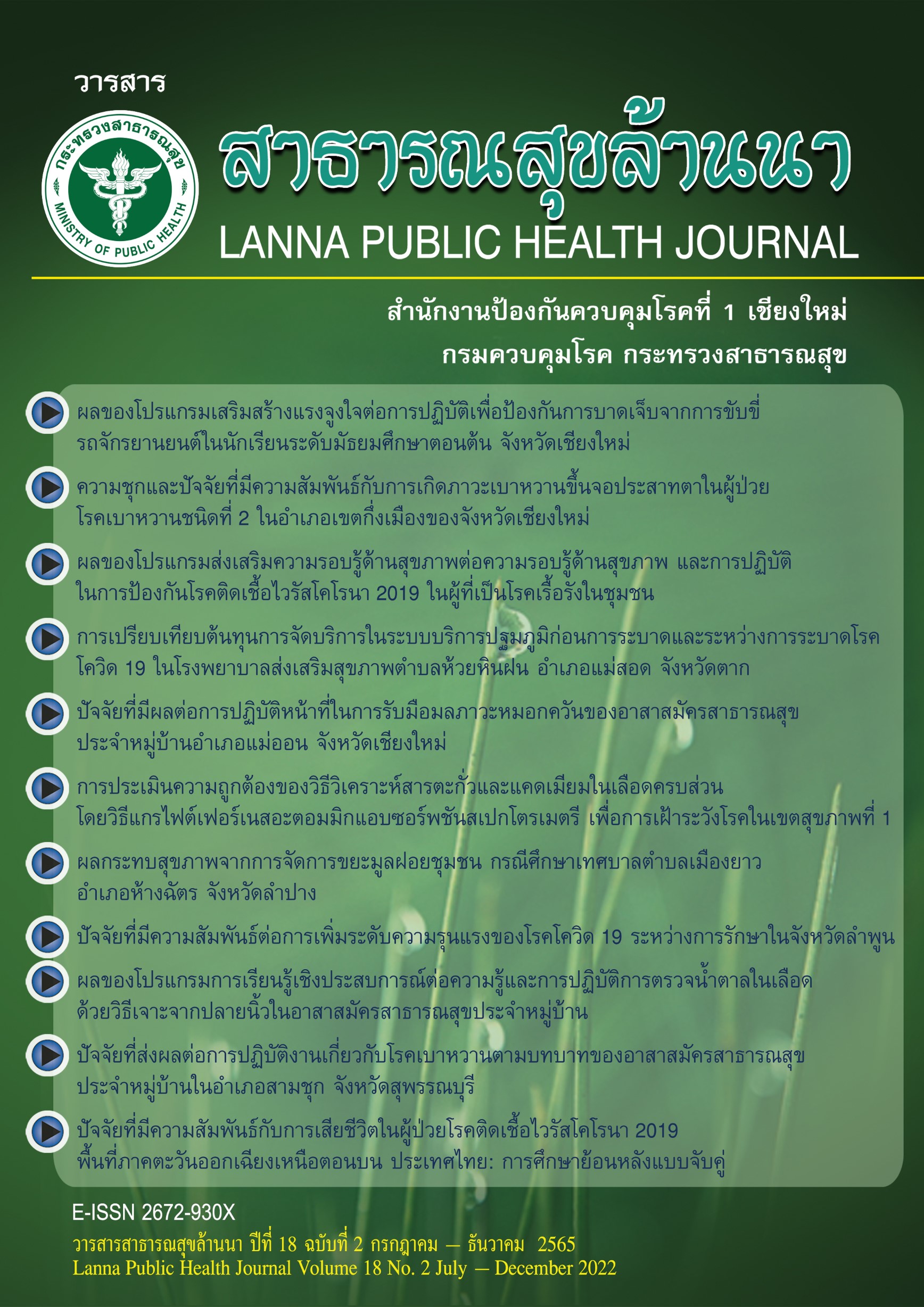
Factors Affecting Increased Severity of COVID-19 during Treatment in Lamphun Province
Keywords:
COVID-19, Risk factor, SeverityAbstract
The descriptive study aimed to identify factors affecting an increased severity of COVID-19 during treatment between April and May 2021 in Lamphun Hospital. A sample of 237 patients with COVID-19 was obtained by an inclusion criteria and the data collected from electronic medical record system of Lamphun hospital. Analyses of the data complied descriptive statistics, univariable and multivariable logistic regression analysis. The results of the study showed the male gender was 54%, a mean age was 34.98 years, and having no underlying disease 78.10%. There were 97.89% of whom with non-smoking, 72.57% had the heart rate less than 100 beats/min, and 82.70% held mild to moderate symptomatic COVID-19. The patients were hospitalized after onset of symptoms less than 48 hours was 53.59%. The patients had abnormal chest x-ray 13.50%, received favipiravir 21.94% and steroids 13.92%. Multivariate logistic regression analysis of the risk factors presented male gender was likely to increase the severity of COVID-19 5.17 times than that of female gender, the patients with underlying diseases had 8.05 times more likely to increase the severity of COVID-19 than that without underlying diseases, and the patients with the heart rate ≥100 beats/min had 3.36 times more likely to increase the severity of COVID-19 than the patients with heart rate < 100 beats/min. Therefore, healthcare workers should improve the care process of covid-19 patients to further reduction the severity of COVID-19.
References
กรมควบคุมโรค กระทรวงสาธารณสุข. (2564). สถานการณ์ผู้ป่วย COVID-19 ภายในประเทศ รายสัปดาห์ [ออนไลน์]. [สืบค้นเมื่อ 1 มิถุนายน 2564]; Available from: https://ddc.moph.go.th/covid19-dashboard/
Badawi, A., & Ryoo, S. G. (2016). Prevalence of comorbidities in the Middle East respiratory syndrome coronavirus (MERS-CoV): a systematic review and meta-analysis. International Journal of Infectious Diseases, 49, 129-133.
Bursac, Z., Gauss, C. H., Williams, D. K., & Hosmer, D. W. (2008). Purposeful selection of variables in logistic regression. Source Code for Biology and Medicine, 3(1), 1-8.
Ciceri, F., Castagna, A., Rovere-Querini, P. et al. (2020). Early predictors of clinical outcomes of COVID-19 outbreak in Milan, Italy. Clinical Immunology, 217, 1-8.
De Wit, E., Van Doremalen, N., Falzarano, D., & Munster, V. J. (2016). SARS and MERS: recent insights into emerging coronaviruses. Nature Reviews Microbiology, 14(8), 523-534.
Gao, Y. D., Ding, M., Dong, X. et al. (2021). Risk factors for severe and critically ill COVID-19 patients: a review. Allergy, 76(2), 428-455.
Gao, Z., Xu, Y., Sun, C. et al. (2021). A systematic review of asymptomatic infections with COVID-19. Journal of Microbiology, Immunology and Infection, 54(1), 12-16.
Huang, X., Wei, F., Hu, L., Wen, L., & Chen, K. (2020). Epidemiology and clinical characteristics of COVID-19. Archives of Iranian Medicine, 23(4), 268-271.
Jaillon, S., Berthenet, K., & Garlanda, C. (2019). Sexual dimorphism in innate immunity. Clinical Reviews in Allergy & Immunology, 56(3), 308-321.
Lotfi, M., Hamblin, M. R., & Rezaei, N. (2020). COVID-19: Transmission, prevention, and potential therapeutic opportunities. Clinica Chimica Acta, 508, 254-266.
Maloberti, A., Ughi, N., Bernasconi, D. P. et al. (2021). Heart Rate in Patients with SARS-CoV-2 Infection: Prevalence of High Values at Discharge and Relationship with Disease Severity. Journal of Clinical Medicine, 10(23), 5590.
Patel, U., Malik, P., Usman, M. S. et al. (2020). Age-adjusted risk factors associated with mortality and mechanical ventilation utilization amongst COVID-19 hospitalizations-a systematic review and meta-analysis. SN Comprehensive Clinical Medicine, 2(10), 1740-1749.
Porzionato, A., Emmi, A., Barbon, S. et al. (2020). Sympathetic activation: a potential link between comorbidities and COVID-19. The FEBS Journal, 287(17), 3681-3688.
Rattanaumpawan, P., Jirajariyavej, S., Lerdlamyong, K., Palavutitotai, N., & Saiyarin, J. (2022). Real-World Effectiveness and Optimal Dosage of Favipiravir for Treatment of COVID-19: Results from a Multicenter Observational Study in Thailand. Antibiotics, 11(6), 805.
Sepandi, M., Taghdir, M., Alimohamadi, Y., Afrashteh, S., & Hosamirudsari, H. (2020). Factors associated with mortality in COVID-19 patients: a systematic review and meta-analysis. Iranian Journal of Public Health, 49(7), 1211-1221.
Shereen, M. A., Khan, S., Kazmi, A., Bashir, N., & Siddique, R. (2020). COVID-19 infection: Emergence, transmission, and characteristics of human coronaviruses. Journal of Advanced Research, 24, 91-98.
Wilder-Smith, A., Teleman, M. D., Heng, B. H., Earnest, A., Ling, A. E., & Leo, Y. S. (2005). Asymptomatic SARS coronavirus infection among healthcare workers, Singapore. Emerging Infectious Diseases, 11(7), 1142-1145.
Zhang, T., Huang, W. S., Guan, W. et al. (2020). Risk factors and predictors associated with the severity of COVID-19 in China: a systematic review, meta-analysis, and meta-regression. Journal of Thoracic Disease, 12(12), 7429-7441.
Zhou, Y., Chi, J., Lv, W., & Wang, Y. (2021). Obesity and diabetes as high-risk factors for severe coronavirus disease 2019 (Covid-19). Diabetes/Metabolism Research and Reviews, 37(2), 1-14.