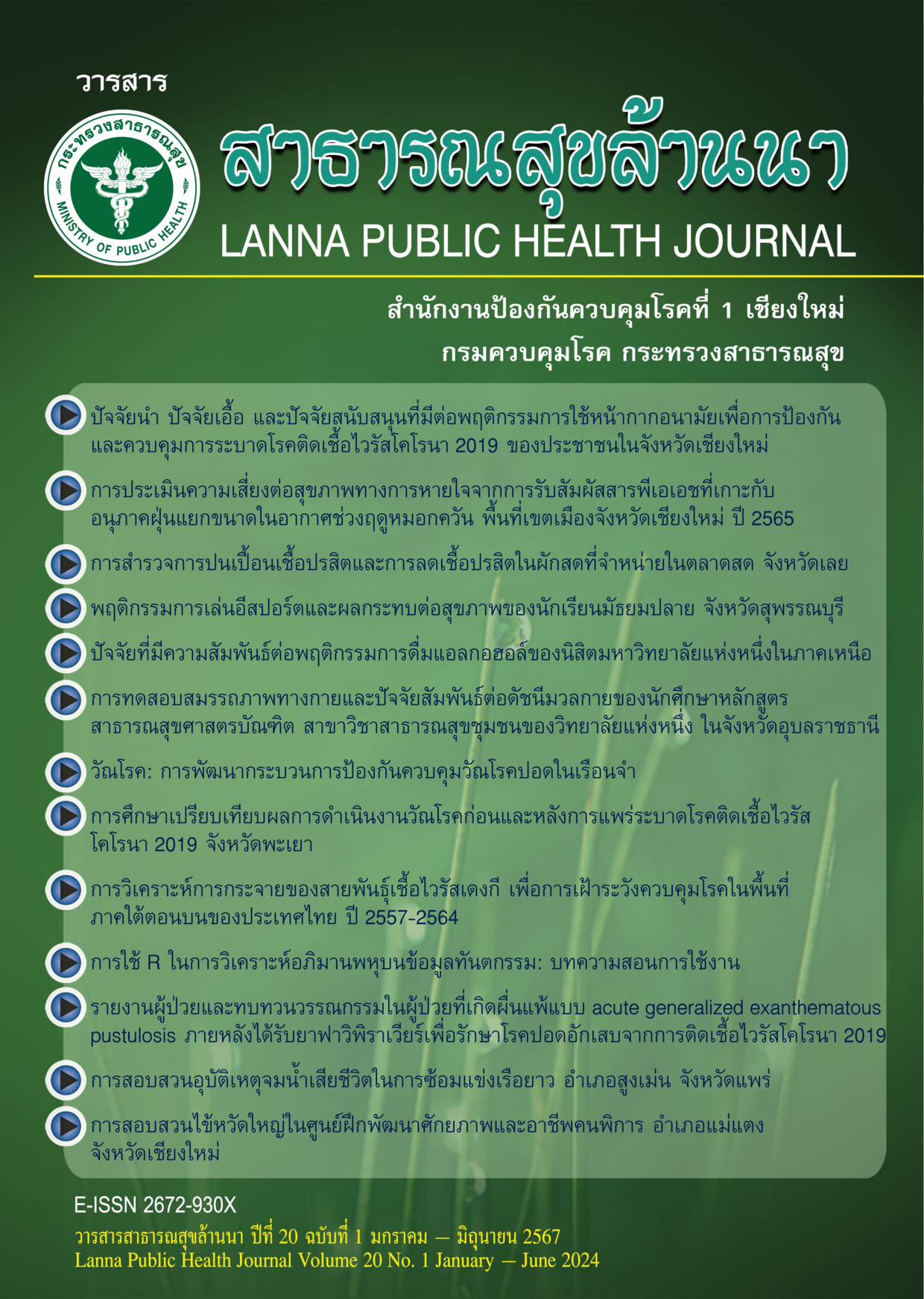
A Comparative Study of Tuberculosis Control Performance Before and After the Coronavirus Disease 2019 Outbreak in Phayao Province
Keywords:
Tuberculosis, Coronavirus disease 2019, Proactive screenAbstract
This descriptive study aims to compare tuberculosis (TB) control performance before and after the COVID-19 outbreak, focusing on proactive screening and laboratory testing. Secondary data were collected from the TB reporting program in Thailand for TB patients registered in 2019 (333 cases) and 2022 (234 cases). The study also examined the work practices of personnel involved in TB management during the COVID-19 outbreak. Data were analyzed using frequencies, percentages, and chi-square test to compare TB control performance before and after the outbreak (year 2019 vs. 2022). The study found that proactive screening using chest X-rays in high-risk groups decreased from 72.27% to 55.78%. TB registration for all patient types decreased from 11.41% to 7.18%. Sputum examination at the end of TB treatment decreased from 66.07% to 47.86%. During the COVID-19 outbreak, personnel involved in TB management predominantly engaged in screening, searching, and following up with patients at 45.95%. Receiving regular support in terms of materials, equipment, and budget accounted for 47.22%. Service delivery adaptation included reducing the number of service recipients, shortening service hours, and minimizing group activities, which led to a decrease in TB control performance in post-COVID-19 outbreak. This was a negative effect especially in proactive screening for TB patients, resulting in delayed diagnosis and treatment, and finally affecting TB transmission. Therefore, it is crucial to properly design TB services during public health emergencies to maintain all aspects of TB care comprehensively.
References
กระทรวงสาธารณสุข. (2563). ตัวชี้วัดที่ 025:อัตราสำเร็จการรักษาวัณโรคปอดรายใหม่ [ออนไลน์]. [สืบค้นเมื่อ 1 มิถุนายน 2564]; แหล่งข้อมูล: https://healthkpi.moph.go.th/kpi2/kpi/index2/?kpi_year=2563
กรมควบคุมโรค กระทรวงสาธารณสุข. (2564). สถานการณ์ผู้ป่วย COVID-19 ภายในประเทศ รายสัปดาห์[ออนไลน์]. [สืบค้นเมื่อ 1 มิถุนายน 2565]; แหล่งข้อมูล:
https://ddc.moph.go.th/covid19-dashboard/
กลุ่มงานควบคุมโรคติดต่อ สำนักงานสาธารณสุขจังหวัดพะเยา. (2565). บทสรุปสำหรับผู้บริหาร เพื่อบริหารจัดการสถานการณ์พื้นที่ ฯ ประจำวันที่ 31 พฤษภาคม 2565 [ออนไลน์]. [สืบค้นเมื่อ 1 มิถุนายน 2565]; แหล่งข้อมูล: http://www.pyomoph.go.th/index_sub.php?id_group=6&page=9
กองวัณโรค กรมควบคุมโรค. (2563). แนวทางการดำเนินงานวัณโรคในสถานการณ์ระบาดของโรคติดเชื้อไวรัสโคโรนา 2019. กรุงเทพมหานคร : สำนักพิมพ์อักษรกราฟฟิคแอนด์ดีไซน์ .
กองวัณโรค กรมควบคุมโรค. (2561). แนวทางการดำเนินงานควบคุมวัณโรคแห่งชาติ พ.ศ. 2561(National Tuberculosis Control Programme Guidelines : NTP GUIDELINES,2018). กรุงเทพมหานคร: กิจการโรงพิมพ์องค์การสงเคราะห์ทหารผ่านศึกในพระบรมราชูปถัมภ์.
กองวัณโรค กรมควบคุมโรค. (2564a). แนวทางการดำเนินงานควบคุมวัณโรค ประเทศไทย ปี พ.ศ. 2564. กรุงเทพมหานคร: สำนักพิมพ์อักษรกราฟฟิคแอนด์ดีไซน์.
กองวัณโรค กรมควบคุมโรค.(2564b) แผนปฏิบัติการระดับชาติด้านการต่อต้านวัณโรค พ.ศ.2560-2564 (เพิ่มเติม พ.ศ.2565). กรุงเทพมหานคร: สำนักพิมพ์อักษรกราฟฟิคแอนด์ดีไซน์.
ประกาศสถานการณ์ฉุกเฉิน ในทุกเขตท้องที่ทั่วราชอาณาจักร. (2563, 25 มีนาคม). ราชกิจจานุเบกษา. เล่มที่ 137 ตอนพิเศษ 69 ง. หน้า 1
สำนักงานสาธารณสุขจังหวัดพะเยา. (2565). แบบรายงานการตรวจราชการกระทรวงสาธารณสุข ประจำปีงบประมาณ พ.ศ 2565 ประเด็นที่ 3 Area Base หัวข้อ Service Plan TB จังหวัดพะเยา รอบที่ 1/ 2565. (เอกสารอัดสำเนา).
เสาวนีย์ วิบุลสันติ. (2565). รายงานสถานการณ์และผลการดำเนินงานวัณโรคเขตสุขภาพที่ 1 เชียงใหม่ นำเสนอในการประชุมเชิงปฏิบัติการจัดทำแผนยุทธศาสตร์เขตสุขภาพที่ 1 ปีงบประมาณ พ.ศ.2566 ระหว่างวันที่ 14-15 พฤศจิกายน 2565 ณ โรงแรมเวียงอินทร์ จังหวัดเชียงราย. (เอกสารอัดสำเนา).
อุษณีย์ อึ้งเจริญ และคณะ. (2563). รายงานโครงการผลกระทบจากสถานการณ์แพร่ระบาดของโรคติดเชื้อไวรัสโคโรนา 2019 (COVID-19) ต่อผลการดำเนินงานวัณโรคในประเทศไทย (The impact of Corona Virus Disease 2019 (COVID-19) outbreak on TB Control outcomes, Thailand). (เอกสารอัดสำเนา)
Jeong, Y., & Min, J. (2023). Impact of COVID-19 pandemic on tuberculosis preventive services and their post-pandemic recovery strategies: a rapid review of literature. Journal of Korean Medical Science, 38(5), 1-17. [cited 2024 June 10]; Available from: https://www.ncbi.nlm.nih.gov/pmc/articles/PMC9902666/
Aznar, M. L., et.al (2021). Impact of the COVID-19 pandemic on tuberculosis management in Spain. International Journal of Infectious Diseases, 108, 300-305. [cited 2024 June 10]; Available from: https://www.sciencedirect.com/science/article/pii/S1201971221003878
Hasan, T., et.al (2022). Retrospective cohort study of effects of the COVID-19 pandemic on tuberculosis notifications, Vietnam, 2020.
Emerging infectious diseases, 28(3), 684-692. [cited 2024 June 10]; Available from: https://doi.org/10.3201/eid2803.211919
Ozdemir, S., Oztomurcuk, D., & Oruc, M. A. (2022). Impact of the COVID-19 pandemic on tuberculosis patients and tuberculosis control programs in Turkey, review and analysis. Archives of Public Health, 80(1), 1-8. [cited 2024 June 10]; Available from: https://doi.org/10.1186/s13690-022-01007-w
World Health Organization. (2021). Global tuberculosis report 2021. Geneva: World Health Organization.