
False Positive Infectious Serologies Mimicking Viral Exanthem in a Patient with Angioimmunoblastic T-Cell Lymphoma
คำสำคัญ:
Morbilliform eruption, maculopapular rash, angioimmunoblastic T-cell lymphoma, false positiveบทคัดย่อ
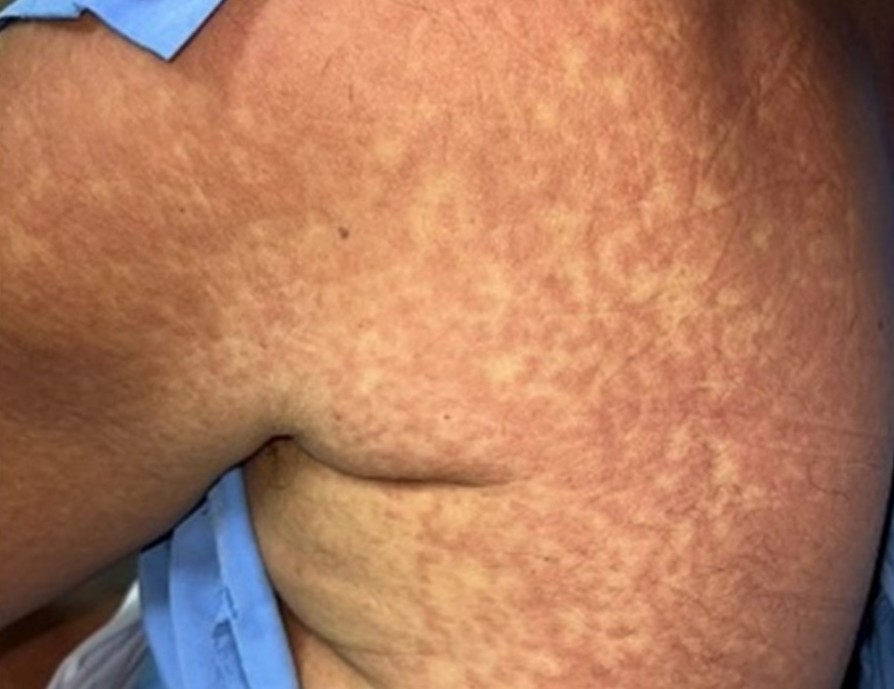
Angioimmunoblastic T-cell lymphoma (AITL) represents a severe subtype of peripheral T-cell lymphoma and mimics drug reactions, infection, or autoimmune diseases. Due to its nonspecific clinical features, diagnosing AITL can be difficult and is frequently delayed. We report a case of a 70-year-old Thai male who presented with fever and generalized morbilliform eruption. Initial laboratory investigations revealed positive serological tests for Mycoplasma, Measle virus, and Epstein-Barr virus. The patient was treated with appropriate antibiotics, however, there was no clinical improvement. The lack of response to antibiotic therapy prompted reconsideration of the initial diagnosis. Subsequent careful examination revealed enlarged cervical lymph nodes, lymph node biopsy confirmed AITL. In patient with AITL, we hypothesize that positive serological tests for multiple pathogens often result from immune dysregulation or cross-reactivity rather than true infections. Therefore, physicians must interpret these findings cautiously to avoid misdiagnosis.
เอกสารอ้างอิง
Lage L, Culler HF, Reichert CO, et al. Angioimmunoblastic T-cell lymphoma and correlated neoplasms with T-cell follicular helper phenotype: from molecular mechanisms to therapeutic advances. Front Oncol 2023;13:1177590.
Lunning MA, Vose JM. Angioimmunoblastic T-cell lymphoma: the many-faced lymphoma. Blood 2017;129:1095-102.
Federico M, Rudiger T, Bellei M, et al. Clinicopathologic characteristics of angioimmunoblastic T-cell lymphoma: analysis of the international peripheral T-cell lymphoma project. J Clin Oncol 2013;31:240-6.
Lage LAPC, Culler HF, Reichert CO, et al. Angioimmunoblastic T-cell lymphoma and correlated neoplasms with T-cell follicular helper phenotype: from molecular mechanisms to therapeutic advances. Front Oncol 2023;13:1-18.
Kuroda K, Tambe A, Iftikhar R, et al. A Case of Angioimmunoblastic T-cell Lymphoma That Mimics As Autoimmune Diseases and Infections. Cureus 2021;13:e16439.
Shida S, Takahashi N, Fujishima N, et al. False-positive human immunodeficiency virus antibody test and autoimmune hemolytic anemia in a patient with angioimmunoblastic T-cell lymphoma. Intern Med 2011;50:2383-7.
Kunitomi T, Miyagami T, Kiyose Y, et al. Recurrent Rash and Anemia: A Diagnostic Challenge of Angioimmunoblastic T-cell Lymphoma Mimicking Parvovirus B19 Infection. Cureus 2024;16:e68517.
Balaraman B, Conley JA, Sheinbein DM. Evaluation of cutaneous angioimmunoblastic T-cell lymphoma. J Am Acad Dermatol 2011;65:855-862.
Botros N, Cerroni L, Shawwa A, et al. Cutaneous manifestations of angioimmunoblastic T-cell lymphoma: clinical and pathological characteristics. Am J Dermatopathol 2015;37:274-83.
Martel P, Laroche L, Courville P, et al. Cutaneous involvement in patients with angioimmunoblastic lymphadenopathy with dysproteinemia: a clinical, immunohistological, and molecular analysis. Arch Dermatol 2000;136:881-6.
ดาวน์โหลด
เผยแพร่แล้ว
รูปแบบการอ้างอิง
ฉบับ
ประเภทบทความ
สัญญาอนุญาต
ลิขสิทธิ์ (c) 2026 วารสารโรคผิวหนัง

อนุญาตภายใต้เงื่อนไข Creative Commons Attribution-NonCommercial-NoDerivatives 4.0 International License.
เนื้อหาและข้อมูลในบทความที่ลงตีพิมพ์ในวารสารโรคผิวหนัง ถือเป็นข้อคิดเห็นและความรับผิดชอบของผู้เขียนบทความโดยตรงซึ่งกองบรรณาธิการวารสาร ไม่จำเป็นต้องเห็นด้วย หรือร่วมรับผิดชอบใดๆ
บทความ ข้อมูล เนื้อหา รูปภาพ ฯลฯ ที่ได้รับการตีพิมพ์ในวารสารโรคผิวหนัง ถือเป็นลิขสิทธิ์ของวารสารฯ หากบุคคลหรือหน่วยงานใดต้องการนำทั้งหมดหรือส่วนหนึ่งส่วนใดไปเผยแพร่ต่อหรือเพื่อกระทำการใดๆ จะต้องได้รับอนุญาตเป็นลายลักอักษรจากบรรณาธิการวารสารโรคผิวหนังก่อนเท่านั้น

