
Finerenone ยายับยั้ง mineralocorticoid receptor ชนิดใหม่ ในการรักษาผู้ป่วยเบาหวานที่มีโรคไตร่วมด้วย
คำสำคัญ:
finerenone, non-steroidal mineralocorticoid receptor antagonist, diabetic kidney diseaseบทคัดย่อ
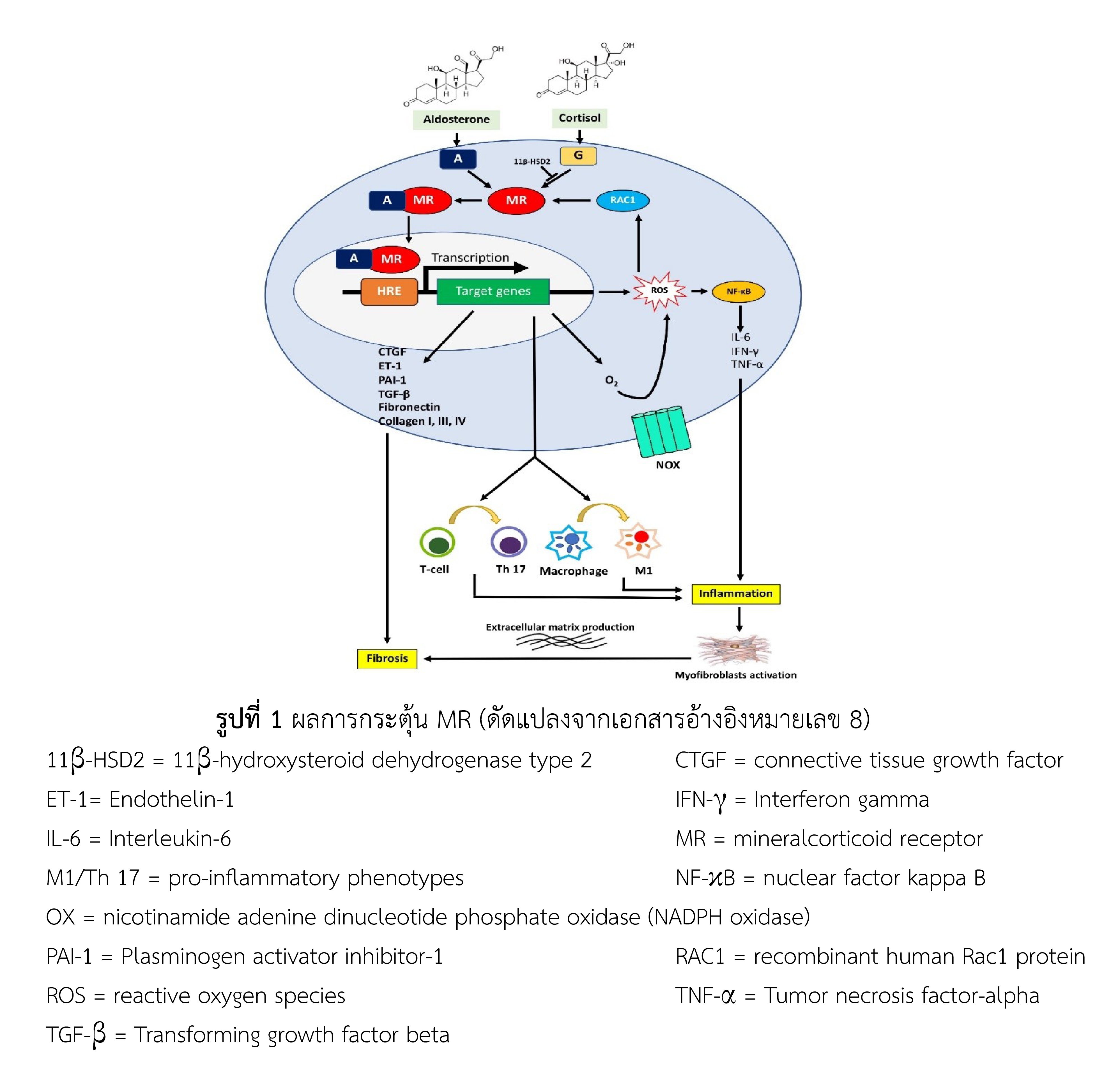
ยากลุ่มยับยั้ง mineralocorticoid receptor (MR) เป็นยากลุ่มหนึ่งที่มีประสิทธิภาพดีในการรักษาผู้ป่วยโรคไตจากเบาหวานหรือผู้ป่วยที่มีภาวะหัวใจล้มเหลว โดยยาจะออกฤทธิ์ยับยั้งไม่ให้ aldosterone จับกับ MR มากเกินไป จึงลดการสร้างอนุมูลอิสระ ลดการอักเสบ และลดการเกิดพังผืดของเซลล์ไตและหัวใจ จึงช่วยชะลอการดำเนินไปของโรค spironolactone และ eplerenone เป็นยาในกลุ่มนี้ที่มีโครงสร้างเป็นสเตียรอยด์และพบว่ายังมีการใช้ในข้อบ่งใช้ดังกล่าวน้อย เนื่องจากยาเพิ่มความเสี่ยงของการเกิดอาการไม่พึงประสงค์รุนแรง เช่น ภาวะโพแทสเซียมในเลือดสูง และการทำงานของไตแย่ลง จึงนำมาสู่การคิดค้นได้เป็น finerenone ซึ่งเป็นยารับประทานกลุ่ม non-steroidal MR antagonist ชนิดใหม่ โดยมีคุณสมบัติทางยาที่แตกต่างจาก spironolactone และ eplerenone ซึ่งเป็น steroidal MR antagonist จึงทำให้ finerenone ไม่ก่อให้เกิดภาวะเต้านมโต รวมถึงไม่มีผลต่อความดันโลหิตด้วย ยานี้ได้รับการรับรองจากองค์การอาหารและยาแห่งประเทศสหรัฐอเมริกา เมื่อปี พ.ศ. 2564 ในข้อบ่งใช้เพื่อลดความเสี่ยงของการดำเนินไปของโรคไตและลดความเสี่ยงของการเกิดโรคหัวใจและหลอดเลือดในผู้ป่วยเบาหวานชนิดที่ 2 ที่มีโรคไตร่วมด้วย อย่างไรก็ตาม ยังต้องมีการตรวจติดตามเพื่อเฝ้าระวังภาวะโพแทสเซียมในเลือดสูง และตรวจติดตามค่าการทำงานของไตอย่างสม่ำเสมอในระหว่างการใช้ยา รวมถึงสังเกตและติดตามอาการข้างเคียงในระยะยาวของยาต่อไป
เอกสารอ้างอิง
Alicic RZ, Rooney MT, Tuttle KR. Diabetic kidney disease: challenges, progress, and possibilities. Clin J Am Soc Nephrol. 2017;12(12):2032-45.
Gansevoort RT, Correa-Rotter R, Hemmelgarn BR, Jafar TH, Heerspink HJ, Mann JF, et al. Chronic kidney disease and cardiovascular risk: epidemiology, mechanisms, and prevention. Lancet. 2013;382(9889):339-52.
Pafundi PC, Garofalo C, Galiero R, Borrelli S, Caturano A, Rinaldi L, et al. Role of albuminuria in detecting cardio-renal risk and outcome in diabetic subjects. Diagnostics (Basel, Switzerland). 2021;11(2):290.
KDIGO 2020 clinical practice guideline for diabetes management in chronic kidney disease. Kidney Int. 2020;98(4s):s1-s115.
American Diabetes Association. 11 microvascular complications and foot care: standards of medical care in diabetes-2020. Diabetes Care. 2020;43(Suppl 1):s135-s51.
Buse JB, Wexler DJ, Tsapas A, Rossing P, Mingrone G, Mathieu C, et al. 2019 update to: management of hyperglycaemia in type 2 diabetes, 2018. A consensus report by the American Diabetes Association (ADA) and the European Association for the Study of Diabetes (EASD). Diabetologia. 2020;63(2):221-8.
Barrera-Chimal J, Girerd S, Jaisser F. Mineralocorticoid receptor antagonists and kidney diseases: pathophysiological basis. Kidney Int. 2019;96(2):302-19.
Buonafine M, Bonnard B, Jaisser F. Mineralocorticoid receptor and cardiovascular disease. Am J Hypertens. 2018;31(11):1165-74.
Gomez-Sanchez E, Gomez-Sanchez CE. The multifaceted mineralocorticoid receptor. Compr Physiol. 2014;4(3):965-94.
Queisser N, Schupp N. Aldosterone, oxidative stress, and NF-κB activation in hypertension-related cardiovascular and renal diseases. Free Radic Biol Med. 2012;53(2):314-27.
Yoshikawa T, Naito Y. What is oxidative stress? JMAJ. 2002;45(7):271–6.
Pitt B, Zannad F, Remme WJ, Cody R, Castaigne A, Perez A, et al. The effect of spironolactone on morbidity and mortality in patients with severe heart failure. N Engl J Med. 1999;341(10):709-17.
Zannad F, McMurray JJV, Krum H, van Veldhuisen DJ, Swedberg K, Shi H, et al. Eplerenone in patients with systolic heart failure and mild symptoms. N Engl J Med. 2010;364(1):11-21.
Bianchi S, Bigazzi R, Campese VM. Long-term effects of spironolactone on proteinuria and kidney function in patients with chronic kidney disease. Kidney Int. 2006;70(12):2116-23.
Currie G, Taylor AH, Fujita T, Ohtsu H, Lindhardt M, Rossing P, et al. Effect of mineralocorticoid receptor antagonists on proteinuria and progression of chronic kidney disease: A systematic review and meta-analysis. BMC Nephrol. 2016;17(1):127.
Bolignano D, Palmer SC, Navaneethan SD, Strippoli GF. Aldosterone antagonists for preventing the progression of chronic kidney disease. Cochrane Database Syst Rev. 2014(4):Cd007004. doi: 10.1002/14651858.CD007004.pub3.
Lazich I, Bakris GL. Prediction and management of hyperkalemia across the spectrum of chronic kidney disease. Semin Nephrol. 2014;34(3):333-9.
Pitt B, Kober L, Ponikowski P, Gheorghiade M, Filippatos G, Krum H, et al. Safety and tolerability of the novel non-steroidal mineralocorticoid receptor antagonist BAY 94-8862 in patients with chronic heart failure and mild or moderate chronic kidney disease: A randomized, double-blind trial. Eur Heart J. 2013;34(31):2453-63.
U.S. Food and Drug Administration. KERENDIA [Internet]. 2021 [cited 2021 Oct 2]. Available from: https://www.accessdata.fda.gov/drugsatfda_docs/label/2021/215341s000lbl.pdf
Bärfacker L, Kuhl A, Hillisch A, Grosser R, Figueroa-Pérez S, Heckroth H, et al. Discovery of BAY 94-8862: A nonsteroidal antagonist of the mineralocorticoid receptor for the treatment of cardiorenal diseases. ChemMedChem. 2012;7(8):1385-403.
Fagart J, Hillisch A, Huyet J, Bärfacker L, Fay M, Pleiss U, et al. A new mode of mineralocorticoid receptor antagonism by a potent and selective nonsteroidal molecule. J Biol Chem. 2010;285(39):29932-40.
U.S. Food and Drug Administration. FDA approves drug to reduce risk of serious kidney and heart complications in adults with chronic kidney disease associated with type 2 diabetes [Internet]. 2021 [cited 2021 Oct 15]. Available from: https://www.fda.gov/drugs/news-events-human-drugs/fda-approves-drug-reduce-risk-serious-kidney-and-heart-complications-adults-chronic-kidney-disease
Heinig R, Gerisch M, Engelen A, Nagelschmitz J, Loewen S. Pharmacokinetics of the novel, selective, non-steroidal mineralocorticoid receptor antagonist finerenone in healthy volunteers: Results from an absolute bioavailability study and drug-drug interaction studies in vitro and in vivo. Eur J Drug Metab Pharmacokinet. 2018;43(6):715-27.
Bakris GL, Agarwal R, Anker SD, Pitt B, Ruilope LM, Rossing P, et al. Effect of finerenone on chronic kidney disease outcomes in type 2 diabetes. N Engl J Med. 2020;383(23):2219-29.
Bakris GL, Agarwal R, Chan JC, Cooper ME, Gansevoort RT, Haller H, et al. Effect of finerenone on albuminuria in patients with diabetic nephropathy: A randomized clinical trial. JAMA. 2015;314(9):884-94.
Filippatos G, Anker SD, Böhm M, Gheorghiade M, Køber L, Krum H, et al. A randomized controlled study of finerenone vs. eplerenone in patients with worsening chronic heart failure and diabetes mellitus and/or chronic kidney disease. Eur Heart J. 2016;37(27):2105-14.
Pitt B, Filippatos G, Agarwal R, Anker SD, Bakris GL, Rossing P, et al. Cardiovascular events with finerenone in kidney disease and type 2 diabetes. N Engl J Med. 2021;385(24):2252-63.
Agarwal R, Filippatos G, Pitt B, Anker SD, Rossing P, Joseph A, et al. Cardiovascular and kidney outcomes with finerenone in patients with type 2 diabetes and chronic kidney disease: The FIDELITY pooled analysis. Eur Heart J. 2022;43(6):474-84.
ดาวน์โหลด
เผยแพร่แล้ว
รูปแบบการอ้างอิง
ฉบับ
ประเภทบทความ
สัญญาอนุญาต
ลิขสิทธิ์ (c) 2022 สมาคมเภสัชกรรมโรงพยาบาล(ประเทศไทย)

อนุญาตภายใต้เงื่อนไข Creative Commons Attribution-NonCommercial-NoDerivatives 4.0 International License.
บทความในวารสารเภสัชกรรมโรงพยาบาลเผยแพร่ภายใต้เงื่อนไขของสัญญาอนุญาตครีเอทีฟคอมมอนส์ในรูปแบบที่ต้องอ้างอิงแหล่งที่มา - ห้ามใช้เพื่อการค้า - ห้ามแก้ไขดัดแปลง เวอร์ชั่น 4.0 (CC BY-NC-ND 4.0) สามารถแจกจ่ายและนำบทความไปใช้ประโยชน์เพื่อการศึกษาได้แต่ต้องระบุการอ้างอิงถึงบทความจากเว็บไซต์วารสารเภสัชกรรมโรงพยาบาล ไม่สามารถนำบทความไปใช้เพื่อการพาณิชย์ใด ๆ เว้นแต่ได้รับอนุญาตจากบรรณาธิการวารสารเภสัชกรรมโรงพยาบาล และกรณีมีการนำบทความไปเรียบเรียงใหม่ เปลี่ยนแปลงเนื้อหา หรือเสริมเติมแต่งเนื้อหาของบทความ ท่านไม่สามารถนำบทความที่ปรับแต่งไปเผยแพร่ได้ในทุกกรณี
ข้อความที่ปรากฏในบทความในวารสารเป็นความคิดเห็นส่วนตัวของผู้แต่งแต่ละท่านไม่เกี่ยวข้องกับสมาคมเภสัชกรรมโรงพยาบาล (ประเทศไทย) และบุคลากรในสมาคมฯ แต่อย่างใด ความรับผิดชอบองค์ประกอบทั้งหมดของบทความแต่ละเรื่องเป็นของผู้แต่งแต่ละท่าน หากมีความผิดพลาดใด ๆ ผู้แต่งแต่ละท่านจะรับผิดชอบบทความของตนเอง ตลอดจนความรับผิดชอบด้านเนื้อหาและการตรวจร่างบทความเป็นของผู้แต่ง ไม่เกี่ยวข้องกับกองบรรณาธิการ


.png)

