The Pharmacist’s Role in Drug-Related Problem Management at a Cancer Clinic in a Tertiary Care Hospital
Keywords:
drug-related problems (DRPs), chemotherapy, pharmacist role, cancer clinicAbstract
Background: Pharmacists have a crucial role in providing pharmaceutical care to cancer patients, working alongside the multidisciplinary professional team to ensure that patients receive the safest and most efficient therapy available.
Objective: This study aims to analyze the types of drug-related problems (DRPs), their causes, the role of pharmacists in their resolution, the rate of physician acceptance of these recommendations by pharmacists, and their clinical significance.
Methods: A retrospective study was conducted. Data from electronic databases of patients receiving anti-cancer drugs at the radiotherapy building at Khon Kaen Hospital from May 1, 2022, to April 30, 2023, were included. Data on patient demographics, types of drug problems, pharmacists' interventions, and physician acceptance rates with clinical significance were collected. All data were analyzed with descriptive statistics and presented as frequency, percentage, mean, and standard deviation.
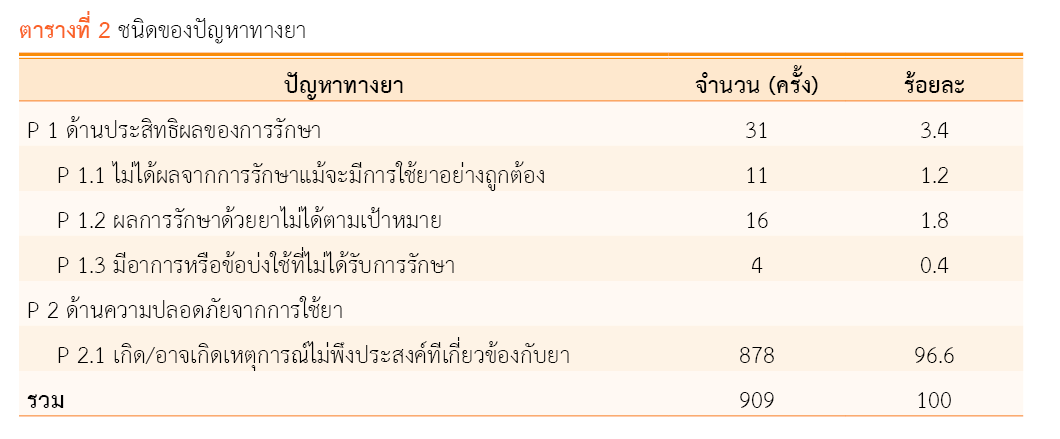
Results: A total of 590 patients who reported at least one episode of a drug-related problem (DRP) were included in the study. A total of 909 DRPs were reported. The primary type of DRPs was safety-related (96.6%), mainly concerning adverse effects from drug mechanisms of action (82.2%). Common adverse effects included neuropathy (17.7%), hand-foot syndrome (15.1%), and neutropenia (8.4%). Pharmacists provided medication counseling to 80.5% of patients and collaborated with physicians to resolve adverse effects in 15.2% of cases. There were 1.8% of cases that did not achieve the intended treatment efficacy level, attributed to lower drug intake, medication omissions, and inadequate instructions or prescription information. Overall, pharmacists provided instructions and changed labels in cooperation with physicians, and 94.7% of these interventions were accepted, resulting in the prevention of chemotherapy toxicity to organs (79.6%).
Conclusion: Pharmacists play a crucial role in monitoring, preventing, and resolving adverse effects caused by chemotherapy. Providing information, reviewing drug lists, and giving recommendations on chemotherapy are thus essential roles of pharmacists in helping patients receive effective and safe drug therapy.
References
สถาบันมะเร็งแห่งชาติ. ทะเบียนมะเร็งระดับโรงพยาบาล พ.ศ. 2563. พิมพ์ครั้งที่ 36 [อินเทอร์เน็ต]. กรุงเทพมหานคร: กลุ่มงานดิจิทัลการแพทย์ สถาบันมะเร็งแห่งชาติ; 2564 [สืบค้นเมื่อ 14 เม.ย. 2566]. สืบค้นจาก: https:// www.nci.go.th/e_book/hosbased_2563/files/main.pdf
สุภัสร์ สุบงกซ, มานิตย์ แซ่เตียว, และสุธาร จันทะวงศ์. เภสัชกรรมปฏิบัติในโรคมะเร็ง (Oncology pharmacy practice). พิมพ์ครั้งที่ 3. ขอนแก่น: ชมรมเภสัชกรโรคมะเร็งภาคพื้นเอเชียแปซิฟิก (ประเทศไทย); 2560.
สมพร ศักดิ์ชินบุตร. ผลของการให้ความรู้และคำปรึกษาโดยเภสัชกรคลินิกแก่ผู้ป่วยนอกโรคมะเร็งที่ได้รับยาเคมีบำบัด [วิทยานิพนธ์ปริญญาเภสัชศาสตรมหาบัณฑิต]. กรุงเทพมหานคร: จุฬาลงกรณ์มหาวิทยาลัย; 2545.
สันติ หวังกีรติกานต์, พัชฎาพร เสาทอง, มนฑิกาญจน์ หอสูติสิมา, รังสฤษดิ์ ไชยพรรค. บทบาทของเภสัชกรในการดูแลผู้ป่วยมะเร็ง. วารสารการแพทย์โรงพยาบาลศรีษะเกษ สุรินทร์ บุรีรัมย์ [อินเทอร์เน็ต]. 2558 [สืบค้นเมื่อ 14 เม.ย. 2566];30(2):121-33. สืบค้นจาก: https://he02.tci-thaijo.org/index.php/MJSSBH/article/view/120391
จันทิมา ชูรัศมี. ความคลาดเคลื่อนทางยาและการเกิดเหตุการณ์ไม่พึงประสงค์ในผู้ป่วยที่ได้รับยาเคมีบำบัด. วารสารเภสัชกรรมไทย [อินเทอร์เน็ต]. 2562 [สืบค้นเมื่อ 14 เม.ย. 2566];11(4):743-53. สืบค้นจาก: https://he01.tci-thaijo.org/index.php/TJPP/article/view/193867
Alexander M, Jupp J, Chazan G, O'Connor S, Chan A. Global oncology pharmacy response to COVID-19 pandemic: medication access and safety. J Oncol Pharm Pract. 2020;26(5):1225-9. doi: 10.1177/1078155220927450.
Alshamrani M, AlHarbi A, Alkhudair N, AlNajjar F, Khan M, Obaid AB, et al. Practical strategies to manage cancer patients during the COVID-19 pandemic: Saudi Oncology Pharmacy Assembly Experts recommendations. J Oncol Pharm Pract. 2020;26(6):1429-40. doi: 10.1177/1078155220935564.
Cortiula F, Pettke A, Bartoletti M, Puglisi F, Helleday T. Managing COVID-19 in the oncology clinic and avoiding the distraction effect. Ann Oncol. 2020;31(5):553–5. doi: 10.1016/j.annonc.2020.03.286.
Oliveira CS, Silva MP, Miranda ÍKSPB, Calumby RT, De Araújo-Calumby RF. Impact of clinical pharmacy in oncology and hematology centers: a systematic review. J Oncol Pharm Pract. 2021;27(3):679–92. doi: 10.1177/1078155220976801.
Roger S, Edeline J, Campillo-Gimenez B, Ventroux E, Rouge-Bugat ME, Chapron A. Adverse events of targeted therapies reported by patients with cancer treated in primary care. Eur J Gen Pract. 2020;26(1):202-9. doi: 10.1080/13814788.2020.1846713.
Du R, Wang X, Ma L, Larcher LM, Tang H, Zhou H, et al. Adverse reactions of targeted therapy in cancer patients: a retrospective study of hospital medical data in China. BMC cancer. 2021;21(1):206. doi: 10.1186/s12885-021-07946-x
Yamane T. Statistics: an introductory analysis. 3rd edition. New York: HarperCollins Publishers; 1973.
Hepler CD, Strand LM. Opportunities and responsibilities in pharmaceutical care. Am J Hosp Pharm. 1990;47(3):533-43. PMID: 2316538.
Schindler E, Richling I, Rose O. Pharmaceutical Care Network Europe (PCNE) drug-related problem classification version 9.00: German translation and validation. Int J Clin Pharm. 2021;43(3):726-30. doi: 10.1007/s11096-020-01150-w
World Health Organization. Safety of medicines, a guide to detecting and reporting adverse drug reactions [Internet]. Geneva: World Health Organization; 2002 [cited 2023 April 14]. Available from: https://iris.who.int/bitstream/handle/10665/67378/WHO_EDM_QSM_2002.2.pdf?sequence=1
โพยม วงศ์ภูวรักษ์. ความหมาย ประเภท และกลไกการเกิด ADR. ใน: ธิดา นิงสานนท์, จันทิมา โยธาพิทักษ์, บรรณาธิการ. ตรงประเด็นเรื่อง Adverse Drug Reaction. กรุงเทพมหานคร: สมาคมเภสัชกรรมโรงพยาบาล (ประเทศไทย); 2549. หน้า 2-6.
Morillo-Verdugo R, Calleja-Hernández MÁ, de Las Aguas Robustillo-Cortés M. A new pharmaceutical care concept: more capable, motivated, and timely. Hosp Pharm. 2019;54(6):348-50. doi: 10.1177/0018578719867657.
Wong SW and Gray ES. Clinical pharmacy services in oncology clinics. J Oncol Pharm Pract. 1999;5(1):49-54. doi: 10.1177/107815529900500104.
Schmoll HJ, Cartwright T, Tabernero J, Nowacki MP, Figer A, Maroun J, et al. Phase III trial of capecitabine plus oxaliplatin as adjuvant therapy for stage III colon cancer: a planned safety analysis in 1,864 patients. J Clin Oncol. 2007;25(1):102-9. doi: 10.1200/JCO.2006.08.1075.
Ribed A, Romero-Jiménez RM, Escudero-Vilaplana V, Iglesias-Peinado I, Herranz-Alonso A, Codina C, et al. Pharmaceutical care program for onco-hematologic outpatients: safety, efficiency and patient satisfaction. Int J Clin Pharm. 2016;38(2):280-8. doi: 10.1007/s11096-015-0235-8.
Galateanu B, Puscasu AI, Tircol SA, Tanase BC, Hudita A, Negrei C, et al. Allergy in cancer care: antineoplastic therapy-induced hypersensitivity reactions. Int J Mol Sci. 2023;24(4):3886. doi: 10.3390/ijms24043886.
Schlichtig K, Dürr P, Dörje F, Fromm MF. Medication errors during treatment with new oral anticancer agents: consequences for clinical practice based on the AMBORA study. Clin Pharmacol Ther. 2021;110(4):1075-86. doi: 10.1002/cpt.2338.
Downloads
Published
How to Cite
Issue
Section
License
Copyright (c) 2024 Association of Hospital Pharmacy (Thailand)

This work is licensed under a Creative Commons Attribution-NonCommercial-NoDerivatives 4.0 International License.
บทความในวารสารเภสัชกรรมโรงพยาบาลเผยแพร่ภายใต้เงื่อนไขของสัญญาอนุญาตครีเอทีฟคอมมอนส์ในรูปแบบที่ต้องอ้างอิงแหล่งที่มา - ห้ามใช้เพื่อการค้า - ห้ามแก้ไขดัดแปลง เวอร์ชั่น 4.0 (CC BY-NC-ND 4.0) สามารถแจกจ่ายและนำบทความไปใช้ประโยชน์เพื่อการศึกษาได้แต่ต้องระบุการอ้างอิงถึงบทความจากเว็บไซต์วารสารเภสัชกรรมโรงพยาบาล ไม่สามารถนำบทความไปใช้เพื่อการพาณิชย์ใด ๆ เว้นแต่ได้รับอนุญาตจากบรรณาธิการวารสารเภสัชกรรมโรงพยาบาล และกรณีมีการนำบทความไปเรียบเรียงใหม่ เปลี่ยนแปลงเนื้อหา หรือเสริมเติมแต่งเนื้อหาของบทความ ท่านไม่สามารถนำบทความที่ปรับแต่งไปเผยแพร่ได้ในทุกกรณี
ข้อความที่ปรากฏในบทความในวารสารเป็นความคิดเห็นส่วนตัวของผู้แต่งแต่ละท่านไม่เกี่ยวข้องกับสมาคมเภสัชกรรมโรงพยาบาล (ประเทศไทย) และบุคลากรในสมาคมฯ แต่อย่างใด ความรับผิดชอบองค์ประกอบทั้งหมดของบทความแต่ละเรื่องเป็นของผู้แต่งแต่ละท่าน หากมีความผิดพลาดใด ๆ ผู้แต่งแต่ละท่านจะรับผิดชอบบทความของตนเอง ตลอดจนความรับผิดชอบด้านเนื้อหาและการตรวจร่างบทความเป็นของผู้แต่ง ไม่เกี่ยวข้องกับกองบรรณาธิการ

.png)

