Fezolinetant: A Novel Drug to Treat Moderate to Severe Vasomotor Symptoms Caused by Menopause
Keywords:
fezolinetant, menopause, vasomotor symptom, hot flashes, neurokinin 3 receptor antagonist, NK3 receptor antagonistAbstract
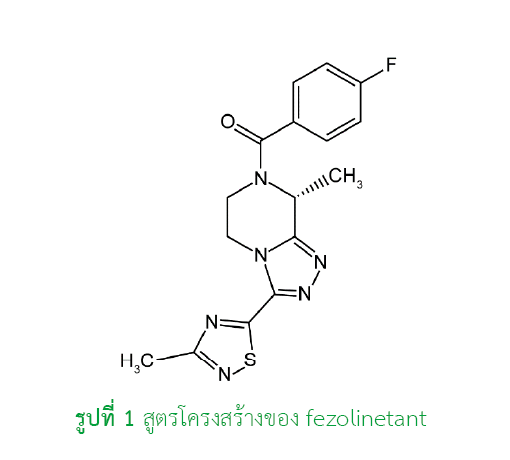
Fezolinetant is the first and only currently approved neurokinin 3 (NK3) receptor antagonist by the U.S. FDA on May 12, 2023, for the treatment of moderate to severe vasomotor symptoms (hot flashes, including night sweats) associated with menopause. But it is the second nonhormonal drug approved by the U.S. FDA for this indication. Fezolinetant works by specifically binding to NK3 receptors in the hypothalamus and inhibiting the activities of NK3 receptors in the hypothalamus, which play a key role in the malfunction of the body’s internal thermostat, resulting in hot flashes on the trunk, face, arms, and legs, and night sweats. The U.S. FDA-approved dose of fezolinetant for the treatment of vasomotor symptoms associated with menopause is one tablet (45 mg) taken once daily. A systematic review of the literature found that the drug is significantly more effective than placebo in reducing the frequency of vasomotor symptoms and has a good safety profile, with a very low or almost no incidence of liver enzyme elevations. Therefore, it is another additional option that is both effective and safe. However, there are still precautions to be taken when using it in patients with kidney and liver disease, and blood values should be monitored during treatment.
References
National Institute on Aging. What is menopause? [Internet]. Bethesda (MD): National Institutes of Health; 2024 [cited 2025 Jan 23]. Available from: https://www.nia.nih.gov/health/menopause/what-menopause
Office on Women’s Health (U.S. Department of Health & Human Services). Menopause basics [Internet]. Washington (DC): Office on Women’s Health; 2025 [cited 2025 Jul 16]. Available from: https://womenshealth.gov/menopause/menopause-basics
Nelson HD, Haney E, Humphrey L, Miller J, Nedrow A, Nicolaidis C, et al. Management of menopause-related symptoms: summary. In: Rockville, editor. Agency for Healthcare Research and Quality (AHRQ) evidence report summaries 1998-2005 [Internet]. n.p.: National Library of Medicine; 2005. Available from: https://www.ncbi.nlm.nih.gov/books/NBK11956/
Peacock K, Carlson K, Ketvertis KM. Menopause [Updated 2023 Dec 21]. In: StatPearls [Internet]. Treasure Island (FL): StatPearls Publishing; 2025 [cited 2025 Jan 23]. Available from: https://www.ncbi.nlm.nih.gov/books/NBK507826/
de Villiers TJ, Gass ML, Haines CJ, Hall JE, Lobo RA, Pierroz DD, et al. Global consensus statement on menopausal hormone therapy. Climacteric. 2013;16(2):203-4. doi: 10.3109/13697137.2013.771520.
Santoro N, Epperson CN, Mathews SB. Menopausal symptoms and their management. Endocrinol Metab Clin North Am. 2015;44(3):497-515. doi: 10.1016/j.ecl.2015.05.001.
American College of Obstetricians and Gynecologists. ACOG practice bulletin No. 141: management of menopausal symptoms. Obstet Gynecol. 2014;123(1):202-16. doi: 10.1097/01.AOG.0000441353.20693.78.
Stearns V, Beebe KL, Iyengar M, Dube E. Paroxetine controlled release in the treatment of menopausal hot flashes: a randomized controlled trial. JAMA. 2003;289(21):2827-34. doi: 10.1001/jama.289.21.2827.
Van Patten CL, Olivotto IA, Chambers GK, Gelmon KA, Hislop TG, Templeton E, et al. Effect of soy phytoestrogens on hot flashes in postmenopausal women with breast cancer: a randomized, controlled clinical trial. J Clin Oncol. 2002;20(6):1449-55. doi: 10.1200/JCO.2002.20.6.1449.
Formoso G, Perrone E, Maltoni S, Balduzzi S, D’Amico R, Bassi C, et al. Short- and long-term effects of tibolone in postmenopausal women. Cochrane Database Syst Rev. 2012;2:CD008536. doi: 10.1002/14651858.CD008536.pub2.
U.S. Food and Drug Administration. FDA approves novel drug to treat moderate to severe hot flashes caused by menopause [Internet]. Silver Spring (MD): U.S. FDA; 2023 [cited 2025 Jan 15]. Available from: https://www.fda.gov/news-events/press-announcements/fda-approves-novel-drug-treat-moderate-severe-hot-flashes-caused-menopause
Food and Drug Administration (Thailand). Details of Medicinal Product: VEOZA 45 MG [Internet]. Nonthaburi: Food and Drug Administration, Ministry of Public Health; [cited 2025 Jul 15]. Available from: https://pertento.fda.moph.go.th/FDA_SEARCH_DRUG/SEARCH_DRUG/pop-up_drug.aspx?Newcode_U=U1DR1C1012670003811C
Astellas Pharma US, Inc. Veozah (fezolinetant) tablets, for oral use: highlights of prescribing information [Internet]. Silver Spring (MD): U.S. Food and Drug Administration; 2023 [cited 2025 Jan 14]. Available from: https://www.accessdata.fda.gov/drugsatfda_docs/label/2023/216578s000lbl.pdf
Meczekalski B, Kostrzak A, Unogu C, Bochynska S, Maciejewska-Jeske M, Bala G, et al. A new hope for woman with vasomotor symptoms: neurokinin B antagonists. J Clin Med. 2025;14(5):1438. doi: 10.3390/jcm14051438.
VA Pharmacy Benefits Management Services. Fezolinetant (VEOZAH) national drug monograph August 2023 [Internet]. Washington (DC): U.S. Department of Veterans Affairs; 2023 [cited 2025 Jan 14]. Available from: https://www.va.gov/formularyadvisor/DOC_PDF/MON_Fezolinetant_VEOZAH_Monograph_Aug_2023.pdf
Lederman S, Ottery FD, Cano A, Santoro N, Shapiro M, Stute P, et al. Fezolinetant for treatment of moderate-to-severe vasomotor symptoms associated with menopause (SKYLIGHT 1): a phase 3 randomised controlled study. Lancet. 2023;401(10382):1091-102. doi: 10.1016/S0140-6736(23)00085-5.
Johnson KA, Martin N, Nappi RE, Neal-Perry G, Shapiro M, Stute P, et al. Efficacy and safety of fezolinetant in moderate to severe vasomotor symptoms associated with menopause: a phase 3 RCT. J Clin Endocrinol Metab. 2023;108(8):1981-97. doi: 10.1210/clinem/dgad058.
Takamatsu K, Miki T, Miyazaki K, Hashimoto A, He W, Wang X. Phase II study of fezolinetant for treatment of vasomotor symptoms associated with menopause in Japan. Climacteric. 2024;27(4):389-97. doi: 10.1080/13697137.2024.2356854.
Neal-Perry G, Cano A, Lederman S, Nappi RE, Santoro N, Wolfman W, et al. Safety of fezolinetant for vasomotor symptoms associated with menopause: a randomized controlled trial. Obstet Gynecol. 2023;141(4):737-47. doi: 10.1097/AOG.0000000000005114.
U.S. Food and Drug Administration. FDA adds warning about rare occurrence of serious liver injury with use of Veozah (fezolinetant) for hot flashes due to menopause [Internet]. Silver Spring (MD): U.S. FDA; 2024 [cited 2025 Jan 14]. Available from: https://www.fda.gov/drugs/drug-safety-and-availability/fda-adds-warning-about-rare-occurrence-serious-liver-injury-use-veozah-fezolinetant-hot-flashes-due
Downloads
Published
How to Cite
Issue
Section
License
Copyright (c) 2025 Association of Hospital Pharmacy (Thailand)

This work is licensed under a Creative Commons Attribution-NonCommercial-NoDerivatives 4.0 International License.
บทความในวารสารเภสัชกรรมโรงพยาบาลเผยแพร่ภายใต้เงื่อนไขของสัญญาอนุญาตครีเอทีฟคอมมอนส์ในรูปแบบที่ต้องอ้างอิงแหล่งที่มา - ห้ามใช้เพื่อการค้า - ห้ามแก้ไขดัดแปลง เวอร์ชั่น 4.0 (CC BY-NC-ND 4.0) สามารถแจกจ่ายและนำบทความไปใช้ประโยชน์เพื่อการศึกษาได้แต่ต้องระบุการอ้างอิงถึงบทความจากเว็บไซต์วารสารเภสัชกรรมโรงพยาบาล ไม่สามารถนำบทความไปใช้เพื่อการพาณิชย์ใด ๆ เว้นแต่ได้รับอนุญาตจากบรรณาธิการวารสารเภสัชกรรมโรงพยาบาล และกรณีมีการนำบทความไปเรียบเรียงใหม่ เปลี่ยนแปลงเนื้อหา หรือเสริมเติมแต่งเนื้อหาของบทความ ท่านไม่สามารถนำบทความที่ปรับแต่งไปเผยแพร่ได้ในทุกกรณี
ข้อความที่ปรากฏในบทความในวารสารเป็นความคิดเห็นส่วนตัวของผู้แต่งแต่ละท่านไม่เกี่ยวข้องกับสมาคมเภสัชกรรมโรงพยาบาล (ประเทศไทย) และบุคลากรในสมาคมฯ แต่อย่างใด ความรับผิดชอบองค์ประกอบทั้งหมดของบทความแต่ละเรื่องเป็นของผู้แต่งแต่ละท่าน หากมีความผิดพลาดใด ๆ ผู้แต่งแต่ละท่านจะรับผิดชอบบทความของตนเอง ตลอดจนความรับผิดชอบด้านเนื้อหาและการตรวจร่างบทความเป็นของผู้แต่ง ไม่เกี่ยวข้องกับกองบรรณาธิการ


.png)

