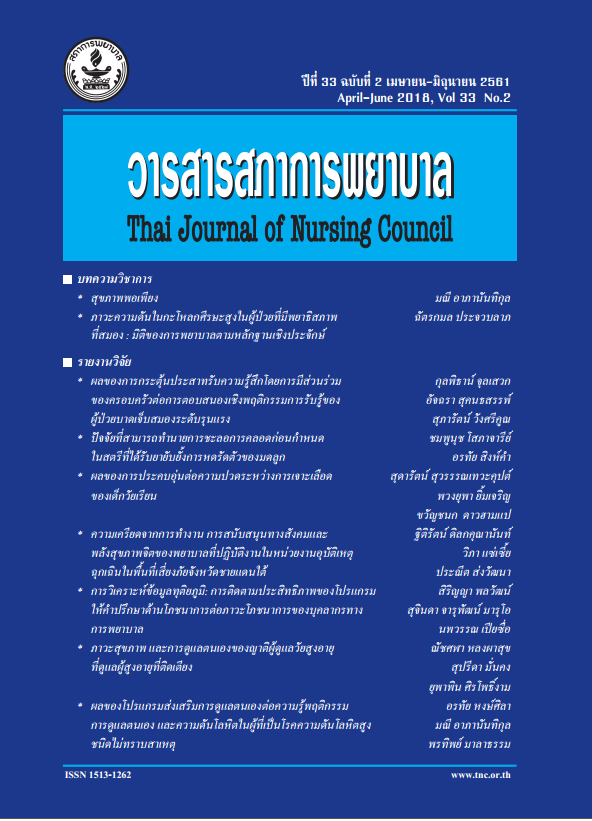
ภาวะความดันในกะโหลกศีรษะสูงในผู้ป่วยที่มีพยาธิสภาพที่สมอง : มิติของการพยาบาลตามหลักฐานเชิงประจักษ์
Increased intracranial pressure; brain pathology; prevention; management; evidence base practice
คำสำคัญ:
ความดันในกะโหลกศรีษะสูง, ผู้ป่วยที่มีพยาธิสภาพที่สมอง, การพยาบาลตามหลักฐานเชิงประจักษ์บทคัดย่อ
บทคัดย่อ
ภาวะความดันในกะโหลกศีรษะสูง (increased intracranial pressure : IICP) เป็นภาวะ
แทรกซ้อนที่สำคัญและพบบ่อยในผู้ป่วยที่มีพยาธิสภาพที่สมอง และเป็นสาเหตุสำคัญของ
การเสียชีวิตหรือภาวะทุพลภาพ สาเหตุเกิดจากการเพิ่มปริมาตรภายในกะโหลกศีรษะทั้ง
ในส่วนของเนื้อสมอง ระบบไหลเวียนเลือด และน้ำหล่อสมองและไขสันหลัง การเพิ่มปริมาตร
ดังกล่าวนั้นเกินขีดความสามารถในการรักษาความสมดุลภายในสมอง ส่งผลให้เกิดภาวะ
ความดันในกะโหลกศีรษะสูง นอกจากนี้ กิจกรรมการพยาบาลบางอย่างอาจเป็นปัจจัยส่งเสริม
ให้ผู้ป่วยที่มีพยาธิสภาพที่สมองเกิดภาวะความดันในกะโหลกศีรษะสูงขึ้น เช่น การจัดท่า
ไม่ถูกต้อง การดูดเสมหะที่ไม่มีประสิทธิภาพ การพลิกตะแคงตัว การควบคุมอุณหภูมิกาย
ไม่ได้ การเฝ้าระวังที่ไม่ได้มาตราฐาน (monitor problems) เป็นต้น ดังนั้นพยาบาลควรมี
ความรู้ความเข้าใจเกี่ยวกับภาวะความดันในกะโหลกศีรษะสูง และใช้ข้อมูลจากหลักฐาน
เชิงประจักษ์เป็นแนวทางในการพัฒนาคุณภาพการพยาบาล โดยประเมินอาการ การเฝ้า
ระวังและป้องกันอันตรายจากภาวะความดันในกะโหลกศีรษะสูงตั้งแต่ระยะเริ่มแรก เพื่อให้
ผู้ป่วยได้รับการรักษาอย่างทันท่วงที กระบวนการฟื้นหายเป็นไปอย่างมีประสิทธิภาพ ลด
ความรุนแรงของโรค ลดความพิการ และอัตราการเสียชีวิต
Downloads
เอกสารอ้างอิง
1.Shaf S, Diaz-Awastia R, Madden C, & Gentilello L. Intracranial pressure monitoring in brain-injury patients are associated with worsening of survival. J Trauma Inj Infect Crit Care 2008; 64(2): 335- 450.
2. Fan JY. Effect of backrest position on intracranial pressure and cerebral perfusion pressure in individuals with brain injury: a systemic review. JNN 2004; 36(5): 278-88.27
3. Usa Ponglaohapun, Suporn Wongwatunyu, Kusuma Khuwatsamrit. Nursing activities and factors related to increased intracranial pressure in head injured patients. Ramathibodi Nursing Journal 2009; 15(2): 221-31. (In Thai)
4. Pedersen CM, Rosendahl-Nielsen M, Hjermind J, Egerod I. Endotracheal suctioning of the adult intubated patient What is the evidence?. Intensive Crit Care Nurs 2009; 25: 21-30.
5. Madden LK & Devon H. Systematic review of the effects of body temperature on outcome following adult traumatic brain injury. J Neurosci Nurs 2015; 47(4): 190-203.
6. Schimpf MM. Diagnosing increased intracranial pressure. Clinical care 2012; 19(3): 160-7.
7. Sudasawan Jiamsakul, Gunyadar Prachusilpa. A study of nursing outcomes quality indicators for patients with neurosurgery. Journal of The Royal Thai Army Nurses 2560; 18(1): 147-54. (In Thai)
8. Sureerat Suwatcharangkoon. Management of acute stroke patients with increased intracranial pressure. Journal of Thai Stroke Society 2015; 14: 94-101. (In Thai)
9.American Nurses Credentialing Center’s Commission on Accreditation. Increased intracranial pressure and monitoring. Washington: RN.com; 2016.
10.Sadoughi A, Rybinnik I & Cohen R. Measurement and management of increased intracranial pressure. BMJ Open 2013; 6: 56-65.
11.Inoue K. Caring for the perioperative patient with increased intracranial pressure. AORN Journal 2010;19(4): 511-15.
12.Hoefnagel D, Dammers R, Ter Laak-Poort MP, et al.Risk factors for infections related to external ventricular drainage. Acta Neurochir (Wien) 2008; 150: 209-14.
13.Bauer DF, Razdan SN, Bartolucci AA, et al. Meta-analysis of hemorrhagic complications from ventriculostomy placement by neurosurgeons. Neurosurgery 2011; 69: 255-60.
14.Kristiansson H, Nissborg E, Bartek J, Andresen M, Reinstrup P & Romner B. Measuring elevated intracranial pressure through noninvasive methods:a review of the literature. J Neurosurg Anesthesiol 2013; 25(4): 372-85.
15.Waterhouse C. The Glasgow Coma Scale and other neurologicalobservations.NursStand2013;19(23): 56-66.
16.Chen JW, Gombart ZJ, Rogers S, Gardiner SK, Cecil S & Bullock RM. Pupillary reactivity as an early indicator of increased intracranial pressure: the introduction of the Neurological Pupil Index. Surg Neurol Int 2011; 2(82): 1-7.
17.Prasat Neurological Institute (Thailand). Clinical nursing practice guidelines for stroke Bangkok: The Institute; 2015.
18.Kara I, Pampal HK, Yildirim F, Dilekoz E, Emmez G, Gocun FPU, Kocabiyik M, Demirel CB. Role of ischemic modifed albumin in the early diagnosis of increased intracranial pressure and brain death. Br Med J 2017; 118(2):112-7.
19.Sankhyan N, Raju V, Sharma S, Gulati S. Management of raised intracranial pressure. Indian J Pediatr 2010; 77: 1409-16.
20.Pedersen CM, Rosendahl-Nielsen M, Hjermind J, Egerod I. Endotracheal suctioning of the adult intubated patient-what is the evidence?. Intensive Crit Care Nurs 2009; 25: 21-30.
21.Rupich K. The use of hypothermia as a treatment for traumatic brain injury. J Neurosci Nurs 2009; 41(3): 159-67.28
22.Beard RM, Day MW. Fever & hyperthermia learn to beat the heat. Nursing 2008; 38(6): 28-31.
23.Madden LK, DeVon HA. Systematic review of the effects of body temperature on outcome following adult traumatic brain injury. J Neurosci Nurs 2015;47(4): 190-203.
24.Badjatia N. Hyperthermia and fever control in brain injury. Crit Care Med 2009; 37(7): 250-7.
25.Thompson HJ, Kirkness CJ, Mitchell PH, Webb DJ. Fever management practices of neuroscience nurse:national and regional perspectives. J Neurosci Nurs 2007; 39(3): 151-61.
26.Kiekkas P, Brokalaki H, Theodorakopoulou G,Baltopoulos GI. Physical antipyresis in critically ill adults. Am J Nurs 2008; 108: 41-9.
27.Ugras GA, Yuksel S. Factors affecting intracranial pressure and nursing interventions. J Nurs Care 2015;1(1): 1-6.
28.Roth C, Stitz H, Kalhout A, Kleffmann J, DeinsbergerW, Ferbert A. Effect of early physiotherapy on intracranial pressure and cerebral perfusion pressure. Neurocrit Care 2013; 18: 33-8.
29.Suadoni MT. Raised intracranial pressure: nursing observations and interventions. Nurs Stand 2009; 23(43): 35-40.
30.Yu SX, Zhang QS, Yin Y, Liu Z, Wu JM, Yang MX. Continuous monitoring of intracranial pressure for prediction of postoperative complications of hypertensive intracerebral hemorrhage. Eur Rev Med Pharmacol Sci 2016; 20: 4750-5.
31.Olson DM, Lewis LS, Bader MK, Bautista C, Malloy R, Riemen KE, McNett MM. Signifcant practice pattern variations associated with intracranial pressure monitoring. J Neurosci Nurs 2013; 45(4):186-93.