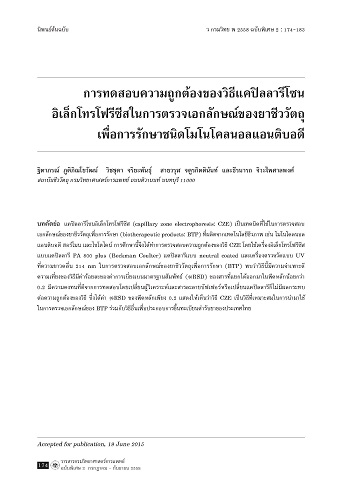
การทดสอบความถูกต้องของวิธีแคปิลลารีโซนอิเล็กโทรโฟรีซีสในการตรวจเอกลักษณ์ของยาชีววัตถุ เพื่อการรักษาชนิดโมโนโคลนอลแอนติบอดี
คำสำคัญ:
CZE, biotherapeutic products, monoclonal antibodyบทคัดย่อ
แคปิลลารีโซนอิเล็กโทรโฟรีซีส (capillary zone electrophoresis: CZE) เป็นเทคนิคที่ใช้ในการตรวจสอบเอกลักษณ์ของยาชีววัตถุเพื่อการรักษา (biotherapeutic products: BTP) ที่ผลิตจากเทคโนโลยีชีวภาพ เช่น โมโนโคลนอลแอนติบอดี ฮอร์โมน และไซโตไคน์ การศึกษานี้จึงได้ทำการตรวจสอบความถูกต้องของวิธี CZE โดยใช้เครื่องอิเล็กโทรโฟรีซีสแบบแคปิลลารี PA 800 plus (Beckman Coulter) แคปิลลารีแบบ neutral coated และเครื่องตรวจวัดแบบ UV ที่ความยาวคลื่น 214 nm ในการตรวจสอบเอกลักษณ์ของยาชีววัตถุเพื่อการรักษา (BTP) พบว่าวิธีนี้มีความจำเพาะดี ความเที่ยงของวิธีมีค่าร้อยละของค่าการเบี่ยงเบนมาตรฐานสัมพัทธ์ (%RSD) ของสารที่แยกได้ออกมาในพีคหลักน้อยกว่า 0.2 มีความคงทนที่ดีจากการทดสอบโดยเปลี่ยนผู้วิเคราะห์และสารละลายบัฟเฟอร์หรือเปลี่ยนแคปิลลารีก็ไม่มีผลกระทบต่อความถูกต้องของวิธี ซึ่งได้ค่า %RSD ของพีคหลักเพียง 0.2 แสดงให้เห็นว่าวิธี CZE เป็นวิธีที่เหมาะสมในการนำมาใช้ในการตรวจเอกลักษณ์ของ BTP ร่วมกับวิธีอื่นเพื่อประกอบการขึ้นทะเบียนตำรับยาของประเทศไทย
เอกสารอ้างอิง
ลีณา สุนทรสุข. ตำราแคปิลลารีอิเล็กโทรโรซีส. กรุงเทพฯ : คณะเภสัชศาสตร์ มหาวิทยาลัยมหิดล; 2550.
Moritz B, Schnaible V, Kiessig S, Heyne A, Wild M, Finkler C, et al. Evaluation of capillary zone electrophoresis for charge heterogeneity testing of monoclonal antibodies. J Chromatogr B 2015; 983-984: 101-10.
Nuchtavorn N, Suntornsuk L. Simultaneous analysis of biologically active pyridines in pharmaceutical formulations by capillary zone electrophoresis. J Chromatogr Sci 2012; 50(2): 151-6.
Majors RE. Basics of capillary electrophoresis. [online].[cited 2015 Jul 10]; [58 screens]. Available from: URL: https://matematicas.udea.edu.co/~carlopez/cnq533/CE_Basics.pdf.
Espinosa-de la Garza CE, Perdomo-Abúndez FC, Padilla-Calderón J, Uribe-Wiechers JM, Pérez NO, Flores-Ortiz LF, et al. Analysis of recombinant monoclonal antibodies by capillary zone electrophoresis. Electrophoresis 2013; 34(8): 1133-40.
Shi Y, Li Z, Qiao Y, Lin J. Development and validation of a rapid capillary zone electrophoresis method for determining charge variants of mAb. J Chromatogr B 2012; 906: 63-8.
Place setter CE in biotechnology. The Newsletter for Capillary Electrophoresis. [online]. 1998 [cited 2015 Jul 10]; 2(2): [13 screens]. Available from: URL: https://www.beckmancoulter.com/products/CELeader/newsletters/(vol02no2)paceset2_2.pdf.
USP 37-NF 32. The United States pharmacopoeia 37 - The national formulary 32. 32nd ed. Rockville: United States Pharmacopoeial Convention; 2014. p. 723-9.
European Pharmacopoeia. 8th ed. Strasbourg: Council of Europe; 2014. p. 79-82, 753-5.
Taga A, Kita S, Nishiura K, Hayashi T, Kinoshita M, Sato A, et al. Analysis of an antibody pharmaceutical, tocilizumab, by capillary electrophoresis using a carboxylated capillary. J Sep Sci 2008; 31(5): 853-8.
ICH harmonised tripartite guideline. Specifications: test procedures and acceptance criteria for biotechnological/biological products (Q6B). London: European Medicines Agency; 2006.
ดาวน์โหลด
เผยแพร่แล้ว
รูปแบบการอ้างอิง
ฉบับ
ประเภทบทความ
สัญญาอนุญาต

อนุญาตภายใต้เงื่อนไข Creative Commons Attribution-NonCommercial-NoDerivatives 4.0 International License.