พยาธิอะนิซาคิสในประเทศไทย
พยาธิอะนิซาคิสในประเทศไทย
คำสำคัญ:
พยาธิอะนิซาคิส, ปลา, ประเทศไทยบทคัดย่อ
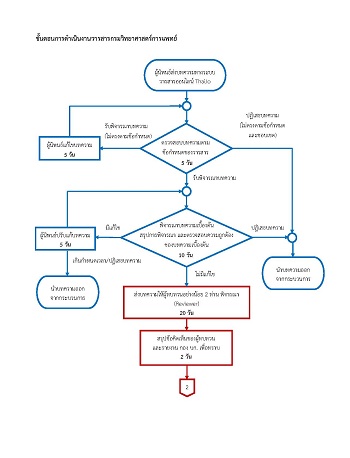
พยาธิตัวกลมในสกุล Anisakis เป็นพยาธิที่ติดต่อจากสัตว์สู่คนและโฮสต์หลักในธรรมชาติเป็นสัตว์เลี้ยงลูกด้วยนมในทะเล ปัจจุบันจำแนกด้วยการวิเคราะห์สารพันธุกรรมได้ 9 สปีชีส์ คนจัดเป็นโฮสต์โดยบังเอิญที่ได้รับตัวอ่อนพยาธิระยะที่ 3 ซึ่งเป็นระยะติดต่อที่มาจากการบริโภคปลาและหมึกแบบดิบหรือแบบปรุงไม่สุก ตัวอ่อนของพยาธิจะไม่เจริญเป็นตัวเต็มวัยในคน แต่สามารถทำให้เกิดโรคอะนิซาเคียซิส (anisakiasis) ในระบบทางเดินอาหารทั้งในกระเพาะอาหาร ทั้งในและนอกลำไส้ และอาการแบบภูมิแพ้ สปีชีส์ที่สำคัญในการก่อโรคในคน คือ Anisakis simplex sensu stricto (s.s.) และ Anisakis pegreffii ด้วยข้อจำกัดทางอนุกรมวิธานจึงเรียกโดยรวมว่า Anisakis simplex ประเทศไทยมีรายงานผู้ป่วยเพียงรายเดียวที่มีการติดเชื้อที่ลำไส้ ปี พ.ศ. 2535 การศึกษาความชุกของ Anisakis spp. ในปลาชนิดต่าง ๆ ในช่วงร้อยละ 2.90–82.50 สูงสุดพบในปลาทรายแดง (Nemipterus peronii) ร้อยละ 82.50 การจำแนกสปีชีส์ด้วยสารพันธุกรรมพบเป็น Anisakis typica ทั้งหมด ซึ่งสปีชีส์นี้ยังไม่พบรายงานการก่อโรคในมนุษย์ จากการทบทวนวรรณกรรมพบว่าการศึกษาพยาธิอะนิซาคิสในประเทศไทยมีน้อย และการศึกษาการกระจายตัวทางภูมิศาสตร์ยังไม่ครอบคลุมชายฝั่งทะเลทั้งหมดของประเทศ นอกจากนี้พบรายงานการปนเปื้อนของพยาธิอะนิซาคิสที่ตายแล้วในปลากระป๋อง บ่งชี้ถึงความรู้ความเข้าใจของบุคลากรในภาคการผลิตที่อาจมีน้อย ส่งผลให้ผู้บริโภคขาดความเชื่อมั่นในด้านความปลอดภัยทางอาหาร ดังนั้นหน่วยงานที่เกี่ยวข้องควรพัฒนางานวิจัยและสร้างความรอบรู้ด้านสุขภาพเกี่ยวกับพยาธิอะนิซาคิสให้ผู้ประกอบการและประชาชน
เอกสารอ้างอิง
กรุงเทพธุรกิจ. กรมอนามัย เตือนกิน “ปลาหมึกช็อต” ระวังแบคทีเรีย-พยาธิ แนะปรุงสุก. [ออนไลน์]. 11 กุมภาพันธ์ 2565; [สืบค้น 13 ก.พ. 2566]: เข้าถึงได้ที่: URL: https://www.bangkokbiznews.com/news/987827.
Audicana MT, Kennedy MW. Anisakis simplex: from obscure infectious worm to inducer of immune hypersensitivity. Clin Microbiol Rev 2008; 21(2): 360-79.
Aibinu IE, Smooker PM, Lopata AL. Anisakis nematodes in fish and shellfish-from infection to allergies. Int J Parasitol Parasites Wildl 2019; 9: 384-93.
Suzuki J, Murata R, Kodo Y. Current status of Anisakiasis and Anisakis larvae in Tokyo, Japan. Food Saf 2021; 9(4): 89-100.
Pravettoni V, Primavesi L, Piantanida M. Anisakis simplex: current knowledge. Eur Ann Allergy Clin Immunol 2012; 44(4): 150-6.
Hemsrichart V. Intestinal anisakiasis: first reported case in Thailand. J Med Assoc Thai 1993; 76(2): 117-21.
Van THIEL P, KUIPERS FC, ROSKAM RT. A nematode parasitic to herring, causing acute abdominal syndromes in man. Trop Geogr Med 1960; 12: 97-113.
Kasuya S, Hamano H, Izumi S. Mackerelinduced urticaria and Anisakis. Lancet 1990; 335(8690): 665.
Audicana MT, Fernández de Corres L, Muñoz D, Fernández E, Navarro JA, del Pozo MD. Recurrent anaphylaxis caused by Anisakis simplex parasitizing fish. J Allergy Clin Immunol 1995; 96(4): 558-60.
Nieuwenhuizen NE, Lopata AL. Anisakis--a food-borne parasite that triggers allergic host defences. Int J Parasitol 2013; 43(12-13): 1047-57.
Murata R, Suzuki J, Sadamasu K, Kai A. Morphological and molecular characterization of Anisakis larvae (Nematoda: Anisakidae) in Beryx splendens from Japanese waters. Parasitol Int 2011; 60(2): 193-8.
Adroher-Auroux FJ, Benítez-Rodríguez R. Anisakiasis and Anisakis: an underdiagnosed emerging disease and its main etiological agents. Res Vet Sci 2020; 132: 535-45.
Umehara A, Kawakami Y, Matsui T, Araki J, Uchida A. Molecular identification of Anisakis simplex sensu stricto and Anisakis pegreffii (Nematoda: Anisakidae) from fish and cetacean in Japanese waters. Parasitol Int 2006; 55(4): 267-71.
Tunya R, Wongsawad C, Wongsawad P, Chai JY. Morphological and molecular characteristics of Anisakis typica larvae in two species of threadfin bream, Nemipterus hexodon and N. japonicus, from the Gulf of Thailand. Korean J Parasitol 2020; 58(1): 15-25.
Nieuwenhuizen NE. Anisakis-immunology of a foodborne parasitosis. Parasite Immunol 2016; 38(9): 548-57.
Yoshikawa M, Sumikawa Y, Kobayashi Y, Uhara H. Specific immunoglobulin E to Anis 1 is rare in patients with Anisakis allergy living in Hokkaido, northern Japan. Allergol Int 2022; 71(3): 409-11.
Amir A, Ngui R, Ismail WH, Wong KT, Ong JS, Lim YA, et al. Anisakiasis causing acute dysentery in Malaysia. Am J Trop Med Hyg 2016; 95(2): 410-2.
Autier B, Stéphant S, Beusnel C, Sichel P, Belaz S, Gangneux JP, et al. Anaphylaxis due to anisakidosis. Clin Microbiol Infect 2021; 27(1): 67-8.
Purivirojkul W. An investigation of larval ascaridoid nematodes in some marine fish from the Gulf of Thailand. Agric Nat Resour 2009; 43(5): 85-92.
Eamsobhana P, Yong HS, Song SL, Tungtrongchitr A, Roongruangchai K. Genetic differentiation of Anisakis species (Nematoda: Anisakidae) in marine fish Priacanthus tayenus from Gulf of Thailand. Trop Biomed 2018; 35(3): 669-77.
วิไลพร ขันทอง. การตรวจหาพยาธิ Anisakis spp. และสารฟอร์มาลินตกค้างในปลาทูตัวสั้น Rastrelliger brachysoma ที่จำหน่ายในตลาดปลาแม่กลอง จังหวัดสมุทรสงคราม. ว สหเวชศาสตร์ มหาวิทยาลัยราชภัฏสวนสุนันทา 2561; 3(1): 36-44.
Chaiphongpachara T. Detection of Anisakis spp. and residual formaldehyde in Indian mackerel and splendid squid from a fish market in Samut Songkhram Province, Thailand. Trop Biomed 2019; 36(1): 53-9.
Tunya R, Wongsawad C. Endoparasitic infection in Threadfin Bream (Nemipterus hexodon and N. japonicus) from Department Store in Chiang Mai Province, Thailand. Microsc Microanal Res 2019; 32(1): 1-6.
วิลาสินี ถุนาพรรณ์, สุพรรณี ลีโทชวลิต, เพ็ญจันทร์ ละอองมณี, มลฤดี สนธิ. การศึกษาพยาธิ Anisakid nematodes ในปลาปากคม (Saurida undosquamis) จากบริเวณอ่าวไทย. แก่นเกษตร 2562; 47(ฉบับพิเศษ 2): 29-34.
Chaiphongpachara T, Adisakwattana P, Suwandittakul N. Intraspecific genetic variation of Anisakis typica in Indian Mackerel Caught from the Gulf of Thailand, Samut Songkhram Province. Sci World J 2022; 2022: 2122619. (10 pages).
จันทิพย์ สิงห์ตุ้ย, นภาพร แก้วดวงดี, ประภาทิพย์ เอี่ยม โสภณา. การตรวจหาและจำแนกพยาธิตัวกลมอะนิซาคิสโดยเทคนิคพีซีอาร์เรสตริกชันเอนโดนิวคลีเอส. ก้าวทันโลกวิทยาศาสตร์ 2555; 12(2): 142-50
Nuchjangreed C, Hamzah Z, Suntornthiticharoen P, Sorosjinda-Nunthawarasilp P. Anisakids in marine fish from the coast of ChonBuri Province, Thailand. Southeast Asian J Trop Med Public Health 2006; 37 (Suppl 3): 35-9.
ขันทอง เพ็ชรนอก, กนกวรรณ นุชนิยม, ก่อเกียรติ ศาสตรินทร์. การตรวจพยาธิในปลาทะเลและผลิตภัณฑ์จากปลาทะเล ในช่วงปี พ.ศ. 2561-2563. ว กรมวิทย พ 2564; 63(4): 809-21.
Mattiucci S, Nascetti G. Molecular systematics, phylogeny and ecology of anisakid nematodes of the genus Anisakis Dujardin, 1845: an update. Parasite 2006; 13(2): 99-113.
Van Hien H, Thi Dung B, Ngo HD, Doanh PN. First morphological and molecular identification of third-stage larvae of Anisakis typica (Nematoda: Anisakidae) from marine fishes in Vietnamese water. J Nematol 2021; 53: e2021-10.
Anshary H, Sriwulan, Freeman MA, Ogawa K. Occurrence and molecular identification of Anisakis Dujardin, 1845 from marine fish in southern Makassar Strait, Indonesia. Korean J Parasitol 2014; 52(1): 9-19.
Bao M, Cipriani P, Giulietti L, Alam MA, Palomba M, Mattiucci S, et al. Ascaridoid nematodes infecting commercially important marine fish and squid species from Bangladesh waters in the Bay of Bengal. Food Waterborne Parasitol 2022; 27: e00157. (13 page).
ดาวน์โหลด
เผยแพร่แล้ว
รูปแบบการอ้างอิง
ฉบับ
ประเภทบทความ
สัญญาอนุญาต
ลิขสิทธิ์ (c) 2024 วารสารกรมวิทยาศาสตร์การแพทย์

อนุญาตภายใต้เงื่อนไข Creative Commons Attribution-NonCommercial-NoDerivatives 4.0 International License.