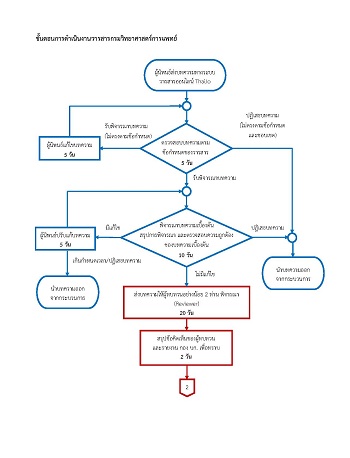
วิธีทางเลือกในการประมาณค่าความไม่แน่นอนของการวิเคราะห์สารเคมีป้องกันกำจัดศัตรูพืชตกค้างในผักและผลไม้
การประมาณค่าความไม่แน่นอนของการวิเคราะห์สารตกค้างในผักและผลไม้
คำสำคัญ:
สารเคมีป้องกันกำจัดศัตรูพืช, ผักและผลไม้, ความไม่นอนของการวัด, แนวทางบนลงล่าง, แนวทางล่างขึ้นบนบทคัดย่อ
ข้อกำหนดตามมาตรฐาน ISO/IEC 17025:2017 ห้องปฏิบัติการต้องมีความสามารถในการประมาณค่าความไม่แน่นอนของการวัดสำหรับการรายงานผลการวิเคราะห์ การรายงานค่าความไม่แน่นอนเป็นสิ่งจำเป็นสำหรับการวิเคราะห์สารเคมีป้องกันกำจัดศัตรูพืชเพื่อใช้ประเมินความสอดคล้องกับมาตรฐาน การศึกษานี้ทำการเปรียบเทียบการประมาณค่าความไม่แน่นอนสามวิธี ได้แก่ วิธี Bottom-up ตามแนวทางของ ISO GUM ซึ่งเป็นวิธีที่ใช้โดยทั่วไป และวิธีทางเลือกสองวิธีตามแนวทาง Top-down คือ วิธีที่ใช้ข้อมูลการควบคุมคุณภาพภายใน และข้อมูลจากผลการเข้าร่วมทดสอบความชำนาญ (PT) โดยมีวัตถุประสงค์เพื่อคัดเลือกวิธีที่เหมาะสมที่สุดสำหรับการรายงานประกอบผลการวิเคราะห์ วิธีแรกคำนวณผลตามแนวทางของ ISO GUM สำหรับวิธีใหม่ตามแนวทาง Top-down โดยใช้ข้อมูล QC ผลความแม่นและความเที่ยงจาก Spiked sample จำนวน 28 ตัวอย่าง จากการเก็บข้อมูลในงานประจำเป็นเวลา 2 ปี และวิธีที่ใช้ข้อมูลผลการประเมินการทดสอบความชำนาญ จำนวน 33 ข้อมูล ได้จากการเข้าร่วม PT 3 รอบ ผลพบค่าความไม่แน่นอนสัมพัทธ์ขยายที่ได้จากการคำนวณ 3 วิธี ได้แก่ วิธี ISO GUM วิธีที่ใช้ข้อมูล QC และวิธีที่ใช้ข้อมูล PT มีค่าเป็นร้อยละ 8.0, 31.7 และ 32.4 ตามลำดับ เมื่อเปรียบเทียบกับค่ามาตรฐานตามที่หน่วยงานระหว่างประเทศกำหนดที่ร้อยละ 50 พบว่าการคำนวณทั้งสามวิธีให้ค่าน้อยกว่าและสอดคล้องกับค่ากำหนด อย่างไรก็ตามวิธี ISO GUM ให้ค่าที่น้อยที่สุด และแตกต่างจากวิธีตามแนวทาง Top-down ทั้งสองวิธี ซึ่งมีค่าที่ใกล้เคียงกันมาก ดังนั้นวิธีที่เหมาะสมสำหรับการรายงานค่าความไม่แน่นอนของการวิเคราะห์สารเคมีป้องกันกำจัดศัตรูพืช คือ วิธีตามแนวทาง Top-down ที่เป็นวิธีทางเลือกใหม่ทั้งสองวิธี
เอกสารอ้างอิง
Codex Alimentarius Commission Guideline CAC/GL 59-2006, Guidelines on estimation of uncertainty of results. [online]. 2006; [cited 2025 Jan 2]; [16 screens]. Available from: URL: https://www.fao.org/faowhocodexalimentarius/shproxy/en/lnk=1&url=https%253A%252F%252Fworkspace.fao.org%252Fsites%252Fcodex%252FStandards%252FCXG%2B592006%252Fcxg_059e.pdf.
ISO/IEC 17025:2017. General requirements for the competence of testing and calibration laboratories. Geneva, Switzerland: International Organization for Standardization; 2017.
Alder L, Korth W, Patey AL, van der Schee HA, Schoeneweiss S. Estimation of measurement uncertainty in pesticide residue analysis. J AOAC Int 2001; 84(5): 1569-78.
Ellison SLR, Williams A, editors. Eurachem/CITAC guide CG 4: Quantifying uncertainty in analytical measurement. 3rd ed. United Kingdom: Eurachem; 2012.
Handbook for calculation of measurement uncertainty in environmental laboratories, Nordtest NT TR 537 edition 4. [online]. 2017; [cited 2025 Jan 2]; [56 screens]. Available from: URL: https://nordtest.info/images/documents/nttechnicalreports/NT_TR_537_edition4_English_Handbook_for_calculation_of_measurement_uncertainty_in_environmental_laboratories.pdf.
EUROLAB Technical Report 1/2007. Measurement uncertainty revised: alternative approaches to uncertainty evaluation. Paris, France: European Federation of National Associations of Measurement, Testing and Analytical Laboratories; 2007.
Kilic M. Validation and measurement uncertainty of the determination of 24 elements in drinking water using ICP-MS. Water Pract Technol 2023; 18(12): 3299-314.
Valverde A, Aguilera A, Valverde-Monterreal A. Practical and valid guidelines for realistic estimation of measurement uncertainty in multi-residue analysis of pesticides. Food Control 2017; 71: 1-9.
Veiga-del-Bano JM, Cuenca-Martinez JJ, Andreo-Martinez P, Camara MA, Oliva J, Motas M. Uncertainty and associated risks in the analysis of pesticides in homogeneous paprika samples. Food Chem 2023; 429: 136963. (7 pages).
Ambrus A, Zentai A, Sali J, Ficzere I. Hidden contributors to uncertainty and accuracy of results of residue analysis. Accredit Qual Assur 2011; 16(1): 3-11.
SANTE 11312/2021 V2. Analytical quality control and method validation procedures for pesticide residues analysis in food and feed. [online]. 2024; [cited 2024 Nov 4]; [55 screens]. Available from: URL: https://food.ec.europa.eu/system/files/202311/pesticides_mrl_guidelines_wrkdoc_2021-11312.pdf.
Kim SH, Cho H, Heo SW, Hwang E. APMPAPLAC joint proficiency testing programs for elemental analysis in food with metrological reference values: assessment of participants’ performance considering measurement uncertainties. Talanta 2023; 255: 124184. (13 pages).
Hakme E, Herrmann SS, Poulsen ME. European Union Proficiency Tests for pesticide residues in cereals and feedstuff, from 2007 to 2022- Data collection experience. Food Control 2023; 152: 109867. (11 pages).
BS EN 15662:2018. Foods of plant origin - determination of pesticide residues using GC-MS and/or LC-MS/MS following acetonitrile extraction/ partitioning and cleanup by dispersive SPE QuEChERS-method. [online]. 2018; [cited 2024 Nov 4]; [84 screens]. Available from: URL: https://www.doc88.com/p-9039138664942.html?r=1.
Kanrar B, Mandal S, Bhattacharyya A. Validation and uncertainty analysis of a multiresidue method for 67 pesticides inm tea, tea infusion, and spent leaves using ethyl acetate extraction and gas chromatography/mass spectrometry. J AOAC Int 2010; 93(2): 411-24.
Banerjee K, Oulkar DP, Patil SB, Patil SH, Dasgupta S, Savant R, et al. Single-laboratory validation and uncertainty analysis of 82 pesticides determined in pomegranate, apple, and orange by ethyl acetate extraction and liquid chromatography/tandem mass spectrometry. J AOAC Int 2008; 91(6): 1435-45.
Kilincer M, Ozyurek M. Comparison between top-down and bottom-up approaches in the estimation of measurement uncertainty in Bisphenol A analysis by HPLC-FLD. J Chem Metrol 2023; 17(2): 225-37.
Barwick VJ, Ellison SLR. VAM Project 3.2.1 Development and harmonisation of measurement uncertainty principles Part (d): Protocol for uncertainty evaluation from validation data. Report no. LGC/VAM/1998/088. Middlesex, UK: LGC (Teddington) Limited; 2000.
Thompson M. Recent trends in inter-laboratory precision at ppb and sub-ppb concentrations in relation to fitness for purpose criteria in proficiency testing. Analyst 2000; 125: 385-6.
ISO 13528:2022. Statistical methods for use in proficiency testing by interlaboratory comparison. Geneva, Switzerland: International Organization for Standardization; 2022.
Dybkaer R. From total allowable error via metrological traceability to uncertainty of measurement of the unbiased result. Accred Qual Assur 1999; 4(9): 401-5.
ISO 5725-2. Accuracy (trueness and precision) of measurement methods and results - Part 2: Basic Method for the determination of repeatability and reproducibility of a standard measurement method. Geneva, Switzerland: International Organization for Standardization; 1994.
ดาวน์โหลด
เผยแพร่แล้ว
รูปแบบการอ้างอิง
ฉบับ
ประเภทบทความ
สัญญาอนุญาต
ลิขสิทธิ์ (c) 2025 วารสารกรมวิทยาศาสตร์การแพทย์

อนุญาตภายใต้เงื่อนไข Creative Commons Attribution-NonCommercial-NoDerivatives 4.0 International License.