การวิเคราะห์ฤทธิ์ต้านอนุมูลอิสระของน้ำมันรําข้าวจากข้าวเจ๊กเชยเสาไห้ (Oryza sativa L.) จาก 4 แหล่งของจังหวัดสระบุรี ด้วยวิธี DPPH Radical Scavenging
คำสำคัญ:
น้ำมันรําข้าว, ฤทธิ์ต้านอนุมูลอิสระ, DPPH, ข้าวเจ๊กเชยเสาไห้, ปริมาณฟลาโวนอยด์บทคัดย่อ
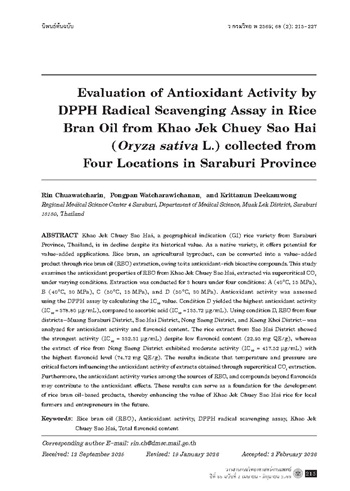
ข้าวเจ๊กเชยเสาไห้เป็นพันธุ์ข้าวพื้นเมืองที่ได้รับการขึ้นทะเบียนสิ่งบ่งชี้ทางภูมิศาสตร์ (GI) จากจังหวัดสระบุรี แม้มีคุณค่าทางประวัติศาสตร์แต่แนวโน้มการเพาะปลูกลดลง อย่างไรก็ตามยังคงมีศักยภาพเชิงเศรษฐกิจโดยเฉพาะการเพิ่มมูลค่าจากรําข้าว ซึ่งสามารถสกัดน้ํามันรําข้าว (Rice Bran Oil: RBO) ที่อุดมด้วยสารออกฤทธิ์ทางชีวภาพและคุณสมบัติต้านอนุมูลอิสระ งานวิจัยนี้มุ่งศึกษาฤทธิ์ต้านอนุมูลอิสระของน้ํามันรําข้าวเจ๊กเชยเสาไห้ โดยใช้การสกัดด้วยคาร์บอนไดออกไซด์ในสภาวะวิกฤติยิ่งยวด (supercritical CO2) เป็นเวลา 3 ชั่วโมง ภายใต้ 4 เงื่อนไข ได้แก่ A (40°C, 15 MPa), B (40°C, 30 MPa), C (50°C, 15 MPa) และ D (50°C, 30 MPa) จากนั้นทดสอบฤทธิ์ต้านอนุมูลอิสระด้วยวิธี DPPH assay และคํานวณค่า IC50 พบว่าสภาวะ D ให้ผลดีที่สุด (IC50= 378.80 µg/mL) เมื่อเปรียบเทียบกับกรดแอสคอร์บิก (IC50= 135.72 µg/mL) เมื่อใช้น้ำมันรําข้าวที่สกัดภายใต้สภาวะ D จาก 4 อําเภอ ได้แก่ เมืองสระบุรี เสาไห้ หนองแซง และแก่งคอย พบว่าน้ำมันรําข้าวจากอําเภอเสาไห้มีฤทธิ์ต้านอนุมูลอิสระสูงสุด (IC50 = 332.31 µg/mL) แม้มีปริมาณฟลาโวนอยด์ต่ำ (22.95 mg QE/g) ในขณะที่น้ำมันรําข้าวจากอําเภอหนองแซงมีฤทธิ์ต้านอนุมูลอิสระปานกลาง (IC50 = 417.52 µg/mL) แต่มีฟลาโวนอยด์สูงสุด (74.72 mg QE/g) ผลการวิจัยชี้ว่าสภาวะการสกัดน้ำมันรําข้าวและแหล่งของรําข้าวมีอิทธิพลสําคัญต่อฤทธิ์ต้านอนุมูลอิสระ อีกทั้งอาจมีสารอื่นนอกเหนือจากฟลาโวนอยด์ที่มีผลต่อฤทธิ์ต้านอนุมูลอิสระ ข้อมูลนี้สามารถใช้เป็นพื้นฐานพัฒนาผลิตภัณฑ์จากน้ำมันรําข้าวเจ๊กเชยเสาไห้ เพื่อเพิ่มมูลค่าและสร้างประโยชน์ต่อเกษตรกรและผู้ประกอบการท้องถิ่นต่อไป
เอกสารอ้างอิง
Tan BL, Norhaizan ME, Chan LC. Rice bran: from waste to nutritious food ingredients. Nutrients 2023; 15(11): 2503. (25 pages).
Tian X, Wang X, Fang M, Yu L, Ma F, Wang X, et al. Nutrients in rice bran oil and their nutritional functions: a review. Crit Rev Food Sci Nutr 2025; 65(14): 2840−57.
Punia S, Kumar M, Siroha AK, Purewal SS. Rice bran oil: emerging trends in extraction, health benefit, and its industrial application. Rice Sci 2021; 28(3): 217−32.
Pal YP, Pratap AP. Rice bran oil: a versatile source for edible and industrial applications. J Oleo Sci 2017; 66(6): 551−6.
Sulaiman A, Sert M, Khan MA. Functional and therapeutic potential of γ-oryzanol. In: Functional foods: phytochemicals and health promoting potential. [online]. 2021; [cited 2025 Aug 21]. Available from: URL: https://www.researchgate.net/publication/353205688_Functional_and_Therapeutic_Potential_of_g_-Oryzanol.
Fraterrigo GS, Cavallini N, Destefano R, Micera M, Cavagnero C, Botto A, et al. Optimization of supercritical carbon dioxide extraction of rice bran oil and γ-oryzanol using multi-factorial design of experiment. Waste Biomass Valor 2023; 14(10): 1−11.
Pimpa B, Thongraung C, Sutthirak P. Effect of solvents and extraction conditions on the properties of crude rice bran oil. Walailak J Sci Tech 2021; 18(17): 9611. (7 pages).
Pranowo D, Savira TD, Sukardi. Rice bran stabilization using autoclave and optimization of crude rice bran oil recovery using ultrasoundassisted extraction. BioResources 2023; 18(4): 8341−61.
Thien Ly LT, Okajima I, Yi KC, Sako T. Oil extraction from rice bran using expanded liquid hexane with CO2. In: Proceeding of the 18th Asian Pacific Confederation of Chemical Engineering Congress (APCChE 2019); 2019 Sep 23–27; Sapporo. Hokkaido, Japan; 2019. p. 08001.
Mathias MG, Okajima I, Ito K, Aoki Y, Kong CY, Sako T. Influence of extraction and pretreatment conditions on the yield, solubility, and quality of rice bran oil extracted with CO2-expanded hexane. BioEnergy Res 2023; 16(3): 1695−705.
Gülçin I. Antioxidants and antioxidant methods: an updated overview. Arch Toxicol 2020; 94(3): 651–715.
Mohamed AF, Martina W, Gudrun S, Ulrike L. Antioxidant, antimicrobial and cytotoxic activities of selected medicinal plants from Yemen. J Ethnopharmacol 2007; 111(3): 657−66.
Kanathip S, Apitsada S, Kanokpich W, Asamaporn M. The comparison of phenolic compounds, flavonoids and antioxidant activities of the ethanolic extracts of shoots, leaves, fruits and seeds of Leucaena leucocephala. Naresuan Phayao J 2020; 13(3): 66−73.
Mohd D, Abang Z, Lai KS, Idayu MI, Mohd JY. Antioxidant properties of rice bran oil from different varieties extracted by solvent extraction methods. J Teknol 2016; 78(6): 6−12.
Siriporn O, Adchareeya K, Taepin J, Songwut Y. Effect of rice variety and modification on antioxidant and anti-inflammatory activities. Drug Discov Ther 2018; 12(4): 206−13.
Ácsová A, Martiniaková S, Hojerová J. Selected in vitro methods to determine antioxidant activity of hydrophilic/lipophilic substances. Acta Chim Slovaca 2019; 12(2): 200−11.
Baixinho JP, Cardeira M, Bento-Silva A, Partidário AMC, Serra AT, Bronze MDR, et al. Optimization of supercritical fluid extraction for the recovery of γ-oryzanol-rich extracts with improved bioactivity from rice bran. Antioxidants 2025; 14(2): 206. (15 pages).
ดาวน์โหลด
เผยแพร่แล้ว
รูปแบบการอ้างอิง
ฉบับ
ประเภทบทความ
สัญญาอนุญาต
ลิขสิทธิ์ (c) 2026 วารสารกรมวิทยาศาสตร์การแพทย์

อนุญาตภายใต้เงื่อนไข Creative Commons Attribution-NonCommercial-NoDerivatives 4.0 International License.