The Effects of Real-Time Medication Tracking by Pharmacists on Medication Adherence, Blood Sugar Control, and Complications in Diabetic Patients with Multimorbidity at Tha Uthen Hospital Nakhon Phanom Province
Keywords:
Real-time medication tracking; Medication adherence; Type 2 diabetes; Comorbidities; PharmacistAbstract
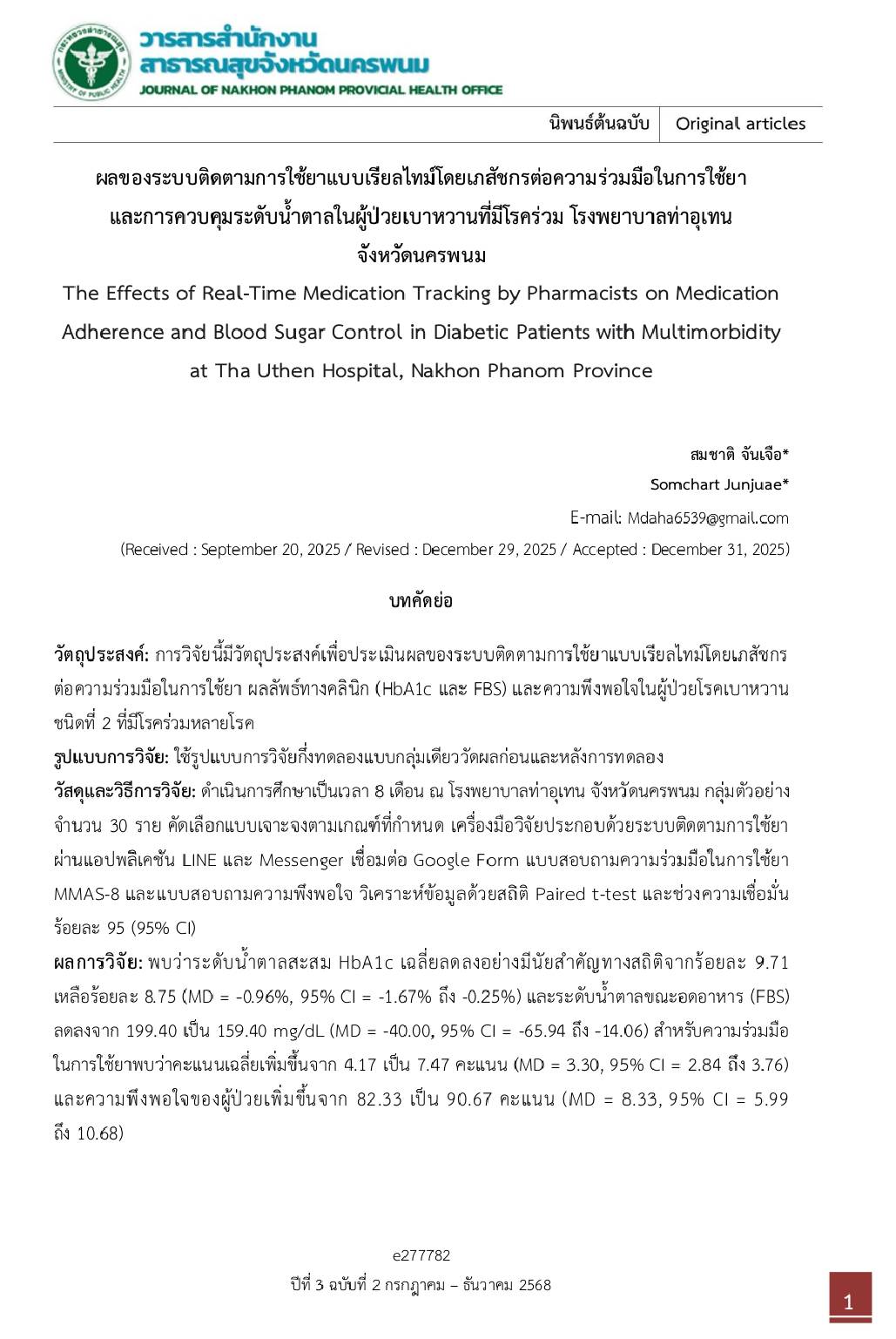
This study aimed to evaluate the effects of pharmacist-led real-time medication tracking on medication adherence, clinical outcomes (HbA1c, FBS, and acute complications), and patient satisfaction among individuals with type 2 diabetes and multiple comorbidities. A quasi-experimental one-group pretest–posttest design was conducted over eight months at Tha Uthen Hospital, Nakhon Phanom Province, involving 30 purposively selected participants. Research tools included a LINE-based medication tracking system integrated with Google Forms, the Morisky Medication Adherence Scale-8 (MMAS-8), and a patient satisfaction questionnaire. Data were analyzed using paired t-tests and effect size calculations. Results showed significant improvements in medication adherence (mean score increased from 4.17 to 7.47, p < 0.001, Cohen’s d = 2.67), reductions in HbA1c (from 9.71% to 8.75%, p = 0.0099, d = 0.50) and FBS (from 199.4 to 159.4 mg/dL, p = 0.0037, d = 0.58), while acute complications decreased from 0.43 to 0.13 episodes, showing a positive but nonsignificant trend (p = 0.059, d = 0.36). Patient satisfaction also significantly increased from 82.33 to 90.67 (p < 0.001, d = 1.33). In conclusion, pharmacist-led real-time medication tracking demonstrated high effectiveness in enhancing adherence, improving glycemic control, and increasing patient satisfaction, making it a promising strategy for primary care services, particularly in rural areas with limited healthcare resources. Further studies with controlled designs, larger sample sizes, and long-term follow-up are recommended to confirm sustainability of clinical and behavioral outcomes.
References
UK Prospective Diabetes Study (UKPDS) Group. Intensive blood-glucose control with sulphonylureas or insulin compared with conventional treatment and risk of complications in patients with type 2 diabetes. Lancet. 1998;352(9131):837-53.
Polonsky WH, Henry RR. Poor medication adherence in type 2 diabetes: recognizing the scope of the problem and its key contributors. Patient Prefer Adherence. 2016;10:1299-307.
สุภาพร สุปินธรรม. ผลของการใช้ telepharmacy ต่อความร่วมมือในการใช้ยาของผู้ป่วยโรคเรื้อรัง. วารสารวิชาการสาธารณสุข. 2566;32(2):115-27.
ศิริพร พรหมรัตน์, พนิตา ค้าผล, ณัฏฐิญา ค้าผล. ผลของโปรแกรมสร้างความร่วมมือในการใช้ยาโดยใช้เภสัชกรรมทางไกลในผู้ป่วยความดันโลหิตสูง. ไทยไภษัชยนิพนธ์ [อินเทอร์เน็ต]. 2564 [สืบค้นเมื่อ 20 ก.ย. 2567];17(1):31-41. สืบค้นจาก: https://li01.tci-haijo.org/index.php/TBPS/article/view/251040
Pérez-Jover V, Sala-González M, Guilabert M, Mira JJ. Mobile apps for increasing treatment adherence: systematic review. J Med Internet Res [Internet]. 2018 [cited 2024 Oct 8];20(6):e120. Available from: https://www.jmir.org/2018/6/e120
Vrijens B, De Geest S, Hughes DA, Przemyslaw K, Demonceau J, Ruppar T, et al. A new taxonomy for describing and defining adherence to medications. Br J Clin Pharmacol. 2012;73(5):691-705.
Istepanian R, Zitouni K, Harry D, Moutosammy N, Sungoor A, Tang B, et al. Mobile phone–based telemonitoring for diabetes care: a systematic review and meta-analysis. Diabetes Obes Metab. 2012;14(5):414-23.
Chan A, Smith B, Choudhry NK. Digital tools to improve medication adherence: systematic review of randomized controlled trials. Lancet Digit Health [Internet]. 2023 [cited 2024 Sep 22];5(2):e85-94. Available from: https://www.thelancet.com/journals/landig/article/PIIS2589-7500(22)00223-5/fulltext
Thakkar J, Kurup R, Laba TL, Santo K, Thiagalingam A, Rodgers A, et al. Mobile telephone text messaging for medication adherence in chronic disease: a meta-analysis. JAMA Intern Med. 2016;176(3):340-9.
Alqarni AM, Alrahbeni T, Almalki Z. Impact of mobile health interventions on medication adherence and patient outcomes in type 2 diabetes: a systematic review. J Diabetes Res. 2021;2021:9941369.
Khunti K, Davies MJ, Kosiborod MN, Nauck MA. Clinical inertia in type 2 diabetes: a focused literature review of its prevalence, causes, and consequences. Diabetes Obes Metab. 2022;24(1):18-25.
Davis FD. Perceived usefulness, perceived ease of use, and user acceptance of information technology. MIS Q. 1989;13(3):319-40.
Downloads
Published
How to Cite
Issue
Section
License
Copyright (c) 2025 Nakhon Phanom Provincial Health Office

This work is licensed under a Creative Commons Attribution-NonCommercial-NoDerivatives 4.0 International License.
บทความที่ได้รับการตีพิมพ์เป็นลิขสิทธิ์ของ สำนักงานสาธารณสุขจังหวัดนครพนม
ข้อความที่ปรากฏในบทความแต่ละเรื่องในวารสารวิชาการเล่มนี้เป็นความคิดเห็นส่วนตัวของผู้เขียนแต่ละท่านไม่เกี่ยวข้องกับสำนักงานสาธารณสุขจังหวัดนครพนม และบุคลากรท่านอื่นๆในสำนักงานฯ แต่อย่างใด ความรับผิดชอบองค์ประกอบทั้งหมดของบทความแต่ละเรื่องเป็นของผู้เขียนแต่ละท่าน หากมีความผิดพลาดใดๆ ผู้เขียนแต่ละท่านจะรับผิดชอบบทความของตนเอง