Factors Influencing Waste Segregation Behavior Among Personnel at Nakhon Phanom Rajanagarindra Psychiatric Hospital
Keywords:
waste segregation behavior; waste management; hospital personnel; PRECEDE-PROCEED Model; self-efficacyAbstract
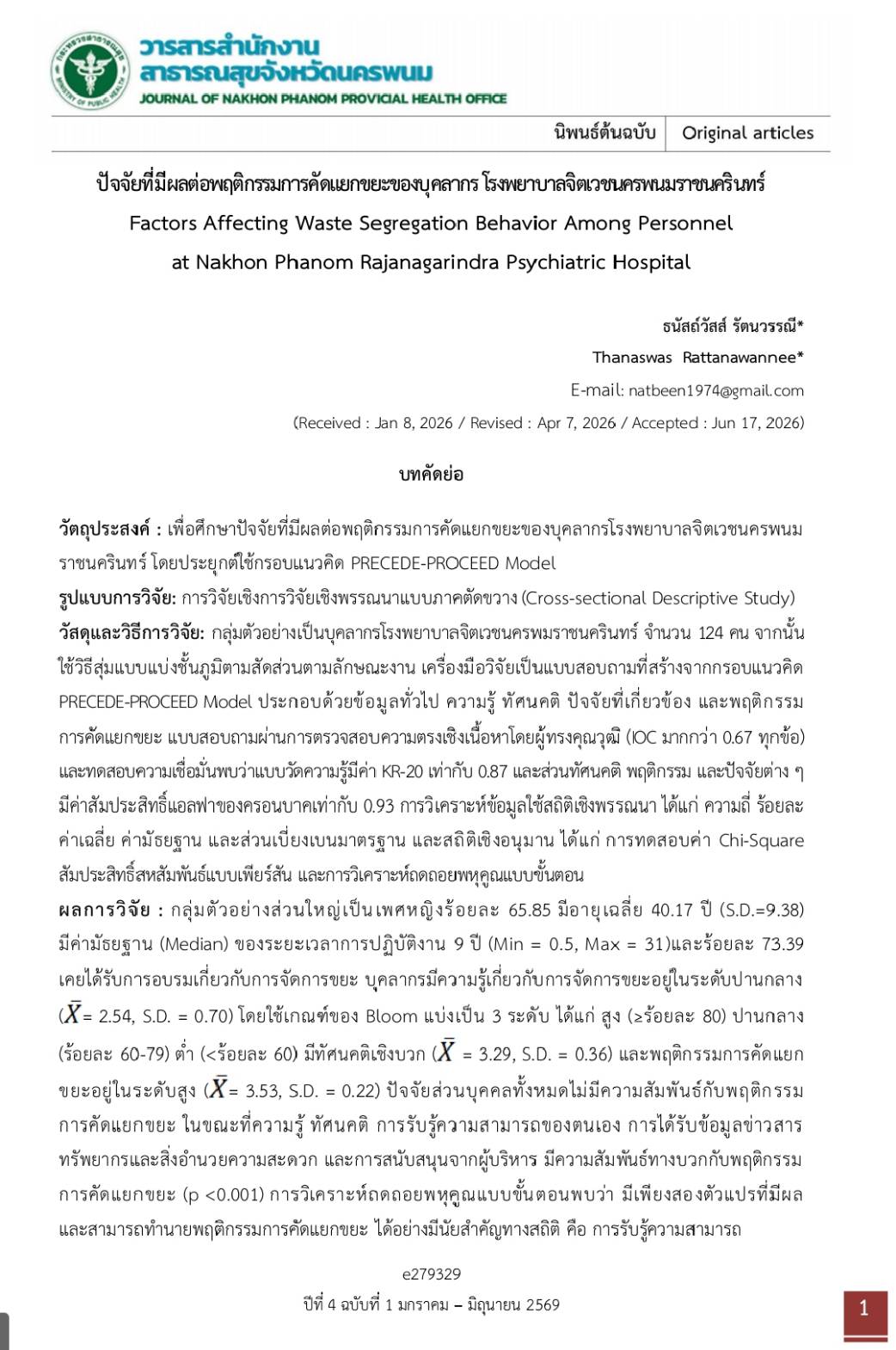
Purpose :
To examine factors influencing waste segregation behavior among hospital personnel at Nakhon Phanom Rajanagarindra Psychiatric Hospital using the PRECEDE-PROCEED Model framework, which encompasses predisposing, enabling, and reinforcing factors.
Study design:
Cross-sectional quantitative research design.
Materials and Methods:
A sample of 124 hospital personnel was selected through proportional stratified random sampling. The research instrument was a questionnaire validated by three experts for content validity, demonstrating high reliability with Cronbach's alpha of 0.93. Data were analyzed using descriptive and inferential statistics, including percentages, means, standard deviations, t-tests, one-way ANOVA, Pearson's correlation, and stepwise multiple regression analysis.
Main findings:
The majority of participants were female (65.85%), with a mean age of 40.17 years (SD = 9.38), average work experience of 10.19 years (SD = 8.24), and 73.39% had received waste management training. Personnel demonstrated moderate knowledge of waste management (M = 2.54, SD = 0.70), favorable attitudes toward waste management (M = 3.29, SD = 0.36), and good waste segregation behavior (M = 3.53, SD = 0.22). Hypothesis testing indicated that all demographic factors showed no significant relationship with waste segregation behavior (p > 0.05). Conversely, knowledge, attitudes, self-efficacy, access to information, resources and facilities, organizational support, and peer support demonstrated significant positive correlations with waste segregation behavior (p < 0.01). Stepwise multiple regression analysis revealed that only two factors significantly predicted waste segregation behavior: self-efficacy (β = 0.448, p < 0.001) and organizational support (β = 0.226, p < 0.01), explaining 38.8% of the variance.
Conclusion and recommendations:
Enhancing personnel's confidence in their waste management capabilities, coupled with establishing effective organizational support systems, can significantly improve waste segregation behavior. Administrators should prioritize personnel capacity development through hands-on training programs, ensure adequate resources and equipment, and foster a work environment that supports pro-environmental behavior.
References
World Health Organization. Health-care waste Geneva: WHO; 2018
กรมควบคุมมลพิษ. รายงานสถานการณ์มลพิษของประเทศไทย ปี พ.ศ. 2563. กรุงเทพฯ: กรมควบคุมมลพิษ; 2563
โรงพยาบาลจิตเวชนครพนมราชนครินทร์. รายงานการจัดการขยะมูลฝอยและของเสียอันตรายประจำปี 2566. โรงพยาบาลจิตเวชนครพนมราชนครินทร์: นครพนม; 2566.
กระทรวงสาธารณสุข. คู่มือการดำเนินงาน Green & Clean Hospital. นนทบุรี: กระทรวงสาธารณสุข; 2557.
United Nations. Transforming our world: the 2030 Agenda for Sustainable Development. New York: UN; 2015.
Green LW KM. Health program planning: an educational and ecological approach. 4th ed. New York: McGraw-Hill; 2005.
สุวิมล ว่องวาณิช. การประยุกต์ใช้แบบจำลอง PRECEDE-PROCEED ในการส่งเสริมพฤติกรรมสุขภาพ. วารสารสาธารณสุขศาสตร์. 2563;50(1):45-58
Cochran WG. Sampling techniques. ed. r, editor. New York: John Wiley & Sons; 1977.
Krejcie RV MD. Determining sample size for research activities. Educ Psychol Meas. 1970;30(3).
Lynn MR. Determination and quantification of content validity. Nurs Res. 1986;35(6):382-5.
Kuder GF, Richardson MW. The theory of the estimation of test reliability. Psychometrika. 1937;2(3):151-60.
Cronbach LJ. Coefficient alpha and the internal structure of tests. Psychometrika. 1951;16(3):297-334.
Field A. Discovering statistics using IBM SPSS statistics. ed t, editor. London: SAGE; 2013.
สุภาพร แก้วมณี. ปัจจัยที่มีผลต่อพฤติกรรมการจัดการสิ่งแวดล้อมในโรงพยาบาล จังหวัดอุบลราชธานี. วารสารวิจัยสาธารณสุขศาสตร์ มหาวิทยาลัยขอนแก่น. 2560;10(3):112-25.
อรุณี ศรีสวัสดิ์. ความสัมพันธ์ระหว่างปัจจัยส่วนบุคคลและพฤติกรรมการจัดการขยะของพยาบาล. วารสารการพยาบาลและสุขภาพ. 2562;13(1):88-97.
Bandura A. Self-efficacy: the exercise of control. New York: Freeman; 1997.
วรรณา พูลสวัสดิ์. การรับรู้ความสามารถของตนเองกับพฤติกรรมการอนุรักษ์สิ่งแวดล้อมของบุคลากรสาธารณสุข. วารสารวิชาการสาธารณสุข. 2565;31(4):678-89.
สมชาย วงศ์ใหญ่. อิทธิพลของการสนับสนุนขององค์กรต่อพฤติกรรมสิ่งแวดล้อมของพนักงาน: กรณีศึกษาโรงพยาบาลรัฐในภาคตะวันออกเฉียงเหนือ. วารสารการจัดการสิ่งแวดล้อม. 2557;10(2):45-62.
Downloads
Published
How to Cite
Issue
Section
License
Copyright (c) 2026 Nakhon Phanom Provincial Health Office

This work is licensed under a Creative Commons Attribution-NonCommercial-NoDerivatives 4.0 International License.
บทความที่ได้รับการตีพิมพ์เป็นลิขสิทธิ์ของ สำนักงานสาธารณสุขจังหวัดนครพนม
ข้อความที่ปรากฏในบทความแต่ละเรื่องในวารสารวิชาการเล่มนี้เป็นความคิดเห็นส่วนตัวของผู้เขียนแต่ละท่านไม่เกี่ยวข้องกับสำนักงานสาธารณสุขจังหวัดนครพนม และบุคลากรท่านอื่นๆในสำนักงานฯ แต่อย่างใด ความรับผิดชอบองค์ประกอบทั้งหมดของบทความแต่ละเรื่องเป็นของผู้เขียนแต่ละท่าน หากมีความผิดพลาดใดๆ ผู้เขียนแต่ละท่านจะรับผิดชอบบทความของตนเอง