
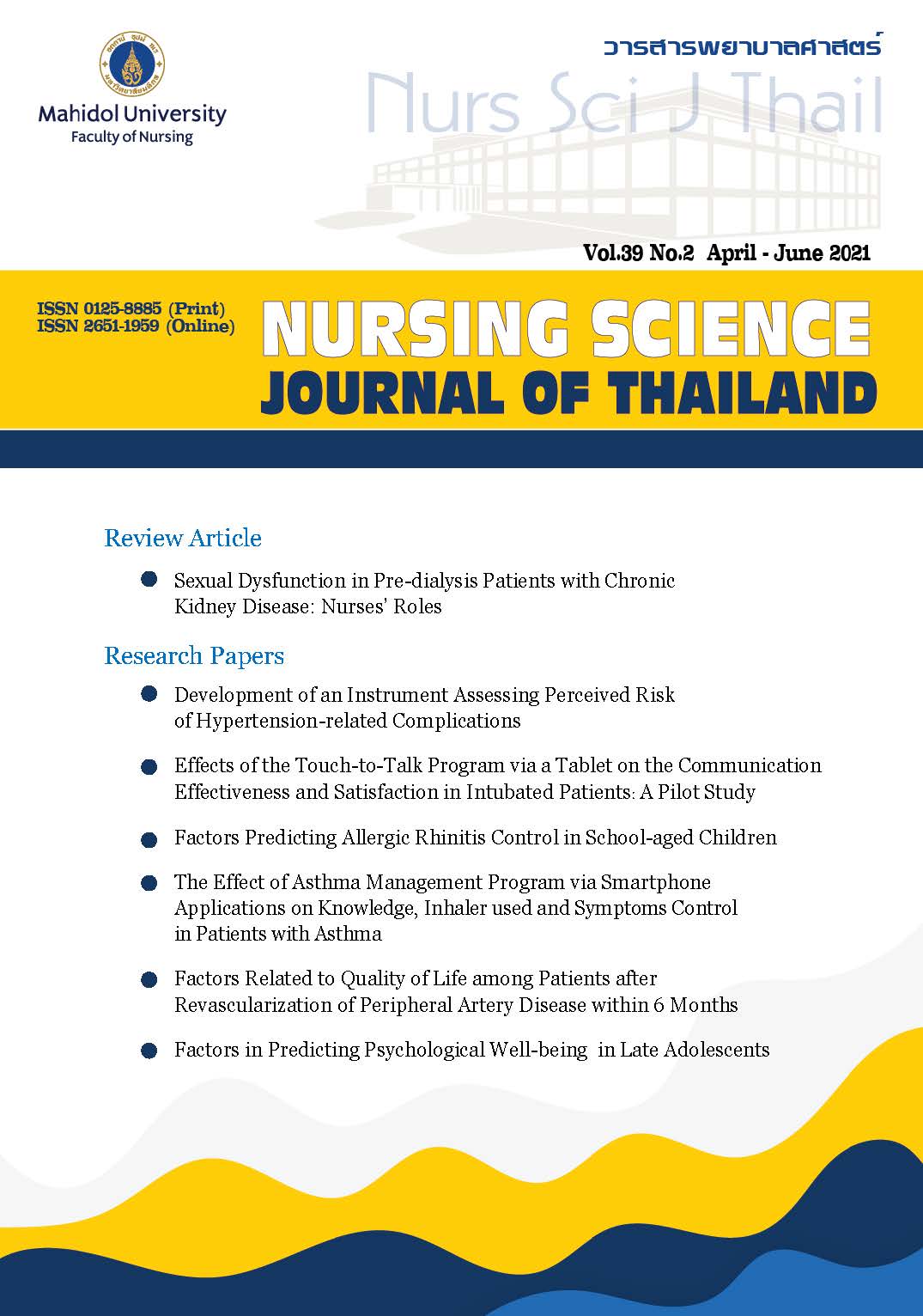
ผลของการใช้โปรแกรม Touch-to-Talk ผ่านแท็บเล็ตต่อประสิทธิภาพในการสื่อสารและความพึงพอใจในผู้ป่วยที่ใส่ท่อช่วยหายใจ การศึกษานำร่อง
Article Sidebar
Main Article Content
บทคัดย่อ
วัตถุประสงค์: เพื่อศึกษาผลของการใช้โปรแกรม “Touch-to-Talk” ผ่านแท็บเล็ตต่อประสิทธิภาพในการสื่อสารและความพึงพอใจในผู้ป่วยที่ใส่ท่อช่วยหายใจ
รูปแบบการวิจัย: แบบกึ่งทดลองชนิดกลุ่มเดียวทดสอบก่อนและหลังการทดลอง
วิธีดำเนินการวิจัย: กลุ่มตัวอย่างเป็นผู้ป่วยใส่ท่อช่วยหายใจที่เข้ารักษาในหอผู้ป่วยกึ่งวิกฤตอายุรกรรม 3 หอผู้ป่วย ของโรงพยาบาลระดับตติยภูมิแห่งหนึ่ง จำนวน 10 คน คัดเลือกกลุ่มตัวอย่างด้วยวิธีการสุ่มอย่างง่าย และให้กลุ่มตัวอย่างใช้วิธีสื่อสารกับพยาบาลด้วยโปรแกรม “Touch-to-Talk” ผ่านแท็บเล็ต เป็นระยะเวลา 24 ชั่วโมง เครื่องมือที่ใช้ในการวิจัย ได้แก่ 1) แบบสอบถามข้อมูลทั่วไป 2) แบบประเมินปัจจัยที่เกี่ยวข้องกับการสื่อสารในผู้ป่วยที่ใส่ท่อช่วยหายใจ 3) แบบประเมินประสิทธิภาพในการสื่อสาร และ 4) แบบประเมินความพึงพอใจ วิเคราะห์ข้อมูลโดยใช้สถิติเชิงพรรณนาและสถิติการทดสอบ Wilcoxon signed rank test
ผลการวิจัย: พบว่าหลังจากได้รับโปรแกรมกลุ่มตัวอย่างมีค่าคะแนนเฉลี่ยของประสิทธิภาพในการสื่อสารสูงกว่าก่อนได้รับโปรแกรม โดยเพิ่มขึ้นจาก 5.59 (SD = 1.74) เป็น 9.20 (SD = 0.53) และค่าคะแนนเฉลี่ยมีความแตกต่างกันอย่างมีนัยสำคัญทางสถิติ (t = .01, p < .05) นอกจากนี้กลุ่มตัวอย่างมีความพึงพอใจมากต่อการใช้โปรแกรมนี้ โดยมีค่าคะแนนเฉลี่ยของความพึงพอใจเท่ากับ 4.53 (SD = 0.98)
สรุปและข้อเสนอแนะ: ผลการศึกษาครั้งนี้แสดงให้เห็นว่าการสื่อสารด้วยโปรแกรม “Touch-to-Talk” ผ่านแท็บเล็ต ช่วยให้ผู้ป่วยสามารถสื่อสารกับบุคลากรสุขภาพได้มีประสิทธิภาพมากขึ้น และผู้ป่วยมีความพึงพอใจมากต่อการใช้โปรแกรมนี้ อย่างไรก็ตาม การวิจัยนี้เป็นเพียงการศึกษานำร่อง ดังนั้นควรมีทดลองใช้โปรแกรมต่อไปในกลุ่มตัวอย่างที่มีจำนวนมากขึ้น
Article Details
ลิขสิทธิ์: วารสารพยาบาลศาสตร์เป็นเจ้าของลิขสิทธิ์ในการเผยแพร่ผลงานที่ตีพิมพ์ ห้ามผู้ใดนำบทความที่ได้รับการตีพิมพ์ในวารสารพยาบาลศาสตร์ไปเผยแพร่ในลักษณะต่างๆ ดังต่อไปนี้ การส่งบทความไปตีพิมพ์เผยแพร่ที่อื่น การนำบทความเผยแพร่ออนไลน์ การถ่ายเอกสารบทความเพื่อกิจกรรมที่ไม่ใช่การเรียนการสอน ยกเว้นเสียแต่ได้รับอนุญาตจากวารสารพยาบาลศาสตร์

Disclaimer: เนื้อหาบทความหรือข้อคิดเห็นใดๆ ในวารสารพยาบาลศาสตร์ ถือเป็นความรับผิดชอบของผู้เขียน กองบรรณาธิการไม่จำเป็นต้องเห็นด้วยและไม่มีส่วนรับผิดชอบแต่อย่างใด
เอกสารอ้างอิง
Khalaila R, Zbidat W, Anwar K, Bayya A, Linton DM, Sviri S. Communication difficulties and psychoemotional distress in patients receiving mechanical ventilation. Amp J Crit Care. 2011;20(6):470-9. doi: 10.4037/ajcc2011989.
Holm A, Dreyer P. Use of communication tools for mechanically ventilated patients in the intensive care unit. Comput Inform Nurs. 2018;36(8):398–405. doi: 10.1097/CIN.0000000000000449.
Rustam JS, Kongsuwan W. Communication in patients with ventilation support: an integrative review. Songklanagarind Journal of Nursing. 2017;37 Suppl:25–31. (in Thai).
Choi J-Y, Campbell ML, Gélinas C, Happ MB, Tate J, Chlan L. Symptom assessment in non-vocal or cognitively impaired ICU patients: implications for practice and future research. Heart Lung. 2017;46(4):239-45. doi: 10.1016/j.hrtlng.2017.04.002.
Karlsson V, Forsberg A, Bergbom I. Communication when patients are conscious during respirator treatment-a hermeneutic observation study. Intensive Crit Care Nurs. 2012;28(4):197-207. doi: 10.1016/j.iccn.2011.12.007.
Hoorn ST, Elbers PW, Girbes AR, Tuinman PR. Communicating with conscious and mechanically ventilated critically ill patients: a systematic review. Crit Care. 2016;20(1):333. doi: 10.1186/s13054-016-1483-2.
Boonsom P. Information to communicate, communication method and the efficiency of communication as perceived by patients while in the intubation [master’s thesis]. Songkhla: Prince of Songkla University; 2007. 83 p. (in Thai).
Pakkeraga W, Wongpiriyayothar A, Wongpanarak N. The effects of communication with handheld computer on satisfaction in communication among endotracheal intubation patients. Journal of Nursing Association of Thailand, North-Eastern Division. 2013;31(2):72–9. (in Thai).
Rodriguez CS, Rowe M, Thomas L, Shuster J, Koeppel B, Cairns P. Enhancing the communication of suddenly speechless critical care patients. Am J Crit Care. 2016;25(3):e40-7. doi: 10.4037/ajcc2016217.
Kaur S, Agnihotri M, Dhandapani M, Lakshmanan G, Mukherjee KK. Effectiveness of communication chart on patient satisfaction among conscious intubated patients: a randomized controlled trial. Journal of Nursing Science & Practice. 2018;8(3):15-23. doi: 10.37591/jonsp.v8i3.449.
Chan-ui P, Thaniwattananon P, Petpichetchian W. Effects of communication card on received care based on needs and perceived communication frustration in endotracheal intubated patients. Journal of Nursing Science and Health. 2010;33(3):1-11. (in Thai).
Carruthers H, Astin F, Munro W. Which alternative communication methods are effective for voiceless patients in intensive care units? a systematic review. Intensive Crit Care Nurs. 2017;42:88-96. doi: 10.1016/j.iccn.2017.03.003.
Holm A, Dreyer P. Intensive care unit patients’ experience of being conscious during endotracheal intubation and mechanical ventilation. Nurs Crit Care. 2017;22(2):81-8. doi: 10.1111/nicc.12200.
Otuzoglu M, Karahan A. Determining the effectiveness of illustrated communication material for communication with intubated patients at an intensive care unit. Int J Nurs Pract. 2014;20(5):490-8. doi: 10.1111/ijn.12190.
Ruangritchankul S, Krairit O. Chronic pain assessment in the elderly. Ramathibodi Medical Journal. 2018;41(3):92-9. (in Thai). doi: 10.14456/rmj.2018.24.
Cohen J. Statistical power analysis for the behavioral science. 2nd ed. Hillsdale NJ: Lawrence Erlbaum Associates; 1988. 567 p.
Wongrattana C. Techniques for using statistics for research. 10th ed. Nonthaburi: Thainaeramitegit Inter Progressive Publisher; 2007. 381 p. (in Thai).
Lomas J, Pickard L, Bester S, Elbard H, Finlayson A, Zoghaib C. The communicative effectiveness index: developmental and psychometric evaluation of a functional communication measure for adult aphasia. J Speech Hear Disord. 1989;54(1):113-24. doi: 10.1044/jshd.5401.113.
Radtke JV, Tate JA, Happ MB. Nurses’ perceptions of communication training in the ICU. Intensive Crit Care Nurs. 2012;28(1):16-25. doi: 10.1016/j.iccn.2011.11.005.
Dithole KS, Thupayagale-Tshweneagae G, Akpor OA, Moleki MM. Communication skills intervention: promoting effective communication between nurses and mechanically ventilated patients. BMC Nurs. 2017;16:74. doi: 10.1186/s12912-017-0268-5.
Grossbach I, Stranberg S, Chlan L. Promoting effective communication for patients receiving mechanical ventilation. Crit Care Nurse. 2011;31(3):46-60. doi: 10.4037/ccn2010728.
Thienmongkol R. The study of fonts legibility for elders: a contextual of Thai alphabets on tablet screen. Veridian E-Journal, Silpakorn University. 2017;10(3):1066-82. (in Thai).
Sirindhorn National Medical Rehabilitation Institute, Department of Medical Services, Ministry of Public Health. Care for patients and the disabled through hearing or meaning [Internet]. Nonthaburi: Sahamitr Printing and Publishing; 2015 [cited 2019 Dec 10]. Available from: http://www.snmri.go.th/snmri/download/book_disability/voice_book.pdf. (in Thai).
Polnoog S. Evaluation of the musculoskeletal system [Internet]. Phitsanulok: Textbook Project, Faculty of Nursing, Naresuan University; 2009 [cited 2019 Dec 10]. Available from: https://www.slideshare.net/UtaiSukviwatsirikul/ss-35699174. (in Thai).
Hosseini S-R, Valizad-Hasanloei M-A, Feizi A. The effect of using communication boards on ease of communication and anxiety in mechanically ventilated conscious patients admitted to intensive care units. Iran J Nurs Midwifery Res. 2018;23(5):358-362. doi: 10.4103/ijnmr.IJNMR_68_17.
