
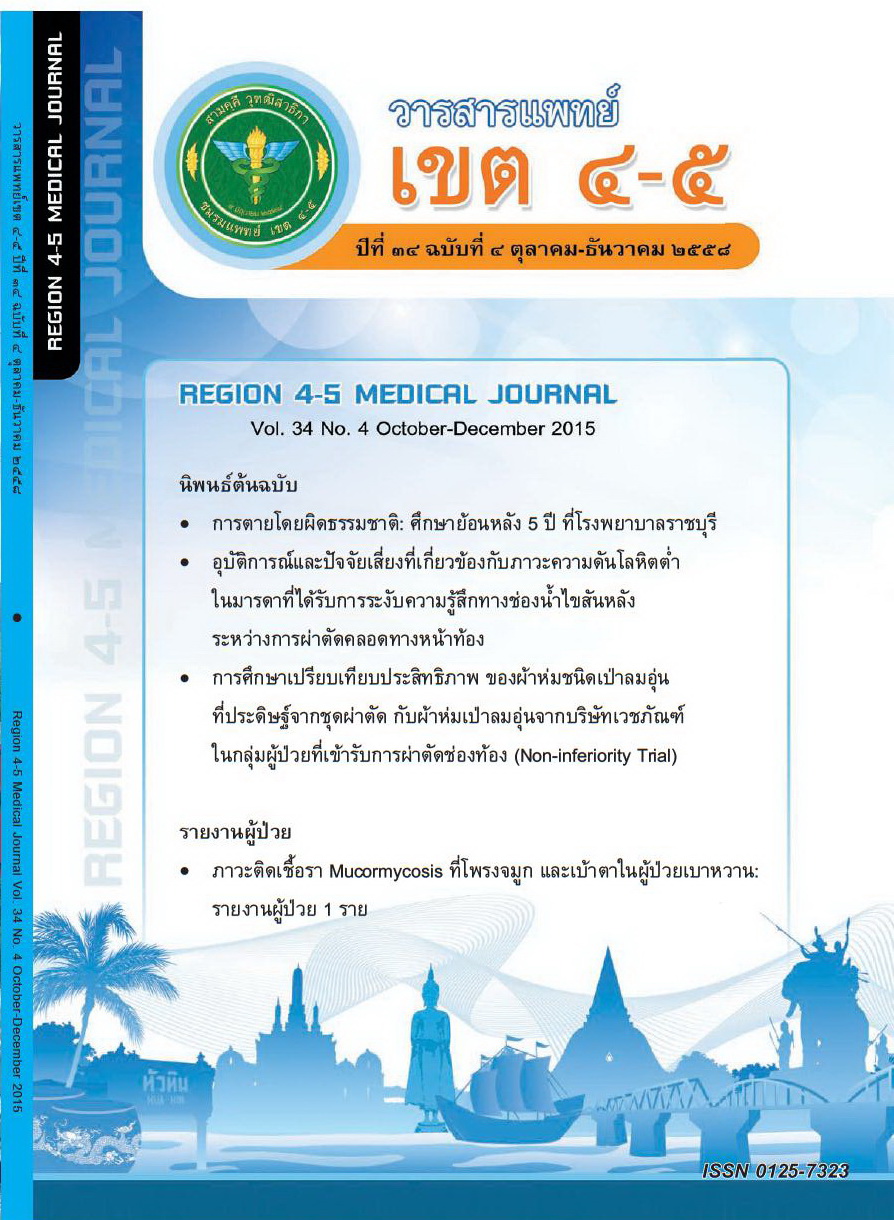
Randomized Prospective Comparison of Forced Air Warming Using Custom-Made Blankets from Disposable Surgical Gown Versus Commercial Blankets in Patients Undergoing Intra-abdominal Surgery: Non-inferiority Trial
Abstract
Objective: This study was to compare the efficacy of forced air warming using custom-made blankets (from disposable surgical gown) and commercial blankets in patients undergoing intra-abdominal surgery
Materials and methods: This was randomized prospective, non-inferiority trial. Sixty-nine adult patients undergoing elective intra-abdominal surgery under general anesthesia were studied. Patients were randomized to receive forced air warming at temperature set point 38°C using commercial blankets (Medwarmer-upper blanket model, control group, n=35) or custom-made blankets (from disposable surgical gown, experimental group, n=34). Intraoperative nasopharyngeal core temperature was monitored. In recovery room, patients were monitored axillary temperature. Shivering and signs of thermal injury were observed.
Results: Custom-made blanket was not inferior to commercial blanket in mean final core temperature. Final core temperature at the end of surgery was similar between groups: experimental, 36.52±0.44°C; control, 36.44±0.57 °C (absolute difference 0.08 °C, 95%CI -0.33, 0.17).There were 9 of 35 patients (25.71%) in control group and 5 of 34 patients (14.71%) in experimental groups had core temperature less than 36°C (p=0.26). In recovery room, axillary temperature at 10, 30, 60 minutes was similar between groups. Thermal injury was not found.
Conclusion: The efficacy of forced air warming using custom-made blanket was not inferior to commercial blanket. The advantages of custom-made blanket compared to commercial blanket are reducing waste product, recycling and cost saving.
References
2. Kurz A. Physiology of thermoregulation. Best Pract Res ClinAnaesthesiol 2008;22(4):627-44.
3. Sessler DI. Mild perioperative hypothermia. N Engl J Med 1997;336:1730-7.
4. Diaz M, Becker DE. Thermoregulation: physiological and clinical considerations during sedation and general anesthesia. Anesth Prog 2010;57:25–32;quiz 33-4.
5. Perl T, Bräuer A, Quintel M. Prevention of perioperative hypothermia with forced-air warming systems and upper body blankets. Surg Technol Int 2006;15:19-22.
6. Horn EP, Schroeder F, Gottschalk A, et al. Active warming during caesarean delivery. Anesth Analg 2002;94:409-14.
7. Mason DS, Sapala JA, Wood MH, et al. Influence of a force air warming system on morbidly obese patients undergoing Roux-en-Y gastric bypass. Obes Surg 1998;8:453-60.
8. Kongsayreepong S, Gunnaleka P, Suraseranivongse S, et al. A reusable, custom-made warming blanket prevents core hypothermia during major neonatal surgery. Can J Anaesth 2002;49:605-9.
9. Pornboonserm S, Kongmuang B, Tivirach W, et al. A custom-made forced-air warming mattress for preventing heat loss during vascular surgery, preliminary report. Thai J Anesthesiology 2007;33:242-8.
10. Ratanatherawichian Y, Asdornwised U, Thongkam N, et al. Incidence and predictive factor of postoperative hypothermia of patients in post-anesthesia care unit (PACU). J Nurs Sci 2013;31:34-44.
11. Mehta SP. Burn injuries from warming devices in the operating room. ASA Monitor 2013;77:16-7.
12. Kabbara A, Goldlust SA, Smith CE, et al. Randomized prospective comparison of forced air warming using hospital blankets versus commercial blankets in surgical patients. Anesthesiology 2002;97:338-44.
13. Zink RS, Iaizzo PA. Convective warming therapy does not increase the risk of wound contamination in the operating room. Anesth Analg 1993;76:50-3.
14. Centers for Disease Control and Prevention. Guideline for disinfection and sterilization in healthcare facilities [Internet] 2008. [cited 2015 Jun 10]. Available from: URL: http://www.cdc.gov/hicpac/pdf/guidelines/Disinfection_Nov_2008.pdf
15. Sigg DC, Houlton AJ, Iaizzo PA. The potential for increased risk of infection due to the reuse of convective air-warming/cooling coverlets. Acta Anaesthesiol Scand1999;43:173-6.
16. National Institute for Health and Clinical Evidence. Clinical practice guideline: The management of inadvertent perioperative hypothermia in adults [Internet] 2008 [Cited 2015 Jun 11]. Available from: URL: http://www.nice.org.uk/nicemedia/pdf/CG65Guidance.pdf.
17. Patel N, Knapke DM, Smith CE, et al. Simulated clinical evaluation of convection of conventional and newer fluid-warming devices. Anesth Analg 1996;82:517-24.
18. American Society of Anesthesiologists. Standards for basic anesthetic monitoring [Internet] 2010 [Cited 2015 Sep 15]. Available from:URL:http://www.asahq.org/~/media/sites/asahq/files/public/resources/standards-guidelines/standards-for-basicanesthetic-monitoring.pdf
19. Sappenfield JW, Hong CM, Galvagno SM. Perioperative temperature measurement and management: moving beyond the Surgical Care Improvement Project. J Anesthesiol Clin Sci 2013;8:1-9.
20. Morris RH. Influence of ambient temperature on patient temperature during intraabdominal surgery. Ann Surg 1971;173:230-3.
Downloads
Published
How to Cite
Issue
Section
License
ลิขสิทธิ์บทความเป็นของผู้เขียนบทความ แต่หากผลงานของท่านได้รับการพิจารณาตีพิมพ์ลงวารสารแพทย์เขต 4-5 จะคงไว้ซึ่งสิทธิ์ในการตีพิมพ์ครั้งแรกด้วยเหตุที่บทความจะปรากฎในวารสารที่เข้าถึงได้ จึงอนุญาตให้นำบทความในวารสารไปใช้ประโยชน์ได้ในเชิงวิชาการโดยจำเป็นต้องมีการอ้างอิงถึงชื่อวารสารอย่างถูกต้อง แต่ไม่อนุญาตให้นำไปใช้ในเชิงพาณิชย์