
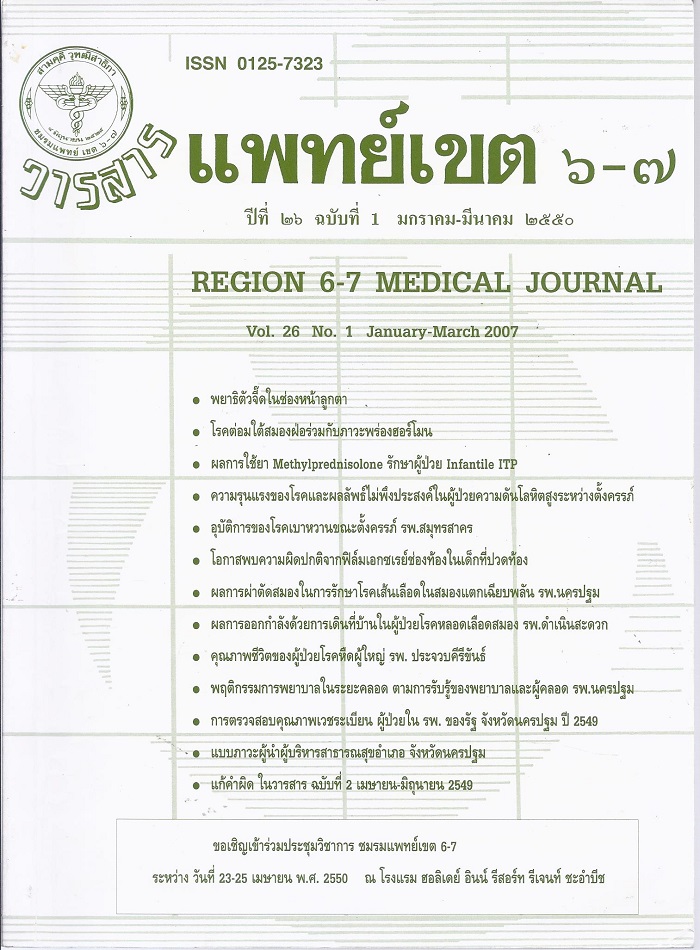
The Study of Hemodynamic Response of Home – Based Walking Program for Stroke Patients in Damnoensaduak Hospital
Abstract
Objective: To determine the hemodynamic response of Home—Based walking program in stroke patients.
Study design: Randomized controlled clinical trial prospective study, pretest and pustlest design.
Material and Method: 60 stroke patients, who were able to walk, were recruited for this study. During the period ot January 2006 — September 2006, sixty stroke patients were divided into two groups by random and thirty patients in experimental group received 12 weeks of Home - Based walking program and followed up every 4 weeks during those time.
Results: Twelve weeks of home — based walking exercise produced significant reduction in resting heart rate and heart rate, systolic BP, Rate Pressure Product at submaximal workload alter 6 minute · walk, but no signilicant reduction in resting systolic BP and resting Rate Pressure Product.
Conclusion: Home-Based walkin program are beneficial for stroke patients and it is safe to be prescribed for stroke patients.
Downloads
Published
How to Cite
Issue
Section
License
ลิขสิทธิ์บทความเป็นของผู้เขียนบทความ แต่หากผลงานของท่านได้รับการพิจารณาตีพิมพ์ลงวารสารแพทย์เขต 4-5 จะคงไว้ซึ่งสิทธิ์ในการตีพิมพ์ครั้งแรกด้วยเหตุที่บทความจะปรากฎในวารสารที่เข้าถึงได้ จึงอนุญาตให้นำบทความในวารสารไปใช้ประโยชน์ได้ในเชิงวิชาการโดยจำเป็นต้องมีการอ้างอิงถึงชื่อวารสารอย่างถูกต้อง แต่ไม่อนุญาตให้นำไปใช้ในเชิงพาณิชย์