
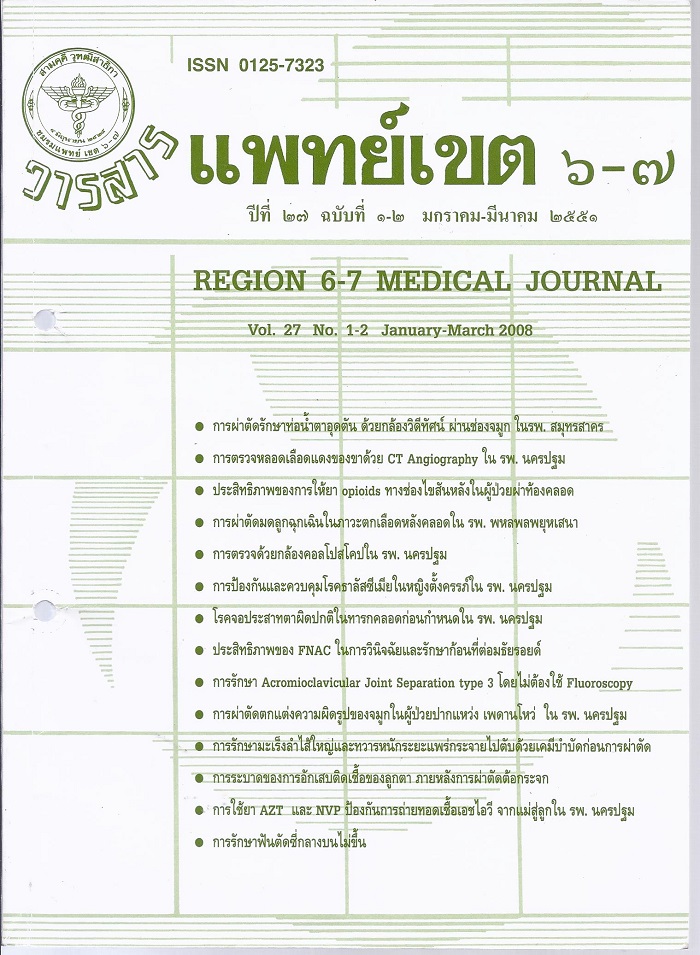
CT Angiography of Lower Extremities in Nakhonpathom Hospital
Keywords:
CTA, slices multidetector CT, Occlusion of lower extremity arteriesAbstract
The conventional study for lower extremity arteries is conventional angiography which is an invasive method. This method required admission and absolute bed rest at least 8-12 hours after procedure. The CT angiography takes advantage over conventional angiography, including 3D volumetric analysis ca, minimally invasive vascular opacification and depiction of mural calcium. Between March 2006 and December 2007, 51 consecutive diagnostic CT angiography performed at Nakhonpathom Hospital were study retrospectively. The common reason for CT angiography was to rule out and determining site of occlusion in arterial occlusive disease. The faster and more slices of current generation of 64 slices multidetector CT scanner is possible to study entire length of lower extremities.
Downloads
Published
How to Cite
Issue
Section
License
ลิขสิทธิ์บทความเป็นของผู้เขียนบทความ แต่หากผลงานของท่านได้รับการพิจารณาตีพิมพ์ลงวารสารแพทย์เขต 4-5 จะคงไว้ซึ่งสิทธิ์ในการตีพิมพ์ครั้งแรกด้วยเหตุที่บทความจะปรากฎในวารสารที่เข้าถึงได้ จึงอนุญาตให้นำบทความในวารสารไปใช้ประโยชน์ได้ในเชิงวิชาการโดยจำเป็นต้องมีการอ้างอิงถึงชื่อวารสารอย่างถูกต้อง แต่ไม่อนุญาตให้นำไปใช้ในเชิงพาณิชย์