
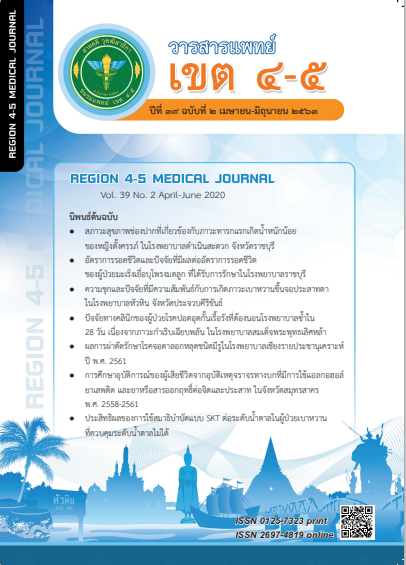
อัตราการรอดชีวิตและปัจจัยที่มีผลต่ออัตราการรอดชีวิตของผู้ป่วยมะเร็งเยื่อบุโพรงมดลูก ที่ได้รับการรักษาในโรงพยาบาลราชบุรี
คำสำคัญ:
มะเร็งเยื่อบุโพรงมดลูก, อัตราการรอดชีพ, ปัจจัยพยากรณ์โรคบทคัดย่อ
วัตถุประสงค์: วัตถุประสงค์หลักเพื่อศึกษาอัตราการรอดชีวิต 5 ปี วัตถุประสงค์รองเพื่อศึกษาปัจจัยพยากรณ์โรคของผู้ป่วยมะเร็งเยื่อบุโพรงมดลูกที่ได้รับการรักษาในโรงพยาบาลราชบุรี
วิธีการศึกษา: วิจัยนี้เป็นการศึกษาแบบย้อนหลัง กลุ่มประชากรคือ ผู้ป่วยที่ได้รับการวินิจฉัยว่าเป็นมะเร็งเยื่อบุโพรงมดลูกและเข้ารับการรักษาในโรงพยาบาลราชบุรี ตั้งแต่วันที่ 1 มกราคม พ.ศ. 2552 ถึงวันที่ 31 ธันวาคม พ.ศ. 2556 และได้รับการติดตามจนถึง 31 ธันวาคม พ.ศ. 2561 โดยเก็บรวบรวมลักษณะทางคลินิกและพยาธิวิทยา นำเสนอข้อมูลด้วย จำนวน ร้อยละ ค่าเฉลี่ย และส่วนเบี่ยงเบนมาตรฐาน รายงานอัตราการรอดชีวิตด้วยสถิติ Kaplan-Meier test เปรียบเทียบอัตราการรอดชีวิตระหว่างกลุ่มผู้ป่วยด้วย log-rank test และนำปัจจัยที่มีความสัมพันธ์กับการทำวิจัยไปวิเคราะห์ด้วยสถิติ Cox regression
ผลการศึกษา: ผู้ป่วยมะเร็งเยื่อบุโพรงมดลูกที่ได้รับการรักษาจำนวน 40 ราย อายุเฉลี่ย 55.8 ปี มีอายุระหว่าง 38-73 ปี มีชีวิตอยู่ 29 ราย (ร้อยละ 72.5) เสียชีวิต 11 ราย (ร้อยละ 27.5) อัตราการรอดชีวิต 5 ปี ของผู้ป่วยทั้งหมดเท่ากับร้อยละ 82.5 เมื่อวิเคราะห์แยกตามระยะโรค พบว่าอัตราการรอดชีวิต 5 ปี ระยะที่ IA, IB, II และ IIIC เท่ากับ ร้อยละ 94.1, 83.3, 80,และ 50 ตามลำดับ อัตราการรอดชีวิต 5 ปี ของมะเร็งระยะเริ่มแรกสูงกว่าระยะลุกลาม (ร้อยละ 88.2 และ 50 ตามลำดับ, p=.030) ปัจจัยที่มีผลต่ออัตราการรอดชีวิตอย่างมีนัยสำคัญทางสถิติ คือ กลุ่มอายุ โดยผู้ป่วยอายุมากกว่า 60 ปี มี adjusted hazard ratio สูงเป็น 14.78 เท่า (p=.008) เทียบกับผู้ป่วยอายุน้อยกว่า
สรุป: ผลการศึกษานี้เน้นให้เห็นว่า การวินิจฉัยโรคและรักษาได้เร็ว ตั้งแต่ระยะแรกจะช่วยให้ผู้ป่วยมะเร็งมีอัตราการรอดชีวิตสูงขึ้น และผู้ป่วยสูงอายุที่ได้รับการรักษาเสร็จสิ้นแล้วควรได้รับการตรวจติดตามอย่างใกล้ชิด
เอกสารอ้างอิง
2. Bernard WS, Christopher PW. World cancer report 2014.1sted.Lyon: the International Agency for Research on Cancer;2014.
3. สถาบันมะเร็งแห่งชาติ. หนังสือทะเบียนมะเร็งระดับโรงพยาบาล พ.ศ. 2560 Hospital-based cancer registry 2017. กรุงเทพฯ: กลุ่มงานเทคโนโลยีสารสนเทศ สถาบันมะเร็งแห่งชาติ; 2561.
4. ศิริวรรณ ตั้งจิตกมล. มะเร็งเยื่อบุโพรงมดลูก Endometrial cancer. กรุงเทพฯ: คณะแพทยศาสตร์วชิรพยาบาล มหาวิทยาลัยนวมินทราธิราช; 2559.
5. Bokhman JV. Two patho genetic types of endometrial carcinoma. Gynecol Oncol. 1983; 15(1): 10-7.
6. Felix AS, Weissfeld JL, Stone RA, et al. Factors associated with Type I and Type II endometrial cancer. Cancer Causes Control. 2010;21(11):1851-6.
7. Pecorelli S. Revised FIGO staging for carcinoma of the vulva, cervix, and endometrium. Int J GynaecolObstet. 2009; 105(2): 103-4.
8. ASTEC/EN.5 Study Group, Blake P, Swart AM, et al. Adjuvant external beam radiotherapy in the treatment of endometrial cancer (MRC ASTEC and NCIC CTG EN.5 randomised trials), pooled trial results, systematic review, and meta-analysis. Lancet. 2009: 373(9658); 137-46.
9. Susumu N, Sagae S, Udagawa Y, et al. Japanese gynecologic oncology group. Randomized phase III trial of pelvis radiotherapy versus cisplatin- based combined chemotherapy in patients with intermediate and high-risk endometrial cancer. A Japanese gynecologic oncology group study. Gynecol Oncol. 2008: 108; 226-33.
10. Noone AM, Howlader N, Krapcho M, et al. SEER Cancer Statistics Review, 1975-2015 [Internet] 2018 [cited 2019 Feb 5]. Available from: https://seer.cancer.gov/csr/1975_2015.
11. Lee NK, Cheung MK, Shin JY, et al. Prognostic factors for uterine cancer in reproductive aged women. ObstetGynecol. 2007;109(3):655-62.
12. Zaino RJ, Kurman RJ, Diana KL, et al. Pathologic models to predict outcome for women with endometrial adenocarcinoma: the importance of the distinction between surgical stage and clinical stage—a Gynecologic Oncology Group study. Cancer. 1996;77(6):1115-21.
13. Okuma K, Yamashita H, Kawana K, et al. Advanced age is a significant determinant of poor prognosis in patients treated with surgery plus postoperative radiotherapy for endometrial cancer. J Obstet Gynaecol Res. 2010;36(4):757-63.
14.Tangjitgamol S, Manusirivithaya S, Srijaipracharoen S, et al. Endometrial cancer in Thai women: clinico-pathological presentation and survival. Asian Pac J Cancer Prev. 2010;11(5):1267-72.
15. American Cancer Society: Cancer Facts and Figures 2015 [Internet]. 2015 [cited 2019 Aug 1]. Available from: http://www.cancer.org/acs/groups/content/@editorial/documents/document/acs [c-044552.pdf.
16. Creasman WT, Odicino F, Maisonneuve P, et al. Carcinoma of the corpus uteri. FIGO 26thAnnaul Report on the Results of Treatment in Gynecological Cancer. Int J GynaecolObstet. 2006; 95(Supp(1): S105-43.
17. Prueksaritanon N, Chantape W. Comparative Survival Outcomes of Uterine Papillary Serous Carcinoma, Clear Cell Carcinoma, Grade 3 Endometrioid Adenocarcinoma, and Carcinosarcoma of Endometrial Cancer in Rajavithi Hospital. J Med Assoc Thai. 2016; 99 (Suppl. 2): S75-S83.
18. Brinton LA, Felix AS, McMeekin DS, et al. Etiologic heterogeneity in endometrial cancer: evidence from a Gynecologic Oncology Group trial. Gynecol Oncol 2013;129(2):277-84.
19. Wright JD, Lewin SN, BarrenaMedel NI, et al. Endometrial cancer in the oldest old: Tumor characteristics, patterns of care, and outcome. Gynecol Oncol. 2011; 122(6): 69-74.
ดาวน์โหลด
เผยแพร่แล้ว
รูปแบบการอ้างอิง
ฉบับ
ประเภทบทความ
สัญญาอนุญาต
ลิขสิทธิ์บทความเป็นของผู้เขียนบทความ แต่หากผลงานของท่านได้รับการพิจารณาตีพิมพ์ลงวารสารแพทย์เขต 4-5 จะคงไว้ซึ่งสิทธิ์ในการตีพิมพ์ครั้งแรกด้วยเหตุที่บทความจะปรากฎในวารสารที่เข้าถึงได้ จึงอนุญาตให้นำบทความในวารสารไปใช้ประโยชน์ได้ในเชิงวิชาการโดยจำเป็นต้องมีการอ้างอิงถึงชื่อวารสารอย่างถูกต้อง แต่ไม่อนุญาตให้นำไปใช้ในเชิงพาณิชย์