
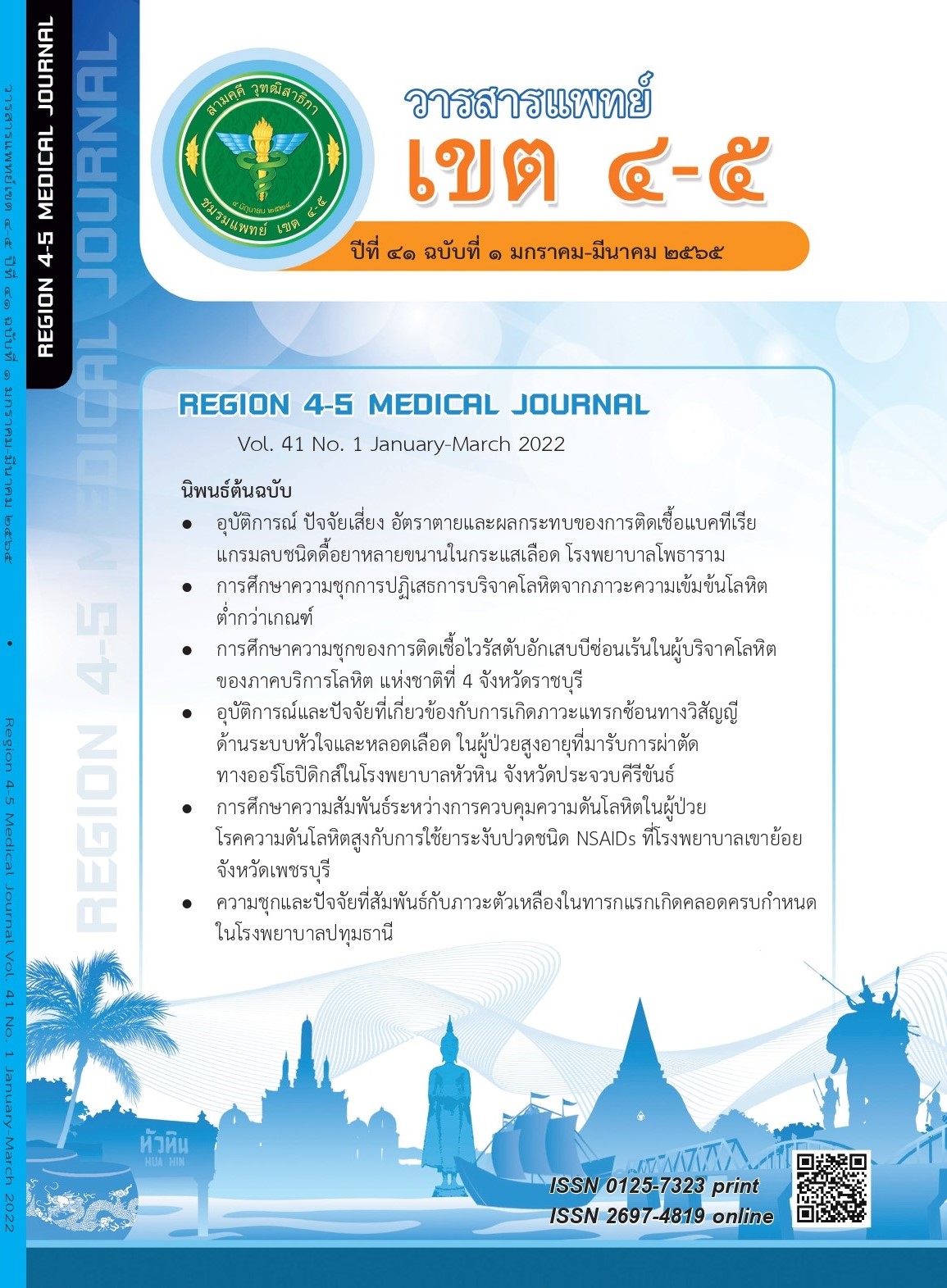
Prevalence and Factors Related to Term Neonatal Hyperbilirubinemia in Pathum Thani Hospital
Keywords:
hyperbilirubinemia, term neonatalAbstract
Objective: This was to study prevalence and associated factors of neonatal jaundice in term newborns in Pathum Thani Hospital.
Material and Methods: A descriptive, retrospective study was done. The data were collected from medical records of term newborns who born in Pathum Thani Hospital between 1 August 2020 to 31 July 2021. The newborns were diagnosed as neonatal jaundice by pediatricians. The samples were specificly selected. The research instrument was a neonatal – record form included gestational age, sex, maternal blood group, pregnancy complication, birth methods, birth trauma, tongue tie, body weight change from birth until the day of phototherapy, maximum serum bilirubin, and child blood group, average age at first onset of phototherapy, and duration of receiving phototherapy. Percentage, mean, standard deviation were presented and associated factors of neonatal jaundice in term newborn were analyzed using chi-squared.
Results: In total 360 term newborns, the prevalence of neonatal jaundice newborns underwent phototherapy was 12.2% (44 cases), tongue tie 7.2% (26 cases), and neonatal sepsis 4.4% (16 cases). The mean hematocrit and mean maximum serum bilirubin were 51% (SD 5.2) and 10.1 mg/dL respectively. The methods of birth by vaginal delivery (p= .013) and neonatal sepsis in 72 hours of birth (p= .034) were associated with neonatal jaundice significantly (p= .05).
Conclusion: The prevalence of neonatal hyperbilirubinemia in Pathum Thani Hospital is 12.2%, related to methods of birth by vaginal delivery and neonatal sepsis in 72 hours of birth. Should be plan of appropriate neonatal care for the purpose of prevention and decrease the prevalence of neonatal jaundice.
References
The National Institute for Health and Care. NICE guide line jaundice. [Internet]. 2012. [cited 2018 Nov 20] Available from: www.evidence.nhs.uk/topic/jaundice.
สำนักนโยบายและยุทธศาสตร์กระทรวงสาธารณสุข. ยุทธศาสตร์ตัวชี้วัดและแนวทางการจัดเก็บข้อมูล กระทรวงสาธารณสุข ประจำปีงบประมาณ พ.ศ. 2560. นนทบุรี: กระทรวงสาธารณสุข. 2560.
Azza HA, Anna KM. Strategies for neonatal hyperbilirubinemia: A literature review. The American journal of maternal child nursing 2003;38(6):377–82.
Farhana R, Hahfuza S, Monir H. Prediction of hyperbilirubinemia in preterm newborns admitted in tertiary care teaching hospital. Bangladesh Journal Child Health 2013;37(2):85–9.
ชมรมเวชศาสตร์ทารกแรกเกิดแห่งประเทศไทย. คู่มือ การดูแลทารกแรกเกิด 1. กรุงเทพฯ: หน่วยทารกแรกเกิด ภาควิชากุมารเวชศาสตร์ คณะแพทยศาสตร์โรงพยาบาลรามาธิบดี; 2556: หน้า 335–51
Mitra S, Rennie J. Neonatal Jaundice: etiology, diagnosis and treatment. Br J Hosp Med (Lond) 2017;78(12):699–704.
โสภาพรรณ เงินฉ่ำ. Neonatal Jaundice ภาวะตัวเหลืองในทารกแรกเกิด. ใน: สุรชัย ลิขสิทธิ์วัฒนกุล. บรรณาธิการ. ตำรากุมารเวชศาสตร์ศิริราช: ประเด็นสำคัญในเวชปฏิบัติ. กรุงเทพฯ: ภาควิชากุมารเวชศาสตร์ คณะแพทยศาสตร์ศิริราชพยาบาล มหาวิทยาลัยมหิดล; 2559: หน้า 179–91.
รายงานสถิติประจำปี โรงพยาบาลปทุมธานี จังหวัดปทุมธานี. ปีงบประมาณ 2561–2564.
Arad I, Fainmesser P, Birkenfeld A, et al. Vacuum extraction and neonatal jaundice. [Internet]. 2009. [cited 2021 Oct 15] Available from: https://www.degruyter.com/document/doi/10.1515/jpme.1982.10.6.273/html.
สุขุมาล หุนทนทาน. การศึกษาความชุก ลักษณะความเสี่ยงทางคลินิก และผลการรักษาของทารกแรกเกิดที่มีภาวะตัวเหลืองในโรงพยาบาลสมเด็จพระยุพราชด่านซ้าย. วารสารการพัฒนาสุขภาพชุมชน มหาวิทยาลัยขอนแก่น. 2557;2(4): หน้า 21–34.
Carolyn GS, Luke CM, Joanne K, et al. Incidence and Risk Factors for Neonatal Jaundice among Newborns in Southern Nepal. Trop Med Int Health 2013;18(11):1317–28.
Gholamali M, Fatemah K, Ashraf M, et al. Hyperbilirubinemia and Neonatal Infection. International Journal of Pediatrics 2013;1(1): 5–12.
กินรี ชัยสวรรค์, ธนพร แย้มสุดา. ปัจจัยที่มีความสัมพันธ์กับภาวะตัวเหลืองในทารกแรกเกิด. วารสารแพทย์นาวี. 2561;45(2) หน้า: 235–249.
Deborah AR, Conrad K, Sameer J. Cephalohematoma. In: StatPearls [Internet]. 2021. [cited 2021 Aug 13] Available from: https://www.ncbi.nlm.nih.gov/books/NBK470192/
Block SL. Ankyloglossia: when frenectomy is the right choice. Pediatr Ann 2012;41:14–6.
Geddes DT, Langton DB, Gollow I, et al. Frenulotomy for breastfeeding infants with ankyloglossia: effect on milk removal and sucking mechanism as imaged by ultrasound. Pediatrics 2008;122: 188–94.
Ricke LA, Baker NJ, Madlon-Kay DJ, et al. Newborn tongue-tie: prevalence and effect on breast-feeding. J Am Board Fam Pract 2005;18:1–7.
Downloads
Published
How to Cite
Issue
Section
License

This work is licensed under a Creative Commons Attribution-NonCommercial-NoDerivatives 4.0 International License.
ลิขสิทธิ์บทความเป็นของผู้เขียนบทความ แต่หากผลงานของท่านได้รับการพิจารณาตีพิมพ์ลงวารสารแพทย์เขต 4-5 จะคงไว้ซึ่งสิทธิ์ในการตีพิมพ์ครั้งแรกด้วยเหตุที่บทความจะปรากฎในวารสารที่เข้าถึงได้ จึงอนุญาตให้นำบทความในวารสารไปใช้ประโยชน์ได้ในเชิงวิชาการโดยจำเป็นต้องมีการอ้างอิงถึงชื่อวารสารอย่างถูกต้อง แต่ไม่อนุญาตให้นำไปใช้ในเชิงพาณิชย์