
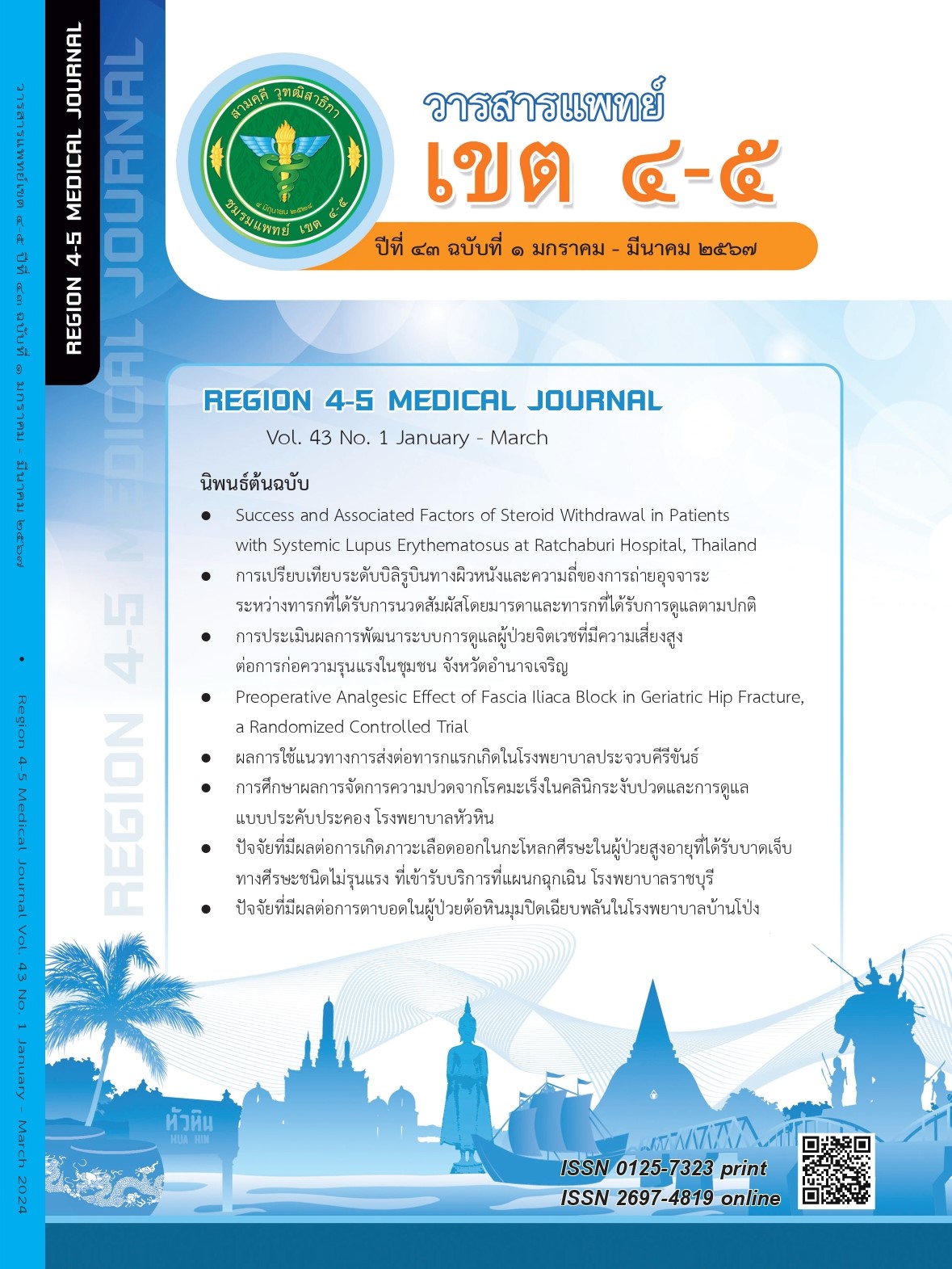
Success and Associated Factors of Steroid Withdrawal in Patients with Systemic Lupus Erythematosus at Ratchaburi Hospital, Thailand
Keywords:
success steroid withdrawal, systemic lupus erythematosus, antimalarial drugsAbstract
Objective: The study aimed to examine the success and associated factors of steroid withdrawal in patients with systemic lupus erythematosus (SLE) at Ratchaburi Hospital, Thailand.
Methods: A retrospective study based on medical records included consecutive patients with SLE who attended the outpatient unit in Ratchaburi Hospital. The success rate of steroid withdrawal without resuming in 1 year was studied and the associated factors were determined. Logistic regression was used to analyze the data.
Results: At Ratchaburi Hospital, 569 patients with SLE were treated with glucocorticoids and followed up for more than 1 year between September 2016 and August 2020. Of these, 200 patients (35.1%) who discontinued prednisolone were included in our study. Of the 200 patients, 87.5% were female. The mean (SD) age was 42.1 (14.0) years. The median SLE disease duration was 28.5 (ranging from 1 to 278) months. The success rate of steroid withdrawal was 89.5%. The findings from the univariate analysis revealed that some factors were associated with success, such as the use of antimalarial drugs at the time of steroid withdrawal, higher BMI, and slow reduction of steroids by decreasing prednisolone below 5 mg/day for more than 12 weeks before stopping with OR 29.67 (95% CI 2.93–300.23), 1.13 (95% CI 1.01–1.23), and 25.44 (95% CI 8.41–76.93) respectively.
Conclusion: The present study reported a high rate of steroid withdrawal success without the need to resume steroid use in a year. The use of antimalarial drugs, a higher BMI, and gradual reduction of prednisolone below 5 mg/day for more than 12 weeks before stopping were found to be associated with success. The study showed the feasibility of steroid withdrawal, and its implications could be useful in planning the SLE management.
References
Amissah-Arthur MB, Gordon C. Contemporary treatment of systemic lupus erythematosus: an update for clinicians. Ther Adv Chronic Dis 2010;1(4):163–75. doi: 10.1177/2040622310380100.
Rees F, Doherty M, Grainge MJ, et al. The worldwide incidence and prevalence of systemic lupus erythematosus: a systematic review of epidemiological studies. Rheumatology (Oxford) 2017;56(11):1945–61. doi: 10.1093/rheumatology/kex260.
Mok CC, Lau CS. Pathogenesis of systemic lupus erythematosus. J Clin Pathol 2003;56(7):481–90. doi: 10.1136/jcp.56.7.481.
Mosca M, Tani C, Aringer M, et al. European League Against Rheumatism recommendations for monitoring patients with systemic lupus erythematosus in clinical practice and in observational studies. Ann Rheum Dis 2010;69(7):1269–74. doi: 10.1136/ard.2009.117200.
Stojan G, Petri M. The risk benefit ratio of glucocorticoids in SLE: have things changed over the past 40 years?. Curr Treatm Opt Rheumatol 2017;3(3):164–72. doi: 10.1007/s40674-017-0069-8.
Tselios K, Gladman DD, Su J, et al. Gradual glucocorticosteroid withdrawal is safe in clinically quiescent systemic lupus erythematosus. ACR Open Rheumatology 2021;3(8):550–7. doi: 10.1002/acr2.11267.
Mathian A, Pha M, Haroche J, et al. Withdrawal of low-dose prednisone in SLE patients with a clinically quiescent disease for more than 1 year: a randomized clinical trial. Annals Rheum Dis 2020;79(3):339–46. doi: 10.1136/annrheumdis-2019-216303.
Nakai T, Fukui S, Ikeda Y, et al. Glucocorticoid discontinuation in patients with SLE with prior severe organ involvement: a single-center retrospective analysis. Lupus Sci Med 2022;9(1):e000682. doi: 10.1136/lupus-2022-000682.
Ji L, Xie W, Zhang Z. Low-dose glucocorticoid should be withdrawn or continued in systemic lupus erythematosus? A systematic review and meta-analysis on risk of flare and damage accrual. Rheumatology (Oxford) 2021;60(12):5517–26. doi: 10.1093/rheumatology/keab149.
Hochberg MC. Updating the American college of rheumatology revised criteria for the classification of systemic lupus erythematosus. Arthritis Rheum 1997;40(9):1725. doi: 10.1002/art.1780400928.
Petri M, Orbai A-M, Alarcón GS, et al. Derivation and validation of the Systemic Lupus International Collaborating Clinics classification criteria for systemic lupus erythematosus. Arthritis Rheum 2012;64(8):2677–86. doi: 10.1002/art.34473.
Aringer M, Costenbader K, Daikh D, et al. 2019 European League Against Rheumatism/American College of Rheumatology classification criteria for systemic lupus erythematosus. Ann Rheum Dis 2019;78(9):1151–59. doi: 10.1136/annrheumdis-2018-214819.
Tani C, Elefante E, Signorini V, et al. Glucocorticoid withdrawal in systemic lupus erythematosus: are remission and low disease activity reliable starting points for stopping treatment? A real-life experience. RMD Open 2019;5(2):e000916. doi: 10.1136/rmdopen-2019-000916.
Moroni G, Longhi S, Giglio E, et al. What happens after complete withdrawal of therapy in patients with lupus nephritis. Clin Exp Rheumatol 2013;31(4 Suppl 78):S75–81.
Lee SJ, Silverman E, Bargman JM. The role of antimalarial agents in the treatment of SLE and lupus nephritis. Nat Rev Nephrol 2011;7(12):718–29. doi: 10.1038/nrneph.2011.150.
Rizk A, Gheita TA, Nassef S, el at. The impact of obesity in systemic lupus erythematosus on disease parameters, quality of life, functional capacity and the risk of atherosclerosis. Int J Rheum Dis 2012;15(3):261–7. doi: 10.1111/j.1756-185X.2011.01698.x.
Teh P, Zakhary B, Sandhu VK. The impact of obesity on SLE disease activity: findings from the Southern California Lupus Registry (SCOLR). Clin Rheumatol 2019;38(2):597–600. doi: 10.1007/s10067-018-4336-3.
Fanouriakis A, Kostopoulou M, Andersen J, et al. EULAR recommendations for the management of systemic lupus erythematosus: 2023 update. Ann Rheum Dis 2024;83(1):15–29. doi:10.1136/ard-2023-224762.
Ji L, Xie W, Fasano S, et al. Risk factors of flare in patients with systemic lupus erythematosus after glucocorticoids withdrawal. A systematic review and meta-analysis. Lupus Sci Med 2022;9(1):e000603. doi: 10.1136/lupus-2021-000603.
Downloads
Published
How to Cite
Issue
Section
License

This work is licensed under a Creative Commons Attribution-NonCommercial-NoDerivatives 4.0 International License.
ลิขสิทธิ์บทความเป็นของผู้เขียนบทความ แต่หากผลงานของท่านได้รับการพิจารณาตีพิมพ์ลงวารสารแพทย์เขต 4-5 จะคงไว้ซึ่งสิทธิ์ในการตีพิมพ์ครั้งแรกด้วยเหตุที่บทความจะปรากฎในวารสารที่เข้าถึงได้ จึงอนุญาตให้นำบทความในวารสารไปใช้ประโยชน์ได้ในเชิงวิชาการโดยจำเป็นต้องมีการอ้างอิงถึงชื่อวารสารอย่างถูกต้อง แต่ไม่อนุญาตให้นำไปใช้ในเชิงพาณิชย์