
Etiology and Outcome of Patients with Acute Liver Failure in 5 Years at Ratchaburi Hospital: A Retrospective Study
Keywords:
acute liver failure, outcomes, predictorAbstract
Objective: The study aimed to identify the etiology and outcome of patients with acute liver failure (ALF) at Ratchaburi Hospital, Thailand.
Methods: A retrospective study based on medical records included patients with acute liver failure who attended the inpatient unit in Ratchaburi Hospital. The etiology of acute liver failure, comorbidities, treatment, complications, and outcome of treatment were studied and the predictive factors of mortality were identified. Chi-square test was used to analyze the data.
Results: There were 21 patients diagnosed with ALF between 2013 and 2017. Of the 21 patients, 61.9% were female. The mean (SD) age was 47.1 ± 11.9 years. The incidence of ALF was 32.9 per million population per year. The most frequent causes of ALF were malignant infiltration of liver (33.3%), viral hepatitis (28.6%), and acetaminophen toxicity (14.3%). There were 15 patients (71.4%) who died in this study and 11 (52.4%) patients died within 30 days after admission. One patient (0.05%) was referred to waiting list for liver transplantation. The most prevalent complications were acute renal failure (42.9%), pneumonia (28.6%), urinary tract infection (23.8%), and septicemia (19%). The predictive influential factors for 30-day mortality cannot identified in this study but infection trended to be found in dead patients.
Conclusion: The present study reported high mortality rate and poor outcome of patients with ALF. Malignant infiltration of liver was the most frequent cause. Predictive factors of mortality could not identified in this study but infection trended to be found in dead patients.
References
Polson J, Lee WM. AASLD position paper: The management of acute liver failure. Hepatology 2005;41(5):1179–97. doi: 10.1002/hep.20703.
Hiramatsu A, Takahashi S, Aikata H, et al. Etiology and outcome of acute liver failure: retrospective analysis of 50 patients treated at a single center. J Gastroenterology Hepatol 2008;23:1216–22. doi: 10.1111/j.1440-1746.2008.05402.x.
Adukauskiene D, Dockiene I, Naginiene R, et al. Acute liver failure in Lithuania. Medicina (Kaunas) 2008;44(7):536–40.
Ichai P, Samuel D. Epidemiology of liver failure. Clin Res Hepatol Gastroenterol 2011;35(10):610–17. doi: 10.1016/j.clinre.2011.03.010.
O'Grady JG, Schalm SW, Williams R. Acute liver failure: Redefining the syndromes. Lancet 1993;342(8866):273–5. doi: 10.1016/0140-6736(93)91818-7.
Marudanayagam R, Shanmugam V, Gunson B, et al. Aetiology and outcome of acute liver failure. HPB (Oxford) 2009;11(5):429–34. doi: 10.1111/j.1477-2574.2009.00086.x
Vasques F, Cavazza A, Bernal W. Acute liver failure. Curr Opin Crit Care 2022;28(2):198–207. doi: 10.1097/MCC.0000000000000923.
Tujios S, Stravitz RT, Lee WM. Management of acute liver failure: Update 2022. Semin Liver Dis 2022;42(3):362–78. doi: 10.1055/s-0042-1755274.
Cordoba J, Dhawan A, Larsen FS, et al. EASL clinical practical guidelines on the management of acute (fulminant) liver failure. J Hepatol 2017;66(5):1047–81. doi: 10.1016/j.jhep.2016.12.003.
Polson J. Assessment of prognosis in acute liver failure. Semin Liver Dis 2008;28(2):218–25. doi: 10.1055/s-2008-1073121.
Thanapirom K, Treeprasertsuk S, Soonthornworasiri N, et al. The incidence, etiologies, outcomes, and predictors of mortality of acute liver failure in Thailand: A population-base study. BMC Gastroenterol 2019;19(1):18–24. doi: 10.1186/s12876-019-0935-y.
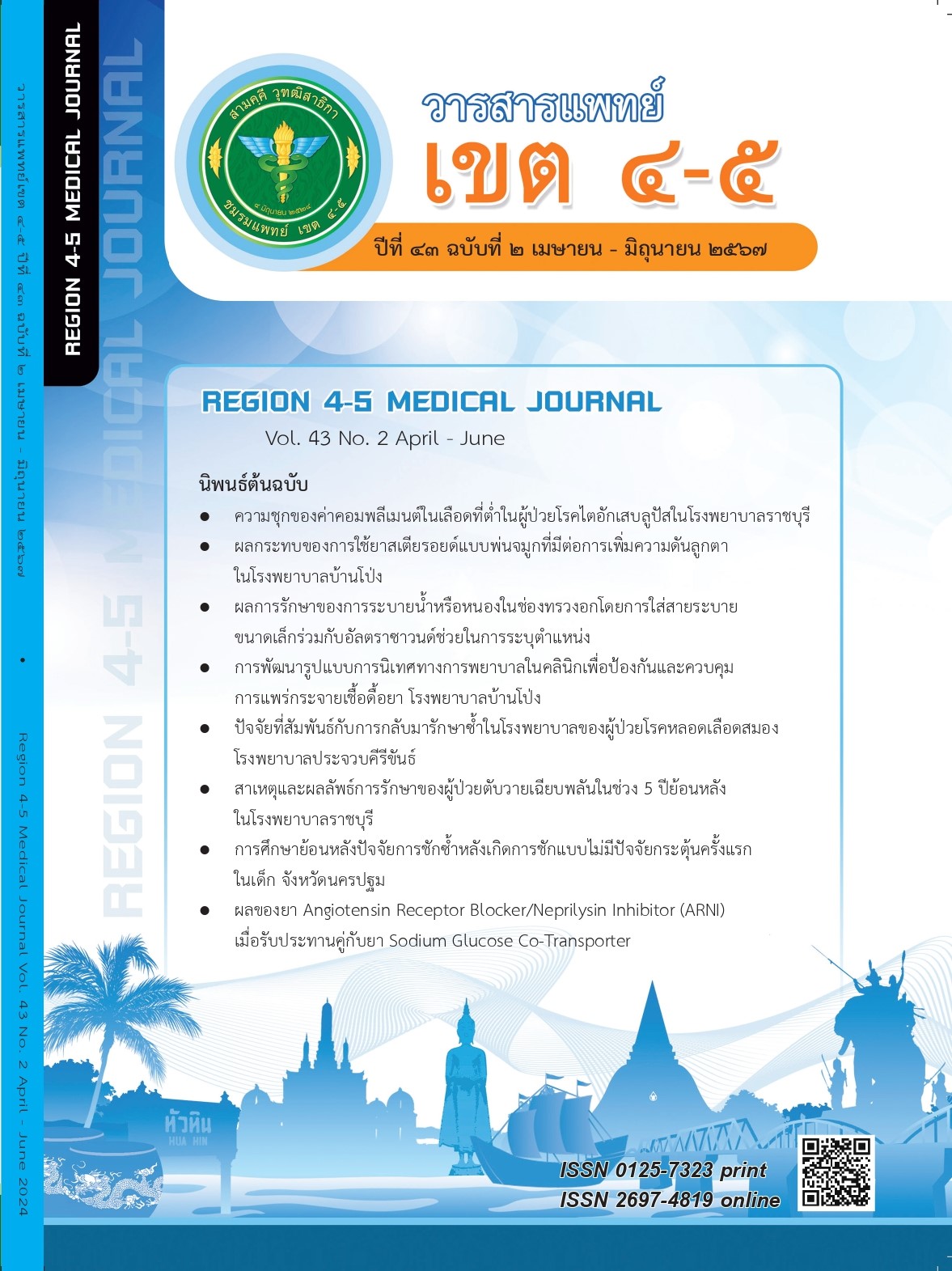
Downloads
Published
How to Cite
Issue
Section
License

This work is licensed under a Creative Commons Attribution-NonCommercial-NoDerivatives 4.0 International License.
ลิขสิทธิ์บทความเป็นของผู้เขียนบทความ แต่หากผลงานของท่านได้รับการพิจารณาตีพิมพ์ลงวารสารแพทย์เขต 4-5 จะคงไว้ซึ่งสิทธิ์ในการตีพิมพ์ครั้งแรกด้วยเหตุที่บทความจะปรากฎในวารสารที่เข้าถึงได้ จึงอนุญาตให้นำบทความในวารสารไปใช้ประโยชน์ได้ในเชิงวิชาการโดยจำเป็นต้องมีการอ้างอิงถึงชื่อวารสารอย่างถูกต้อง แต่ไม่อนุญาตให้นำไปใช้ในเชิงพาณิชย์