
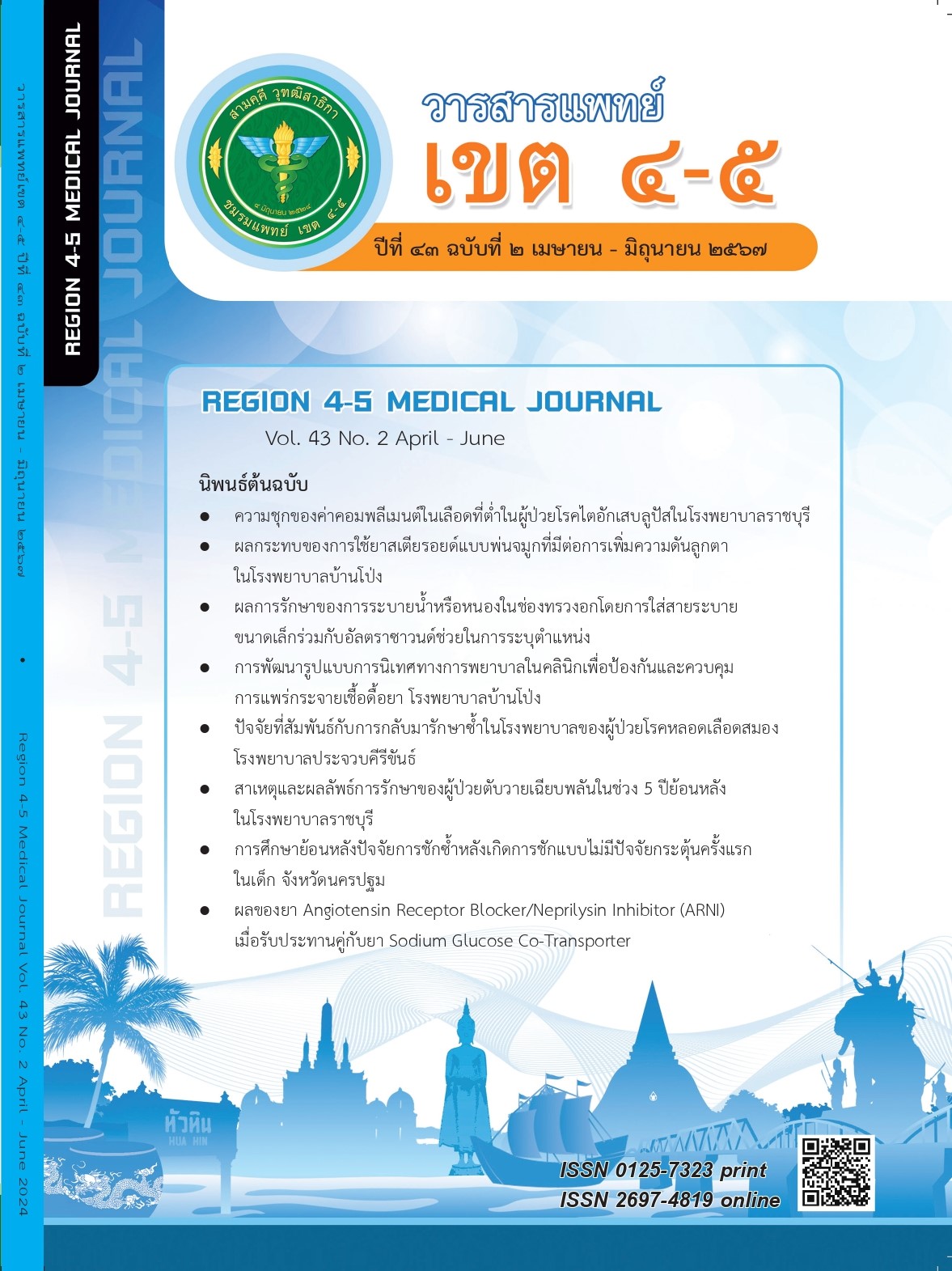
Outcomes of Synergistic Effects of Angiotensin Receptor Blocker/Neprilysin Inhibitor (ARNI) and Sodium Glucose Co-Transporter Subtype 2 Inhibitor (SGLT2i) in Patients with Heart Failure with Reduced Ejection Fraction (HFrEF) at Ratchaburi Hospital
Keywords:
heart failure with reduced ejection fraction, anti-heart failure drugs, heart failure hospitalizationAbstract
Objective: The study purpose is to study whether new anti-heart failure drugs such as angiotensin receptor blocker/neprilysin inhibitor (ARNI) and sodium glucose co-transporter subtype 2 inhibitor (SGLT2i) in combination can reduce incidence of heart failure hospitalization rate in patients with reduced left ventricular ejection fraction and to measure the duration from both drugs with GDMT dosages to first heart failure hospitalization.
Methods: This retrospective cohort study was conducted in patients with heart failure
with reduced ejection fraction (HFrEF) to whom administered both new anti-heart failure drugs such as angiotensin receptor blocker/neprilysin inhibitor (ARNI) and sodium glucose co-transporter subtype 2 inhibitor (SGLT2i) in consecutive fashion. Evaluation of the outcome was done by exploring the incidence of heart failure hospitalization and measuring the duration of first admission from date of optimal medical treatment to date of admission.
Results: Among 242 patients there were no differences in baseline characteristics (age, sex, co-morbidity, concomitant drug use, echocardiographic/angiographic data) The statistical analysis revealed no statistically significant reduction of incidence of heart failure hospitalization rate in first 45 days but after 45 days there was a positive trend to reduce rate of hospitalization without serious drug adverse reaction.
Conclusion: Both new anti-heart failure drugs cannot reduce rate of heart failure hospitalization in first 45 days but perhaps a positive trend comes up thereafter without serious drug adverse events.
References
Dickstein K. ESC guidelines for the diagnosis and treatment of acute and chronic heart failure 2008: application of natriuretic peptides: reply. Eur Heart J 2008;30(3):383. doi.org/10.1093/eurheartj/ehn561
Hunt SA, Abraham WT, Chin MH, et al. 2009 Focused update incorporated into the ACC/AHA 2005 guidelines for the diagnosis and management of heart failure in adults a report of the American College of Cardiology Foundation/American Heart Association Task Force on Practice Guidelines developed in collaboration with the International Society for Heart and Lung Transplantation. J Am Coll Cardiol 2009;53(15):e1–90. doi.org/10.1016/j.jacc.2008.11.013
Laothavorn P, Hengrussamee K, Kanjanavanit K. Thai acute decompensated heart failure registry (Thai ADHERE). CVD 2010;5:89–95.
McMurray JJV, Packer M, Desai AS, et al. Angiotensin-neprilysin inhibition versus enalapril in heart failure. N Engl J Med 2014;371(11):993–1004. doi: 10.1056/NEJMoa1409077.
McMurray JJV, Solomon SD, Inzucchi SE, et al. Dapagliflozin in patients with heart failure and reduced ejection fraction. N Engl J Med 2019;381(21):1995–2008. doi: 10.1056/NEJMoa1911303
Neal B, Perkovic V, Matthews DR. Canagliflozin and cardiovascular and renal events in type 2 diabetes. N Engl J Med 2017;377(21):2099. doi: 10.1056/NEJMc1712572.
Zinman B, Wanner C, Lachin JM, et al. Empagliflozin, cardiovascular outcomes, and mortality in type 2 diabetes. N Engl J Med 2015;373(22):2117–28. doi: 10.1056/NEJMoa1504720.
Blonde L, Umpierrez GE, Reddy SS, et al. American association of clinical endocrinology clinical practice guideline: developing a diabetes mellitus comprehensive care plan-2022 update. Endocr Pract 2022;28(10):923–1049. doi: 10.1016/j.eprac.2022.08.002.
Schrier RW, Abraham WT. Hormones and hemodynamics in heart failure. N Engl J Med 1999;341(8):577–85. doi: 10.1056/NEJM199908193410806.
Krum H, Abraham WT. Heart failure. Lancet 2009;373(9667):941–55. doi: 10.1016/S0140-6736(09)60236-1.
Mann DL. Mechanisms and models in heart failure: A combinatorial approach. Circulation 1999;100(9):999–1008. doi: 10.1161/01.cir.100.9.999.
Konstam MA, Kramer DG, Patel AR, et al. Left ventricular remodeling in heart failure: current concepts in clinical significance and assessment. JACC Cardiovasc Imaging 4(1):98–108. doi: 10.1016/j.jcmg.2010.10.008.
Yingchoncharoen T, Kanjanavanich R. Heart Failure Council of Thailand (HFCT) heart failure guideline: pharmacologic treatment of chronic heart failure - part II. J Med Assoc Thai 2019;102(3):368–72.
McMurray JJ, Packer M, Desai AS, et al. Angiotensin-neprilysin inhibition versus enalapril in heart failure. N Engl J Med 2014; 371(11):993–1004. doi: 10.1056/NEJMoa1409077.
Downloads
Published
How to Cite
Issue
Section
License

This work is licensed under a Creative Commons Attribution-NonCommercial-NoDerivatives 4.0 International License.
ลิขสิทธิ์บทความเป็นของผู้เขียนบทความ แต่หากผลงานของท่านได้รับการพิจารณาตีพิมพ์ลงวารสารแพทย์เขต 4-5 จะคงไว้ซึ่งสิทธิ์ในการตีพิมพ์ครั้งแรกด้วยเหตุที่บทความจะปรากฎในวารสารที่เข้าถึงได้ จึงอนุญาตให้นำบทความในวารสารไปใช้ประโยชน์ได้ในเชิงวิชาการโดยจำเป็นต้องมีการอ้างอิงถึงชื่อวารสารอย่างถูกต้อง แต่ไม่อนุญาตให้นำไปใช้ในเชิงพาณิชย์