
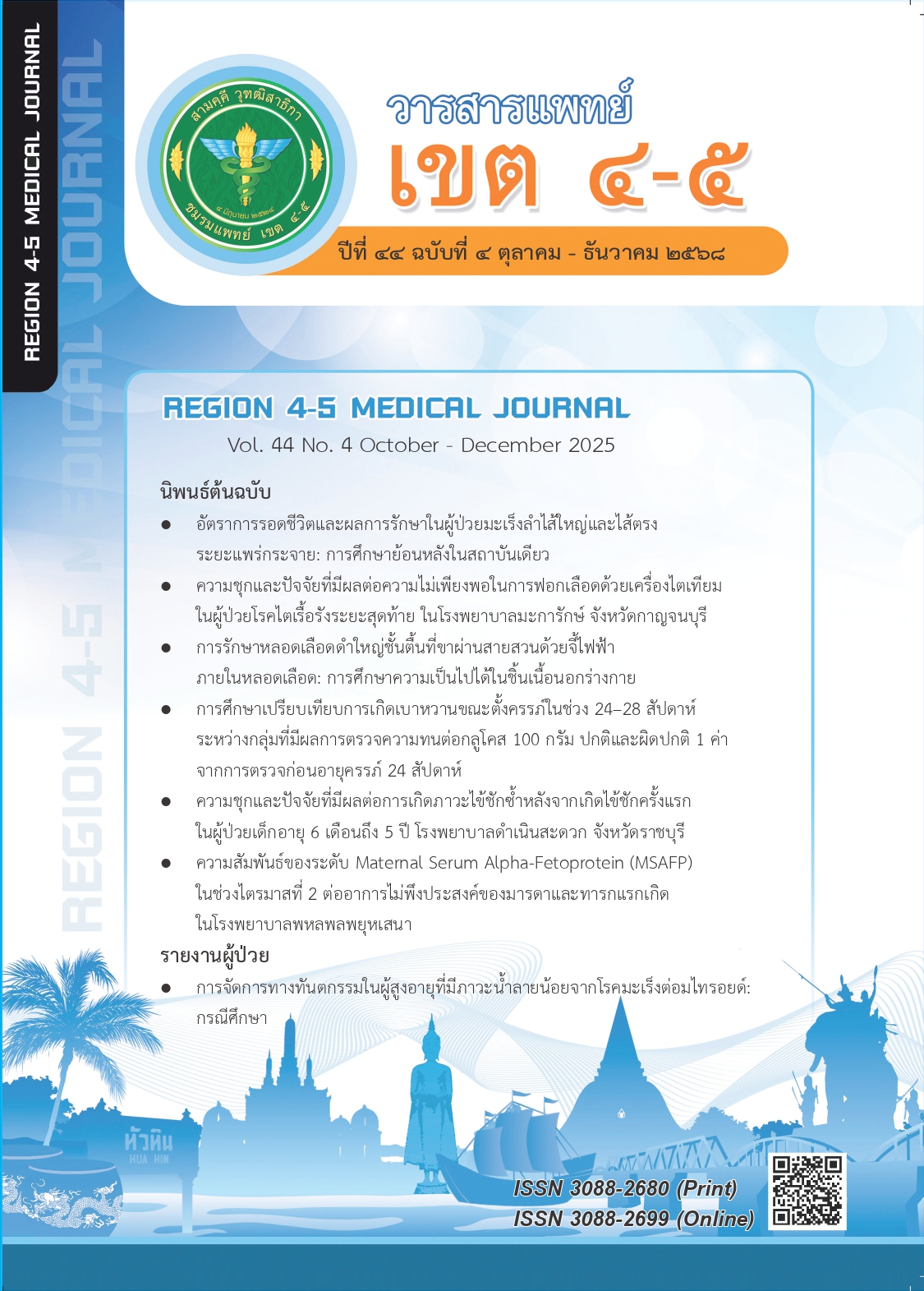
Relationship Between Maternal Serum Alpha-Fetoprotein (MSAFP) Levels During the Second Trimester and Adverse Outcomes in Pregnancies and Neonates at Phaholpolpayuhasena Hospital
Keywords:
maternal serum alpha-fetoprotein, adverse maternal outcomes, neonatal complicationsAbstract
Objective: To investigate the association between second-trimester maternal serum alpha-fetoprotein (MSAFP) levels and adverse maternal and neonatal outcomes at Phaholpolpayuhasena Hospital.
Methods: This retrospective cohort study included singleton pregnant women who underwent Down syndrome screening with the quadruple test at Phaholpolpayuhasena Hospital from March 2022 to March 2024 with normal fetal ultrasound findings. A total of 219 participants were categorized into two groups: MSAFP >2.0 MoM (n = 73) and MSAFP ≤2.0 MoM (n = 146). Data were collected from medical records using a structured data collection form. Descriptive statistics and inferential statistics, including the chi-square test or Fisher’s exact test, independent t test, and log-binomial regression were used for analysis. Adjusted risk ratios (adj. RRs) and 95% confidence intervals (CIs) were reported. A p-value < .05 was considered statistically significant.
Results: Among the 219 participants, elevated MSAFP levels (>2.0 MoM) were significantly associated with several adverse outcomes: preeclampsia/gestational hypertension (adj. RR= 4.69; 95% CI = 1.46–15.02), preterm birth (adj. RR= 9.94; 95% CI = 3.05–32.35), small for gestational age infants (<10th percentile) (adj. RR= 18.33; 95% CI = 3.67–91.47), and neonatal intensive care unit (NICU) admission (adj. RR= 6.20; 95% CI = 1.82–21.13).
Conclusion: Elevated second-trimester MSAFP levels were significantly associated with adverse maternal and neonatal outcomes, particularly preeclampsia/gestational hypertension, preterm birth, small for gestational age, and NICU admission.
References
กาญจนา ศรีสวัสดิ์. การตั้งครรภ์และการฝากครรภ์ในการพยาบาลสำหรับสตรีตั้งครรภ์. กรุงเทพมหานคร: จุฬาลงกรณ์มหาวิทยาลัย; 2563.
Perry SE, Hockenberry MJ, Lowdermilk DL, Wilson D. Maternal child nursing care. 5th ed. Missouri: Elsevier Mosby; 2014.
นิศารัตน์ พิทักษ์วัชระ. การตรวจคัดกรองในระหว่างการตั้งครรภ์ในเวชศาสตร์ปริกำเนิดคัดกรองป้องกันส่งเสริมสุขภาพ. กรุงเทพมหานคร: ยูเนี่ยนครีเอชั่น; 2554.
ปานวาด หาญอมร, เกษมศรี ศรีสุพรรณดิฐ. Neural tube defect (NTD) [อินเทอร์เน็ต]. 2561 [เข้าถึงเมื่อ วันที่ 12 เมษายน พ.ศ. 2567]; เข้าถึงได้จาก: URL: https://w1.med.cmu.ac.th/obgyn/lecturestopics/topic-review/6080/
Bradley LA, Palomaki GE, McDowell GA. Technical standards and guidelines: prenatal screening for open neural tube defects. Genet Med. 2005;7(5):355–69. doi: 10.1097/00125817-200505000-00010.
Puntachai P, Wanapirak C, Sirichotiyakul S, Tongprasert F, Srisupundit K, Luewan S, et al. Associations between pregnancy outcomes and unexplained high and low maternal serum alpha-fetoprotein levels. Arch Gynecol Obstet. 2015;292(1):81–5. doi: 10.1007/s00404-014-3606-9.
Abd Elraheim MM, Abd Elraheim IM, Mohamed MA, Mohamed AH. Alpha-feto protein in obstetrics. Sohag Med J. 2020;24(2):187–91.
Anfuso S, Soncini E, Bonelli P, Piantelli G, Gramellini D. Second-trimester maternal serum alpha-fetoprotein elevation and its association with adverse maternal/fetal outcome: ten years experience. Acta Biomed. 2007;78(3):214–9.
Ayyash M, Keerthy M, Roberson J, Shaman M. Recurrence rate for isolated elevated maternal serum alpha-fetoprotein levels and pregnancy outcomes. Genet Test Mol Biomarkers. 2022;26(9):443–8. doi: 10.1089/gtmb.2022.0083.
Başbuğ D, Başbuğ A, Gülerman C. Is unexplained elevated maternal serum alpha-fetoprotein still important predictor for adverse pregnancy outcome? Ginekol Pol. 2017;88(6):325–30. doi: 10.5603/GP.a2017.0061.
Dai X, Zhang H, Wu B, Ning W, Chen Y, Chen Y. Correlation between elevated maternal serum alpha-fetoprotein and ischemic placental disease: a retrospective cohort study. Clin Exp Hypertens. 2023;45(1):2175848. doi: 10.1080/10641963.2023.2175848.
Dehghani-Firouzabadi R, Tayebi N, Ghasemi N, Tahmasbi Z. The association between second-trimester maternal serum alpha-fetoprotein in 14–22 weeks and adverse pregnancy outcome. Acta Med Iran. 2010;48(4):234–8.
Karya U, Kumari S, Rani A, Singh S. Clinical significance of unexplained elevated maternal serum alpha feto-protein in second trimester of pregnancy. Int J Reprod Contracept Obstet Gynecol. 2018;7(6):2245–50.
Songthamwat S. Prevalence of abnormal prenatal screening for down syndrome in Udonthani hospital using nuchal translucency and biochemical marker. Srinagarind Med J. 2008;23(2):153–60.
Gerami R, Agahi T, Barkhordari S, Kargar J. Evaluation of sensitivity and accuracy of maternal serum alpha fetoprotein to the diagnosis of open spina bifida in comparison with sonographic findings of open spina bifida and Chiari II malformation in pregnant women. Egypt J Radiol Nucl Med. 2022;53(1):177.
Głowska-Ciemny J, Szmyt K, Kuszerska A, Rzepka R, von Kaisenberg C, Kocyłowski R. Fetal and Placental Causes of Elevated Serum Alpha-Fetoprotein Levels in Pregnant Women. J Clin Med. 2024;13(2):466. doi: 10.3390/jcm13020466.
Tancrede S, Bujold E, Giguère Y, Renald MH, Girouard J, Forest JC. Mid-trimester maternal serum AFP and hCG as markers of preterm and term adverse pregnancy outcomes. J Obstet Gynaecol Can. 2015;37(2):111–6. doi: 10.1016/s1701-2163(15)30331-5.
Allen R, Marleen S, Velauthar L, Harrington K, Aquilina J. The relationship between second trimester alpha fetoprotein levels and adverse pregnancy outcome. Open J Obstet Gynecol. 2013;3(2):262–6. doi: 10.4236/ojog.2013.32049
Bakrania BA, Spradley FT, Drummond HA, LaMarca B, Ryan MJ, Granger JP. Preeclampsia: linking placental ischemia with maternal endothelial and vascular dysfunction. Compr Physiol. 2020;11(1):1315–49. doi: 10.1002/cphy.c200008.
Yuan W, Chen L, Bernal AL. Is elevated maternal serum alpha-fetoprotein in the second trimester of pregnancy associated with increased preterm birth risk? A systematic review and meta-analysis. Eur J Obstet Gynecol Reprod Biol. 2009;145(1):57–64. doi: 10.1016/j.ejogrb.2009.04.017.
Williams MA, Hickok DE, Zingheim RW, Luthy DA, Kimelman J, Nyberg DA, et al. Elevated maternal serum alpha-fetoprotein levels and midtrimester placental abnormalities in relation to subsequent adverse pregnancy outcomes. Am J Obstet Gynecol. 1992;167(4 Pt 1):1032–7. doi: 10.1016/s0002-9378(12)80033-0.
Hu J, Zhang J, He G, Zhu S, Tang X, Su J, et al. First-trimester maternal serum alpha-fetoprotein is not a good predictor for adverse pregnancy outcomes: a retrospective study of 3325 cases. BMC Pregnancy Childbirth. 2020;20(1):104. doi: 10.1186/s12884-020-2789-2.
Wardinger JE, Ambati S. Placental Insufficiency [internet]. 2022 [cited 2025 Aug 15]; Available from: URL: http://www.ncbi.nlm.nih.gov/books/NBK563171/
Downloads
Published
How to Cite
Issue
Section
License

This work is licensed under a Creative Commons Attribution-NonCommercial-NoDerivatives 4.0 International License.
ลิขสิทธิ์บทความเป็นของผู้เขียนบทความ แต่หากผลงานของท่านได้รับการพิจารณาตีพิมพ์ลงวารสารแพทย์เขต 4-5 จะคงไว้ซึ่งสิทธิ์ในการตีพิมพ์ครั้งแรกด้วยเหตุที่บทความจะปรากฎในวารสารที่เข้าถึงได้ จึงอนุญาตให้นำบทความในวารสารไปใช้ประโยชน์ได้ในเชิงวิชาการโดยจำเป็นต้องมีการอ้างอิงถึงชื่อวารสารอย่างถูกต้อง แต่ไม่อนุญาตให้นำไปใช้ในเชิงพาณิชย์