
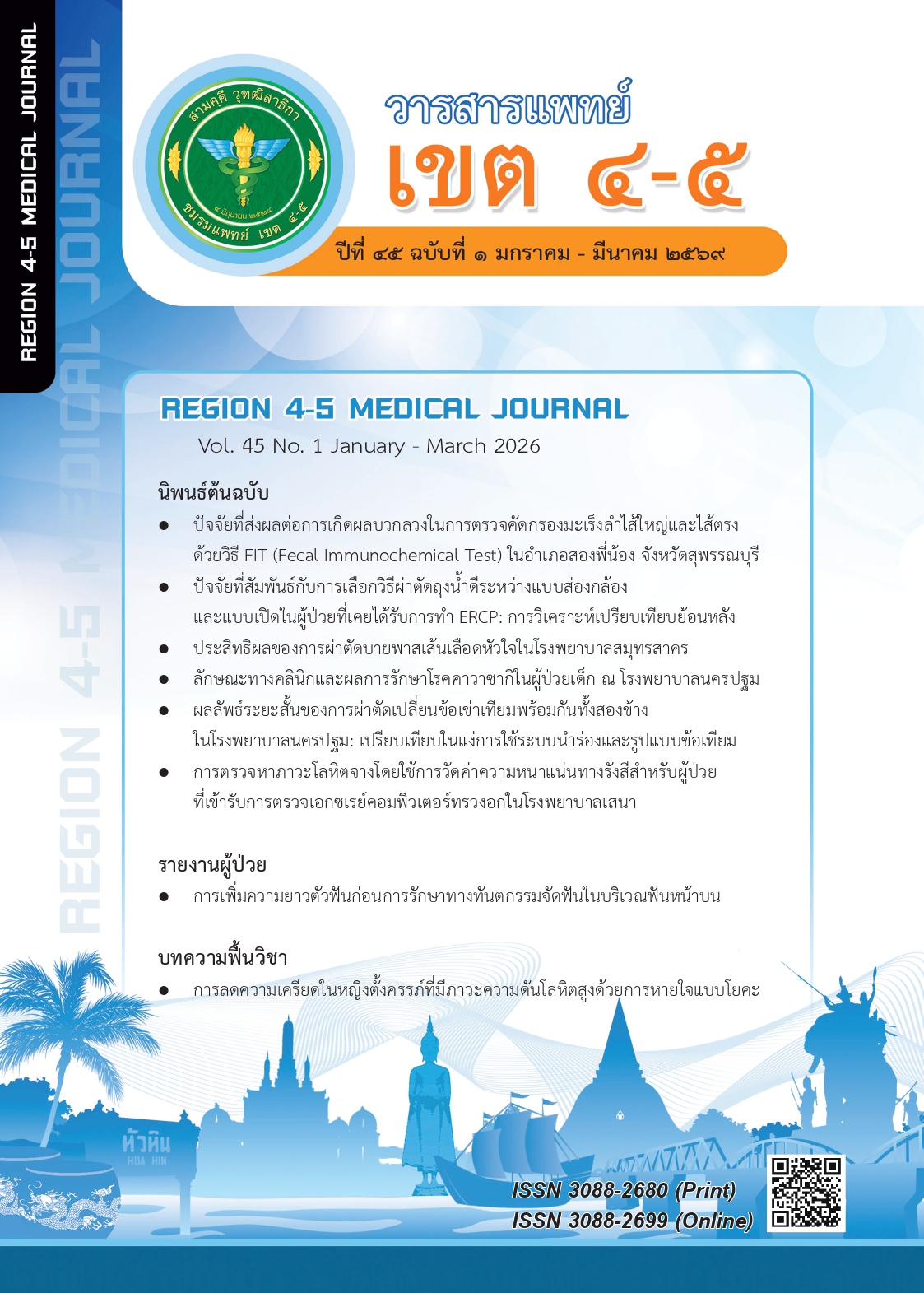
Factors Associated with the Choice Between Laparoscopic Cholecystectomy and Open Cholecystectomy in the Patients with Prior ERCP: A Retrospective Comparative Analysis
Keywords:
laparoscopic cholecystectomy, open cholecystectomy, , endoscopic retrograde cholangiopancreatography, conversion rate from LC to OC, endoscopic retrograde cholangiopancreatographyAbstract
Objective: To identify factors associated with the choice of laparoscopic cholecystectomy (LC) versus open cholecystectomy (OC) in patients with prior endoscopic retrograde cholangiopancreatography (ERCP), and to analyze surgical outcomes, conversion rates, and complications between the two approaches.
Methods: A retrospective cohort study was conducted on the patients who underwent cholecystectomy after ERCP in Somdejprasangkharach 17th Hospital, Suphan Buri between October 2020 and March 2025. Data were collected from medical records including patient demographics, laboratory results, imaging findings, ERCP characteristics, and surgical outcomes. Statistical analyses included chi-square test, Fisher’s exact probability test, independent t test, Mann-Whitney U test, and the outcomes among each type of the operations were analyzed by using one-way analysis of variance, statistical significance set at p < .05.
Results: Among 50 patients, 23 (46%) underwent LC and 27 (54%) underwent OC, with a conversion rate of 21.7%. Preoperative diagnosis was significantly associated with the choice of procedure (p < .001). Patients with acute cholecystitis, CBD stone with cholangitis, and gallstone pancreatitis were more likely to undergo OC. The successful LC group had less blood loss (mean 10 vs. 100 cc; p < .001), but had longer operative time (mean 106.5 vs. 81 minutes; p = .001), and shorter hospital stay (mean 3 vs. 5 days; p = .019) compared to OC. Complications were observed more frequently in the OC group than in the LC group; however, the difference was not statistically significant.
Conclusion: Preoperative diagnosis is the key determinant in selecting the surgical approach for cholecystectomy in post-ERCP patients. While LC offers better advantages in recovery and less complications, the high conversion rate necessitates careful risk assessment, comprehensive patient counseling, and preparation of the operating team for conversion.
References
Wu Y, Xu CJ, Xu SF. Advances in risk factors for recurrence of common bile duct stones. Int J Med Sci. 2021;18(4):1067–74. doi:10.7150/ijms.52974.
Williams E, Beckingham I, El Sayed G, Gurusamy K, Sturgess R, Webster G, et al. Updated guideline on the management of common bile duct stones (CBDS). Gut. 2017;66:765–82. doi: 10.1136/gutjnl-2016-312317.
ASGE Standards of Practice Committee, Buxbaum JL, Abbas Fehmi SM, Sultan S, Fishman DS, Qumseya BJ, et al. ASGE guideline on the role of endoscopy in the evaluation and management of choledocholithiasis. Gastrointest Endosc. 2019;89:1075–105.e15 doi: 10.1016/j.gie.2018.10.001
ราชวิทยาลัยศัลยแพทย์แห่งประเทศไทย. แนวทางการรักษาพยาบาลผู้ป่วยทางศัลยกรรม โรคนิ่ว
ในทางเดินน้ำดี [อินเทอร์เน็ต]. 2566 [เข้าถึงเมื่อ วันที่ 4 มกราคม พ.ศ. 2569]; เข้าถึงได้จาก: URL: www.rcst.or.th/ view.php?group=4&id=204, 2566.
McCarty TR, Farrelly J, Njei B, Jamidar P, Muniraj T. Role of prophylactic cholecystectomy after endoscopic sphincterotomy for biliary stone disease: A systematic review and meta analysis. Ann Surg. 2021;273:667–75. doi: 10.1097/SLA.0000000000003977
Wong CSL, Krishnan A, Kumaran N, Tanner N. Post-ERCP clearance of bile duct stones: Should the gallbladder be left in-situ? Surg Endosc. 2025;39(3):1653–60. doi: 10.1007/ s00464-024-11510-6.
Roy DK, Sheikh R. A systematic review and meta-analysis of the outcomes of laparoscopic cholecystectomy compared to the open procedure in patients with gallbladder disease. Avicenna J Med. 2024;14(1):3–21. doi: 10.1055/s-0043-1777710.
Tongyoo A, Chotiyasilp P, Sriussadaporn E, Limpavitayaporn P, Mingmalairak C. The pre-operative predictive model for difficult elective laparoscopic cholecystectomy: A modification. Asian J Surg. 2021;44(4):656–61. doi: 10.1016/j.asjsur.2020.11.018.
Boonsinsukh T, Sudcharoen A, Viriyaroj V, Yodying H, Tullavardhana T, Rookkachart T, et al. Effect of difficult common bile duct stone on conversion rate from laparoscopic to open cholecystectomy. JHSMR. 2024;42(4):e20231022.
Chartkitchareon A, Tullavardhana T. Integrating critical view of safety and indocyanine green cholangiography to enhance safety in laparoscopic cholecystectomy: A retrospective cross-sectional study. Sci Rep. 2025;15(1):22566. doi: 10.1038/s41598-025-00991-7.
Wu K, Xiao L, Xiang J, Huan L, Xie W. Is early laparoscopic cholecystectomy after clearance of common bile duct stones by endoscopic retrograde cholangiopancreatography superior?: A systematic review and meta-analysis of randomized controlled trials. Medicine (Baltimore). 2022;101(45):e31365. doi: 10.1097/MD.0000000000031365.
Poprom N, Suragul W, Muangkaew P, Vassanasiri W, Rungsakulkij N, Mingphruedhi S, et al. Timing of laparoscopic cholecystectomy after endoscopic retrograde cholangiopancreatography in cholelithiasis patients: A systematic review and meta-analysis. Ann Hepatobiliary Pancreat Surg. 2023;27(1):20–7. doi: 10.14701/ahbps.22-040.
Abdalkoddus M, Franklyn J, Ibrahim R, Yao L, Zainudin N, Aroori S. Delayed cholecystectomy following endoscopic retrograde cholangio-pancreatography is not associated with worse surgical outcomes. Surg Endosc. 2022;36(5):2987–93. doi: 10.1007/s00464-021-08593-w.
สหธรรม สมินทรปัญญา. ปัจจัยที่มีผลต่อความยากในการผ่าตัดถุงน้ำดีผ่านกล้อง. วารสารลำปางเวชสาร. 2552;30(3):131–7.
Reinders JSK, Gouma DJ, Heisterkamp J, Tromp E, van Ramshorst B, Boerma D. Laparoscopic cholecystectomy is more difficult after a previous endoscopic retrograde cholangiography. HPB (Oxford). 2013;15:230–4. doi: 10.1111/j.1477-2574.2012.00582.x.
Warchałowski Ł, Łuszczki E, Bartosiewicz A, Dereñ K, Warchałowska M, Oleksy Ł, et al. The analysis of risk factors in the conversion from laparoscopic to open cholecystectomy. Int J Environ Res Public Health. 2020;17(20):7571. doi: 10.3390/ ijerph17207571
Halbert C, Altieri MS, Yang J, Meng Z, Chen H, Talamini M, et al. Long-term outcomes of patients with common bile duct injury following laparoscopic cholecystectomy. Surg. Endosc. 30(10):4294–9. doi: 10.1007/s00464-016-4745-9.
Bostanci EB, Ercan M, Ozer I, Teke Z, Parlak E, Akoglu M. Timing of elective laparoscopic cholecystectomy after endoscopic retrograde cholangiopancreaticography with sphincterotomy: a prospective observational study of 308 patients. Langenbecks Arch Surg. 2010;395(6):661–6. doi: 10.1007/s00423-010-0653-y.
Takada T, Isaji S, Mayumi T, Yoshida M, Takeyama Y, Itoi T, et al. JPN clinical practice guidelines 2021 with easy-to-understand explanations for the management of acute pancreatitis. J Hepatobiliary Pancreat Sci. 2022;29(10):1057–83. doi: 10.1002/jhbp.1146
Overby DW, Apelgren KN, Richardson W, Fanelli R; Society of American Gastrointestinal and Endoscopic Surgeons. SAGES guidelines for the clinical application of laparoscopic biliary tract surgery. Surg Endosc. 2010;24(10):2368–86. doi: 10.1007/s00464-010-1268-7.
Giger UF, Michel JM, Opitz I, Th Inderbitzin D, Kocher T, Krähenbühl L; Swiss Association of Laparoscopic and Thoracoscopic Surgery (SALTS) Study Group. Risk factors for perioperative complications in patients undergoing laparoscopic cholecystectomy: analysis of 22,953 consecutive cases from the Swiss Association of Laparoscopic and Thoracoscopic Surgery database. J Am Coll Surg. 2006;203(5):723–8. doi: 10.1016/j.jamcollsurg.2006.07.018.
Downloads
Published
How to Cite
Issue
Section
License
Copyright (c) 2026 Region 4-5 Medical Journal

This work is licensed under a Creative Commons Attribution-NonCommercial-NoDerivatives 4.0 International License.
ลิขสิทธิ์บทความเป็นของผู้เขียนบทความ แต่หากผลงานของท่านได้รับการพิจารณาตีพิมพ์ลงวารสารแพทย์เขต 4-5 จะคงไว้ซึ่งสิทธิ์ในการตีพิมพ์ครั้งแรกด้วยเหตุที่บทความจะปรากฎในวารสารที่เข้าถึงได้ จึงอนุญาตให้นำบทความในวารสารไปใช้ประโยชน์ได้ในเชิงวิชาการโดยจำเป็นต้องมีการอ้างอิงถึงชื่อวารสารอย่างถูกต้อง แต่ไม่อนุญาตให้นำไปใช้ในเชิงพาณิชย์