
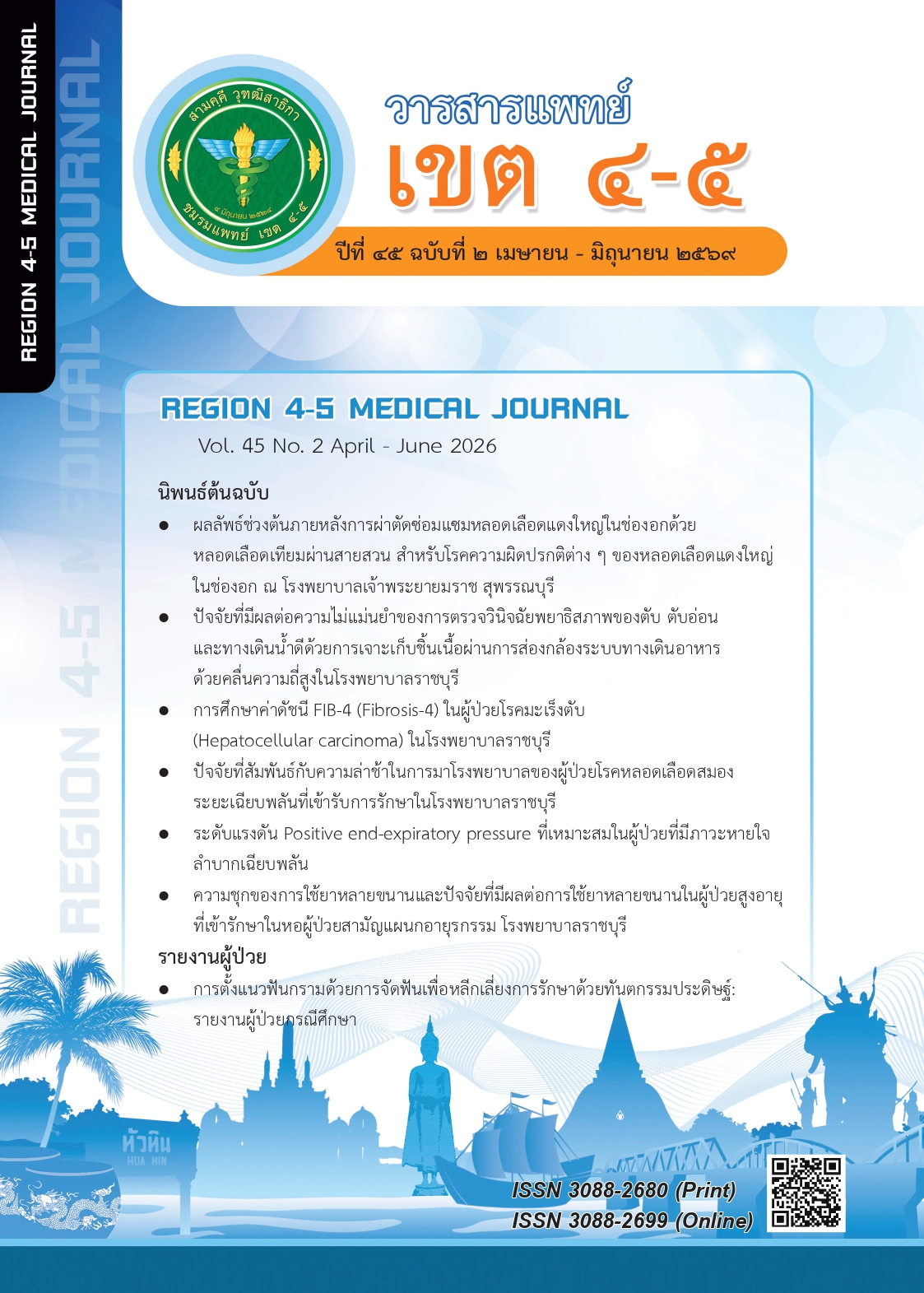
Optimal Level of Positive End-Expiratory Pressure in Patients with Acute Respiratory Distress Syndrome
Keywords:
acute respiratory distress syndrome, optimal level of positive end-expiratory pressureAbstract
Objective: To determine the optimal level of positive end-expiratory pressure (PEEP) in patients with acute respiratory distress syndrome (ARDS) and to compare 30-day mortality rates between different PEEP applications
Methods: This retrospective analytical study collected data over a one-year period, from November 1, 2024, to October 30, 2025. The study population included patients diagnosed with ARDS admitted to the Intensive Care Unit (ICU) at Ratchaburi Hospital. Data were retrieved from electronic medical records, including i-chart and HOSxP systems. Statistical analysis was performed using descriptive statistics; comparative analyses were conducted using independent t tests and chi-square tests (or Fisher’s exact test where appropriate).
Results: A total of 112 patients were included and divided into two groups: the High PEEP group (n = 43) and the Low PEEP group (n = 69). The 30-day mortality rate was 13.9% (6 out of 43) in the High PEEP group and 7.2% (5 out of 69) in the Low PEEP group. There was no statistically significant difference in mortality rates between the two groups. However, the High PEEP group showed a superior trend in the improvement of the PaO2/FiO2 ratio (P/F ratio) compared to the Low PEEP group.
Conclusion: In patients with ARDS, different levels of PEEP did not significantly affect 30-day mortality rates. Nevertheless, the application of high PEEP was more effective in improving blood oxygenation levels.
References
Thompson BT, Chambers RC, Liu KD. Acute respiratory distress syndrome. N Engl J Med. 2017;377(6):562–72. doi: 10.1056/NEJMra1608077.
Matthay MA, Arabi Y, Arroliga AC, Bernard G, Bersten AD, Brochard LJ, et al. A new global definition of acute respiratory distress syndrome. Am J Respir Crit Care Med. 2024;209(1):37–47. doi: 10.1164/rccm.202303-0558WS.
Walkey AJ, Goligher CE, Del Sorbo L, Hodgson CL, Adhikari NKJ, Wunsch H, et al. Low tidal volume versus non-volume-limited strategies for patients with acute respiratory distress syndrome: A systematic review and meta-analysis. Ann Am Thorac Soc. 2017;14(Suppl 4):S271–9. doi: 10.1513/AnnalsATS.201704-337OT.
Confalonieri M, Salton F, Fabiano F. Acute respiratory distress syndrome. Eur Respir Rev. 2017;26(144):160116. doi: 10.1183/16000617.0116-2016.
Zhao Z, Steinmann D, Frerichs I, Guttmann J, Moller K. PEEP titration guided by ventilation homogeneity: A feasibility study using electrical impedance tomography. Critical care. 2010; 14(1):R8. doi: 10.1186/cc8860.
Franchineau G, Brechot N, Lebreton G, Hekimian G, Nieszkowska A, Trouillet JL, et al. Bedside contribution of electrical impedance tomography to setting positive end-expiratory pressure for extracorporeal membrane oxygenation-treated patients with severe acute respiratory distress syndrome. Am J Respir Crit Care Med. 2017;196(4):447–57. doi: 10.1164/rccm.201605-1055OC.
Bouhemad B, Mongodi S, Via G, Rouquette I. Ultrasound for “Lung Monitoring” of ventilated patients. Anesthesiology. 2014;122(2). 437–47. doi: 10.1097/ALN.0000000000000558.
Stefanidis K, Dimopoulos S, Tripodaki E-S, Vitzilaios K, Politis P, et al. Lung sonography and recruitment in patients with early acute respiratory distress syndrome: A pilot study. Crit Care. 2011;15(4):R185. doi: 10.1186/cc10338
Sabine K-Z, Benjamin S, Jörn K, Ullrich M-L, Knut M, Zhanqi Z. Positioning of electrode plane systematically influences EIT imaging. Physiol Meas. 2015;36(6):1109–18. doi: 10.1088/0967-3334/36/6/1109.
Eronia N, Mauri T, Maffezzini E, Gatti S, Bronco A, Alban L, et al. Bedside selection of positive end-expiratory pressure by electrical impedance tomography in hypoxemic patients: A feasibility study. Ann Intensive Care. 2017;7(1):76. doi: 10.1186/s13613-017-0299-9.
Guo L, Xie J, Huang Y, Pan C, Yang Y, Qiu H, et al. Higher PEEP improves outcomes in ARDS patients with clinically objective positive oxygenation response to PEEP: A systematic review and meta-analysis. BMC Anesthesiol. 2018;18(1):172. doi: 10.1186/s12871-018-0631-4.
Downloads
Published
How to Cite
Issue
Section
License
Copyright (c) 2026 Region 4-5 Medical Journal

This work is licensed under a Creative Commons Attribution-NonCommercial-NoDerivatives 4.0 International License.
ลิขสิทธิ์บทความเป็นของผู้เขียนบทความ แต่หากผลงานของท่านได้รับการพิจารณาตีพิมพ์ลงวารสารแพทย์เขต 4-5 จะคงไว้ซึ่งสิทธิ์ในการตีพิมพ์ครั้งแรกด้วยเหตุที่บทความจะปรากฎในวารสารที่เข้าถึงได้ จึงอนุญาตให้นำบทความในวารสารไปใช้ประโยชน์ได้ในเชิงวิชาการโดยจำเป็นต้องมีการอ้างอิงถึงชื่อวารสารอย่างถูกต้อง แต่ไม่อนุญาตให้นำไปใช้ในเชิงพาณิชย์