
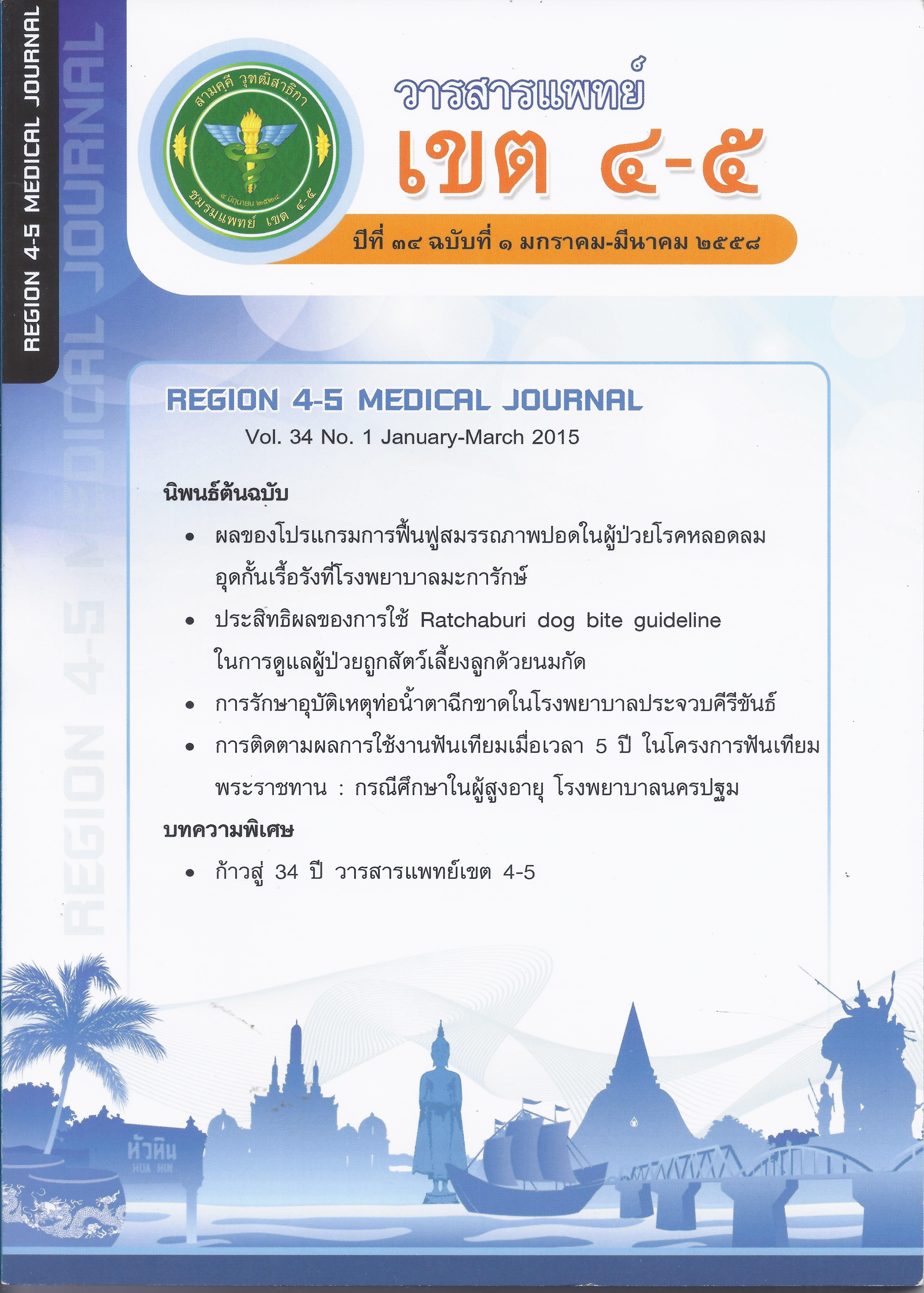
ประสิทธิผลของการใช้ Ratchaburi dog bite guideline ในการดูแลผู้ป่วยถูกสัตว์เลี้ยงลูกด้วยนมกัด
คำสำคัญ:
ผู้ป่วยสัตว์เลี้ยงลูกด้วยนมกัด, แนวทางป้องกันโรคพิษสุนัขบ้า, กรมควบคุมโรค, โรงพยาบาลราชบุรีบทคัดย่อ
วัตถุประสงค์ : ศึกษาเปรียบเทียบการได้รับวัคซีน และหรืออิมมูโนโกลบูลิน ของผู้ป่วยถูกสัตว์เลี้ยงลูกด้วยนมกัด ตามแนวทางเวชปฏิบัติโรคพิษสุนัขบ้า ของสำนักงานโรคติดต่อทั่วไป กรมควบคุมโรค กระทรวงสาธารณสุข และการหยุดฉีดวัคซีนหลังสัตว์ที่กัดยังมีชีวิตอยู่เกิน 10 วัน ก่อนและหลังการใช้ Ratchaburi Dog Bite Guideline
วัสดุและวิธีการศึกษา : เป็นการศึกษาย้อนหลังและเลือกสุ่มข้อมูลจากเวชระเบียนผู้ป่วยถูกสัตว์เลี้ยงลูกด้วยนมกัด ที่มารับการรักษาที่โรงพยาบาลราชบุรีในช่วงเดือนมกราคม พ.ศ. 2554 ถึงเดือนธันวาคม พ.ศ. 2556 โดยเปรียบเทียบอัตราการได้รับวัคซีน และหรืออิมมูโนโกลบูลิน ตามแนวทางเวชปฏิบัติโรคพิษสุนัขบ้า ของกรมควบคุมโรค กระทรวงสาธารณสุข ของกลุ่มผู้ป่วยก่อนและหลังการใช้ Ratchaburi Dog Bite Guideline และอัตราการหยุดฉีดวัคซีนหลังสัตว์ที่กัดยังมีชีวิตอยู่เกิน 10 วัน ในกลุ่มผู้ป่วยหลังมีการใช้ Ratchaburi Dog Bite Guideline
ผลการศึกษา : อัตราการได้รับวัคซีน และหรืออิมมูโนโกลบูลิน ตามแนวทางเวชปฏิบัติโรคพิษสุนัขบ้า ของกรมควบคุมโรค กระทรวงสาธารณสุข ของผู้ป่วยถูกสัตว์เลี้ยงลูกด้วยนมกัด ก่อนและหลังการใช้ Ratchaburi Dog Bite Guideline คิดเป็นเป็นร้อยละ 35.2 และร้อยละ 59.3 ตามลำดับ ซึ่งแตกต่างกันอย่างมีนัยสำคัญทางสถิติ (p- value = 0.01) และหลังการใช้ Ratchaburi Dog Bite Guideline พบการซักประวัติและตัดสินใจหยุดฉีดวัคซีนแก่ผู้ป่วย หลังสัตว์ที่กัดยังมีชีวิตอยู่เกิน 10 วัน คิดเป็นร้อยละ 49
สรุป : การใช้ Ratchaburi Dog Bite Guideline ช่วยให้ผู้ป่วยที่ถูกสัตว์เลี้ยงลูกด้วยนมกัด ได้รับการให้วัคซีน และหรืออิมมูโนโกลบูลินตามแนวทางเวชปฏิบัติโรคพิษสุนัขบ้า กรมควบคุมโรค กระทรวงสาธารณสุขเพิ่มขึ้น และมีการหยุดฉีดวัคซีนหลังสัตว์ที่กัดยังมีชีวิตอยู่เกิน 10 วัน ซึ่งทำให้ลดค่าใช้จ่ายจากการฉีดวัคซีนลงได้
เอกสารอ้างอิง
2. Dean DJ, Baer GM, Thomson WR. Studies on the local treatment of rabies-infected wounds. Bull World Health Organ 1963;28:477-86.
3. Rabies vaccines. WHO position paper. Wkly Epidermiol Rec 2007;82(49-50):425-35.
4. Manning SE, Rupprecht CE, Fishbein D, et al. Human rabies prevention-United States, 2008: recommendations of the Advisory Committee on Immunization Practices. MMWR Recomm Rep 2008;57(RR-3):1-28.
5. Dodet B. An important date in rabies history. Vaccine 2007;25:8647-50.
6. Tepsumethanon V, Lumlertdacha B, Mitmoonpitak C, et al Fluorescent antibody test for rabies: prospective study 0f 8,987 brains. Clin infect Dis 1997;25:1459-61.
7. Tepsumethanon V, Lumlertdacha B, Mitmoonpitak C, et al. Survival of naturally infected rabid dogs and cats. Clin infect Dis 2004;39:278-80.
8. Zoonoses control. WHO consultation on intradermal application of human rabies vaccines. Wkly Epidermiol Rec 1995;70:336-8.
9. Dodet B; Asian Rabies Expert Bureau. Preventing the incurable: Asian rabies experts advocate rabies control. Vaccine 2006;24(16):3045-9.
10. Wilde H, Hemachudha T. How far can the antigen content to tissue culture rabies vaccines be reduced safely? Vaccine 2006;24(10):1489.
ดาวน์โหลด
เผยแพร่แล้ว
รูปแบบการอ้างอิง
ฉบับ
ประเภทบทความ
สัญญาอนุญาต
ลิขสิทธิ์บทความเป็นของผู้เขียนบทความ แต่หากผลงานของท่านได้รับการพิจารณาตีพิมพ์ลงวารสารแพทย์เขต 4-5 จะคงไว้ซึ่งสิทธิ์ในการตีพิมพ์ครั้งแรกด้วยเหตุที่บทความจะปรากฎในวารสารที่เข้าถึงได้ จึงอนุญาตให้นำบทความในวารสารไปใช้ประโยชน์ได้ในเชิงวิชาการโดยจำเป็นต้องมีการอ้างอิงถึงชื่อวารสารอย่างถูกต้อง แต่ไม่อนุญาตให้นำไปใช้ในเชิงพาณิชย์