
Postoperative Pain and Blood Loss of Non-use Compared to Partial-use of a Tourniquet in Bilateral Total Knee Replacement: A Randomized Control Trial
DOI:
https://doi.org/10.33192/smj.v77i6.271055Keywords:
Total knee arthroplasty, Bilateral, Pain, TourniquetAbstract
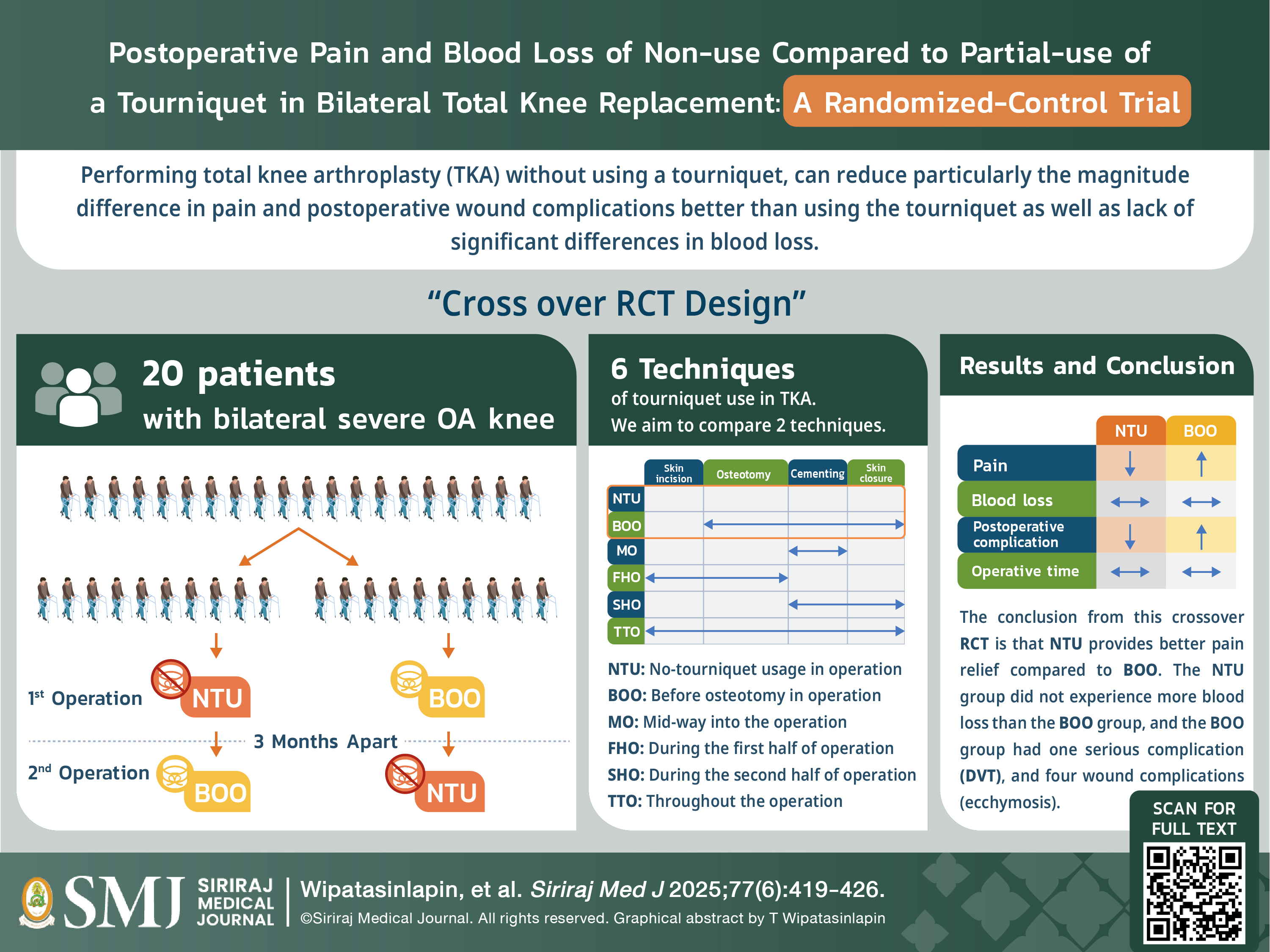
Objective: This study aimed to compare the effects of non-tourniquet usage (NTU) and partial-tourniquet usage (before osteotomy in operation; BOO) of a tourniquet in bilateral total knee arthroplasty (TKA) on postoperative
pain and complications.
Materials and Methods: A prospective randomized control trial with cross-over design was designed to compare the effect of NTU vs BOO in the patients underwent bilateral TKA. The opioid consumption and pain score were primary outcomes. Blood loss, the number of wound complications, the postoperative complications and time to ambulation were secondary outcomes.
Results: NTU group showed a significantly reduction in opioid consumption (14.8 ± 8.3 mg) as compared to that of BOO group (24.6 ± 10.8 mg) in the postoperative 24 hours. The postoperative pain score was significantly lower by the first, second, third and fourth day postoperative in NTU group (3.2, 3.9, 3.5, 2.3) compared to BOO group (4.3, 5.6, 4.8, and 4.1). There was no significant difference in blood loss between the groups. Early postoperative wound ecchymosis was found in BOO group (5 knees), more than in the NTU group (1 knee) with statistical significance.
Conclusion: Performing total knee arthroplasty (TKA) without using a tourniquet, can reduce particularly the magnitude difference in pain and opioid consumption better than using the tourniquet as well as lack of significant difference in blood loss. This will allow for future clinical implications to determine that NTU may be preferable due to reduced postoperative pain and fewer postoperative wound complications.
References
Luansritisakul C. Quality of Life after Total Knee Replacement at Siriraj Hospital, Thailand. Siriraj Med J. 2016;68(2):72-78.
Vandenbussche E, Duranthon LD, Couturier M, Pidhorz L, Augereau B. The effect of tourniquet use in total knee arthroplasty. Int Orthop. 2002;26(5):306-9.
Ozkunt O, Sariyilmaz K, Gemalmaz HC, Dikici F. The effect of tourniquet usage on cement penetration in total knee arthroplasty: a prospective randomized study of 3 methods. Medicine (Baltimore). 2018;97(4):e9668.
Arthur JR, Spangehl MJ. Tourniquet use in total knee arthroplasty. J Knee Surg. 2019;32(08):719-29.
Alexandersson M, Wang EY, Eriksson S. A small difference in recovery between total knee arthroplasty with and without tourniquet use the first 3 months after surgery: a randomized controlled study. Knee Surg Sports Traumatol Arthrosc. 2019;27(4):1035-42.
Jawhar A, Stetzelberger V, Kollowa K, Obertacke U. Tourniquet application does not affect the periprosthetic bone cement penetration in total knee arthroplasty. Knee Surg Sports Traumatol Arthrosc. 2019;27:2071-81.
Matar HE, Platt SR, Gollish JD, Cameron HU. Overview of randomized controlled trials in total knee arthroplasty (47,675 patients): what have we learnt? J Arthroplasty. 2020;35(6):1729-36.e1.
Liu Y, Si H, Zeng Y, Li M, Xie H, Shen B. More pain and slower functional recovery when a tourniquet is used during total knee arthroplasty. Knee Surg Sports Traumatol Arthrosc. 2020;28:1842-60.
Cao Z, Guo J, Li Q, Wu J, Li Y. Comparison of efficacy and safety of different tourniquet applications in total knee arthroplasty: a network meta-analysis of randomized controlled trials. Ann Med. 2021;53(1):1816-26.
Wang KY, LaVelle MJ, Gazgalis A, Bender JM, Geller JA, Neuwirth AL, Cooper HJ, Shah RP. Bilateral total knee arthroplasty: current concepts review. JBJS Rev. 2023;11(1):e22.
Kumar K, Railton C, Tawfic Q. Tourniquet application during anesthesia: “What we need to know?” J Anaesthesiol Clin Pharmacol. 2016;32(4):424-30.
Tai TW, Lin CJ, Jou IM, Chang CW, Lai KA, Yang CY. Tourniquet use in total knee arthroplasty: a meta-analysis. Knee Surg Sports Traumatol Arthrosc. 2011;19:1121-30.
Alcelik I, Pollock RD, Sukeik M, Bettany-Saltikov J, Armstrong PM, Fismer P. A comparison of outcomes with and without a tourniquet in total knee arthroplasty: a systematic review and meta-analysis of randomized controlled trials. J Arthroplasty. 2012;27(3):331-40.
Deering EM, Hu SY, Abdulkarim A. Does tourniquet use in TKA increase postoperative pain? A systematic review and meta-analysis. Clin Orthop Relat Res. 2019;477(3):547-58.
Published
How to Cite
License
Copyright (c) 2025 Siriraj Medical Journal

This work is licensed under a Creative Commons Attribution-NonCommercial-NoDerivatives 4.0 International License.
Authors who publish with this journal agree to the following conditions:
Copyright Transfer
In submitting a manuscript, the authors acknowledge that the work will become the copyrighted property of Siriraj Medical Journal upon publication.
License
Articles are licensed under a Creative Commons Attribution-NonCommercial-NoDerivatives 4.0 International License (CC BY-NC-ND 4.0). This license allows for the sharing of the work for non-commercial purposes with proper attribution to the authors and the journal. However, it does not permit modifications or the creation of derivative works.
Sharing and Access
Authors are encouraged to share their article on their personal or institutional websites and through other non-commercial platforms. Doing so can increase readership and citations.