
Ergonomic Risks and Musculoskeletal Pain among Office Workers in a Healthcare Setting: A Cross- Sectional Study
DOI:
https://doi.org/10.33192/smj.v77i6.272161Keywords:
Work-Related Musculoskeletal Disorders, Ergonomics, Rapid Office Strain AssessmentAbstract
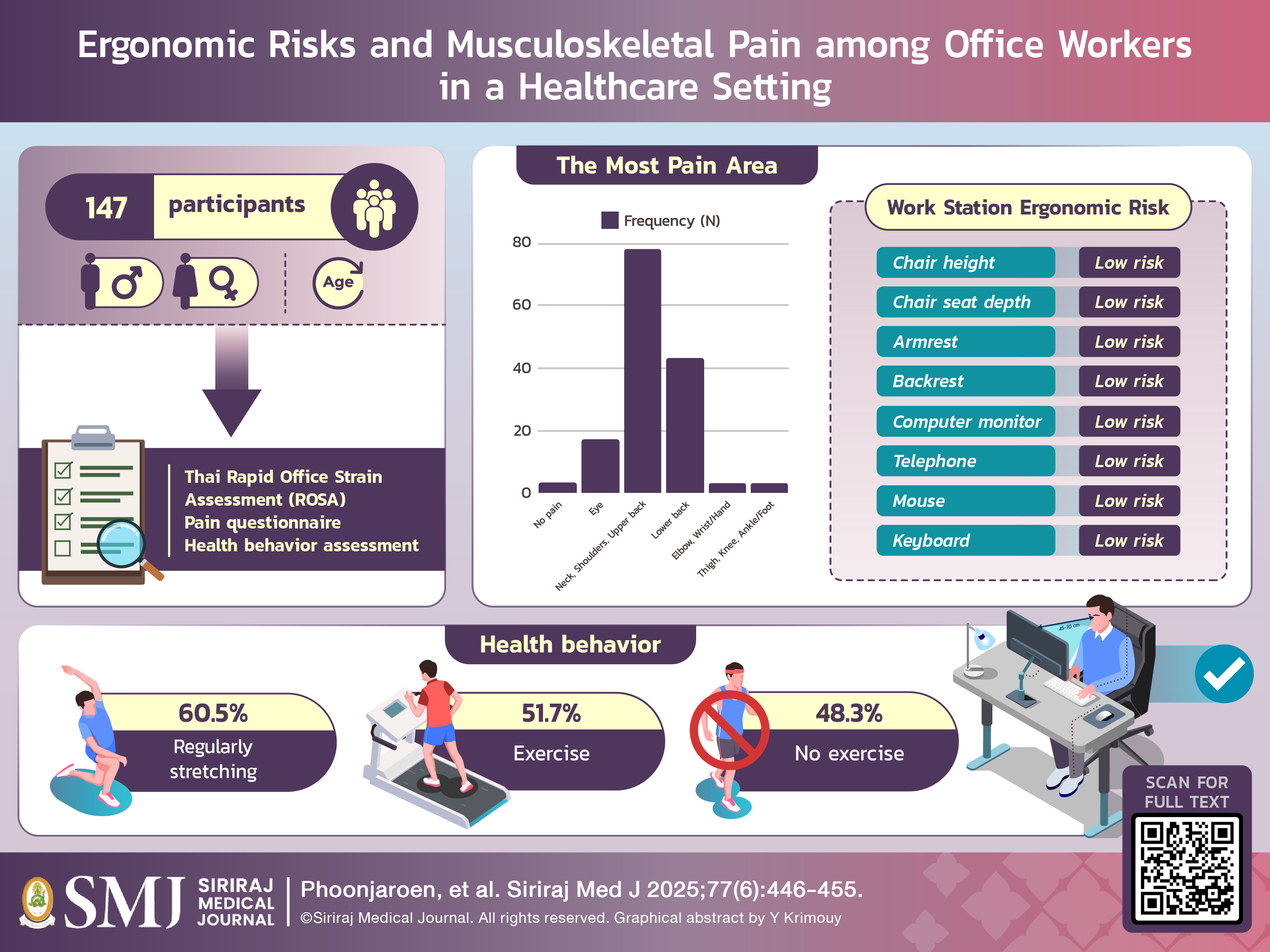
Objective: The primary aim of this study is to assess ergonomic risks among office workers at the Golden Jubilee Medical Center using the Rapid Office Strain Assessment Thai version (Thai ROSA). Additionally, the study explores the relationship between ergonomic risks and pain, considering the multifaceted nature of work-related discomfort.
Materials and Methods: A cross-sectional study was conducted, involving 147 office workers who regularly use desktop computers. The Thai ROSA tool was employed for ergonomic risk assessment. Self-report questionnaires, including a pain questionnaire and health behavior assessment, were utilized. Statistical analyses, including descriptive statistics and bivariate analyses, were applied to interpret the data.
Results: While the majority of participants reported low ergonomic risk, the prevalence of musculoskeletal pain, particularly in the neck and lower back, was noteworthy. Surprisingly, discrepancies were observed between Thai ROSA-assessed ergonomic risks and reported pain levels.
Conclusion: The study highlights the pervasive issue of musculoskeletal pain among office workers, urging comprehensive strategies beyond conventional ergonomic assessments. Despite low Thai ROSA-assessed risks, a substantial portion reported discomfort, emphasizing the need for refined ergonomic tools and workplace interventions. Encouraging healthy behaviors is crucial for overall well-being, and future research should explore the intricate interplay between physical and mental factors contributing to work-related pain.
References
Beer P, Mulder RH. The Effects of technological developments on work and their implications for continuous vocational education and training: a systematic review. Front Psychol. 2020;11:918.
Soonthornvinit W, Chaiear N, Boonjaraspinyo S, Tiamkao S. Working Hours Related to Good Quality of Work Life (QoWL) among Doctors Working in Public Hospitals in Northeastern Thailand. J Med Assoc Thai. 2019;102(Suppl 1):S47-S54.
Chinedu NOO, Henry NAT, Nene NJJ, Okwudili NJD. Work-Related Musculoskeletal Disorders among Office Workers in Higher Education Institutions: A Cross-Sectional Study. Ethiop J Health Sci. 2020;30(5):715-24.
Baker R, Coenen P, Howie E, Williamson A, Straker L. The short term musculoskeletal and cognitive effects of prolonged sitting during office computer work. Int J Environ Res Public Health. 2018;15(8):1678.
Jacquier-Bret J, Gorce P. Prevalence of Body Area Work-Related Musculoskeletal Disorders among Healthcare Professionals: A Systematic Review. Int J Environ Res Public Health. 2023;20(1):841.
Hush JM, Michaleff Z, Maher CG, Refshauge K. Individual, physical and psychological risk factors for neck pain in Australian office workers: a 1-year longitudinal study. Eur Spine J. 2009;18(10):1532-40.
Hernandez AM, Peterson AL. Work-Related musculoskeletal disorders and pain. In: Springer eBooks. 2012.p.63-85.
Chang YF, Yeh CM, Huang SL, Ho CC, Li RH, Wang WH, et al. Work Ability and Quality of Life in Patients with Work-Related Musculoskeletal Disorders. Int J Environ Res Public Health. 2020;17(9):3310.
Ghosh S, Bagchi A, Sen D, Bandyopadhyay P. Ergonomics: A bridge between fundamentals and applied research. Indian J Occup Environ Med. 2011;15(1):14-7.
Soares CO, Pereira BF, Gomes MVP, Marcondes LP, De Campos Gomes F, De Melo- Neto JS. Fatores de prevenção de distúrbios osteomusculares relacionados ao trabalho: revisão narrativa. Revista Brasileira De Medicina Do Trabalho. 2019;17(3):415-30.
Jun D, Zoe M, Johnston V, O’Leary S. Physical risk factors for developing non-specific neck pain in office workers: a systematic review and meta-analysis. Int Arch Occup Environ Health. 2017;90(5):373-410.
Kittijaruwattana J, Ratcha M, Tuprakay S, Surach A. A Systematic Review: Using Trends of Ergonomic Risk Assessment Tools. Health Sci J Thai. 2023;5(4):49-58.
Kingkaew WM, Paileeklee S, Jaroenngarmsamer P. Validity and Reliability of the Rapid Office Strain Assessment [ROSA] Thai version. J Med Assoc Thai. 2018;101(1):145-9.
Kibria MG, Parvez MS, Saha P, Talapatra S. Evaluating the ergonomic deficiencies in computer workstations and investigating their correlation with reported musculoskeletal disorders and visual symptoms among computer users in Bangladeshi university. Heliyon. 2023;9(11):e22179.
Bade S, Eckert J. Occupational therapists’ critical value in work rehabilitation and ergonomics. Work. 2008;31(1):101-11.
Gainer RD. History of ergonomics and occupational therapy. Work. 2008;31(1):5-9.
Setia MS. Methodology series module 3: Cross-sectional studies. Indian J Dermatol. 2016;61(3):261-4.
Krusun M, Chaiklieng S. Ergonomic risk assessment in university office workers. APST. 2017;19(5):696-707.
Boonstra AM, Stewart RE, Köke AJ, Oosterwijk RFA, Swaan JL, Schreurs KMG, et al. Cut-Off Points for Mild, Moderate, and Severe Pain on the Numeric Rating Scale for Pain in Patients with Chronic Musculoskeletal Pain: Variability and Influence of Sex and Catastrophizing. Front Psychol. 2016;7:1466.
Sonne M, Villalta DL, Andrews DM. Development and evaluation of an office ergonomic risk checklist: ROSA – Rapid office strain assessment. Appl Ergon. 2012;43(1):98-108.
Sonne M, Andrews DM. The Rapid Office Strain Assessment (Rosa): Validity of online worker self-assessments and the relationship to worker discomfort. Occupational Ergonomics. 2012;10(3):83-101.
World Health Organization. Regional Office for the Western Pacific. The Asia-Pacific perspective: redefining obesity and its treatment. Sydney: Health Communications Australia. 2000. Available from: https://iris.who.int/handle/10665/206936
Matos M, Arezes PM. Ergonomic evaluation of Office Workplaces with Rapid Office Strain Assessment (ROSA). Procedia Manufacturing. 2015;3:4689-94.
Chiasson MÈ, Imbeau D, Major J, Aubry K, Delisle A. Influence of musculoskeletal pain on workers' ergonomic risk-factor assessments. Appl Ergon. 2015;49:1-7.
Andersen LL, Vinstrup J, Sundstrup E, Skovlund SV, Villadsen E, Thorsen SV. Combined ergonomic exposures and development of musculoskeletal pain in the general working population: A prospective cohort study. Scand J Work Environ Health. 2021;47(4):287-95.
Arvidsson I, Gremark Simonsen J, Lindegård-Andersson A, Björk J, Nordander C. The impact of occupational and personal factors on musculoskeletal pain - a cohort study of female nurses, sonographers and teachers. BMC Musculoskelet Disord. 2020;21(1):621.
Khanngern N, Ratta-apha W, Wannarit K. Burnout among Mental Health Professionals in a Tertiary University Hospital. Siriraj Med J. 2022;74(3):185-92.
Espin A, Núñez-Cortés R, Irazusta J, Rodriguez-Larrad A, Torres-Unda J, Vinstrup J, et al. Mental health and vitality predict spinal pain in healthcare workers. Occup Med (Lond). 2023;73(8):464-9.
van Eerd D, Cole D, Irvin E, Mahood Q, Keown K, Theberge N, et al. Process and implementation of participatory ergonomic interventions: a systematic review. Ergonomics. 2010;53(10):1153-66.
Koma BS, Bergh AM, Costa-Black KM. Barriers to and facilitators for implementing an office ergonomics programme in a South African research organisation. Appl Ergon. 2019;75:83-90.
Okoye EA, Ugbebor J, Adaramola S. Assessing the effectiveness of ergonomics practices in selected workplaces in Port Harcourt, Nigeria. All Days. 2018 Aug 6; Available from: https://onepetro.org/SPENAIC/proceedings-abstract/18NAIC/All-18NAIC/216246
Mahmoud NA, Abu Raddaha AH, Zaghamir DE. Impact of Digital Device Use on Neck and Low Back Pain Intensity among Nursing Students at a Saudi Government University: A Cross-Sectional Study. Healthcare (Basel). 2022;10(12):2424.
Elvan A, Cevik S, Vatansever K, Erak I. The association between mobile phone usage duration, neck muscle endurance, and neck pain among university students. Sci Rep. 2024;14(1):20116.
Machado-Matos M, Arezes PM. Impact of a workplace exercise program on neck and shoulder segments in office workers. DYNA. 2016;83(196):63-68.
Karatrantou K, Gerodimos V. A Comprehensive Workplace Exercise Intervention to Reduce Musculoskeletal Pain and Improve Functional Capacity in Office Workers: A Randomized Controlled Study. Healthcare (Basel). 2024;12(9):915.
Barr-Anderson DJ, AuYoung M, Whitt-Glover MC, Glenn BA, Yancey AK. Integration of short bouts of physical activity into organizational routine a systematic review of the literature. Am J Prev Med. 2011;40(1):76-93.
Stults-Kolehmainen MA, Sinha R. The effects of stress on physical activity and exercise. Sports Med. 2014;44(1):81-121.
Puttipaibool S, Akarasereenont P, Chomchai S, Udomphorn Y, Asavamongkolkul A. Effects of Different Durations of 9-Square Dance Exercise Versus Treadmill Exercise on the Physical Fitness and Quality of Life of Healthy Volunteers: A Pilot Randomized Controlled Trial. Siriraj Med J. 2022;74(12):883-90.
Radwan A, Barnes L, DeResh R, Englund C, Gribanoff S. Effects of active microbreaks on the physical and mental well-being of office workers: A systematic review. Cogent Engineering. 2022;9(1).
Published
How to Cite
Issue
Section
Categories
License
Copyright (c) 2025 Siriraj Medical Journal

This work is licensed under a Creative Commons Attribution-NonCommercial-NoDerivatives 4.0 International License.
Authors who publish with this journal agree to the following conditions:
Copyright Transfer
In submitting a manuscript, the authors acknowledge that the work will become the copyrighted property of Siriraj Medical Journal upon publication.
License
Articles are licensed under a Creative Commons Attribution-NonCommercial-NoDerivatives 4.0 International License (CC BY-NC-ND 4.0). This license allows for the sharing of the work for non-commercial purposes with proper attribution to the authors and the journal. However, it does not permit modifications or the creation of derivative works.
Sharing and Access
Authors are encouraged to share their article on their personal or institutional websites and through other non-commercial platforms. Doing so can increase readership and citations.