
Predicting Functional Decline in Geriatric Abdominal Surgery Patients: Unveiling Incidence, Risk Factors, and Innovative Predictive Models in Thailand
DOI:
https://doi.org/10.33192/smj.v77i6.272262Keywords:
Activities of daily living, Functional status, Geriatrics, Risk factors, SurgeryAbstract
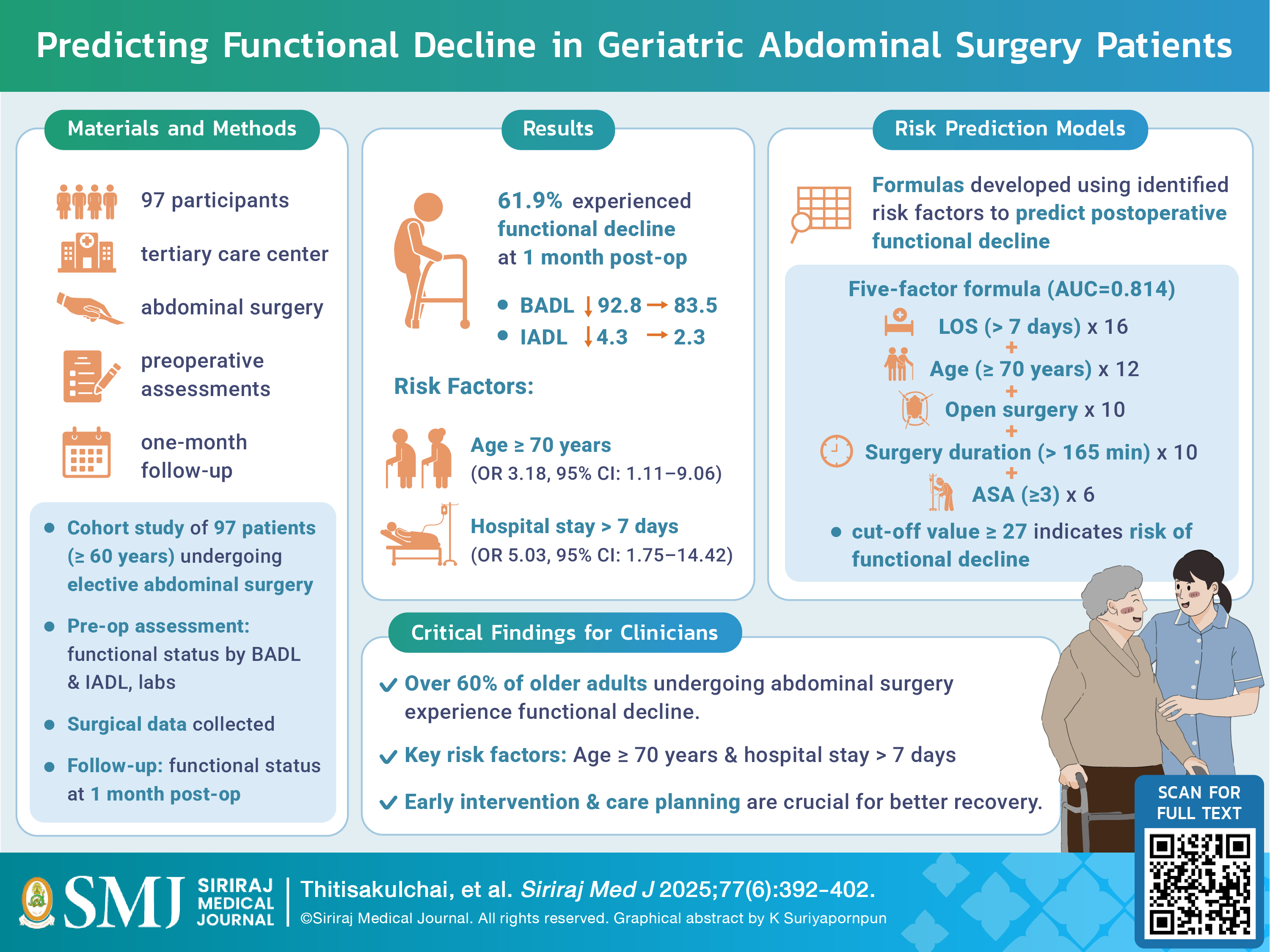
Objective: Surgery poses significant challenges for older adults, potentially leading to functional decline. This study investigated the incidence and risk factors associated with postoperative functional decline in older adults and developed formulas to predict its occurrence.
Materials and Methods: This cohort study analyzed patients aged 60 and over who underwent elective abdominal surgery at a tertiary care center in Thailand. The baseline characteristics including Basic Activities of Daily Living [BADL] and Instrumental Activities of Daily Living [IADL] scores, preoperative laboratory testing and surgical-related data were recorded. Functional status was reassessed one month post-surgery.
Results: The study involved 97 participants. One month post-surgery, the incidence of functional decline was 61.9%. The mean BADL and IADL scores in the functional decline group decreased from 92.8 ± 11.3 to 83.5 ± 17.8 and from 4.3 ± 1.3 to 2.3 ± 1.3, respectively (p<0.001). Multivariable logistic regression analysis identified age ≥ 70 years (adjusted OR 3.18, 95% CI 1.11–9.06, p=0.031) and a length of stay > 7 days (adjusted OR 5.03, 95% CI 1.75–14.42, p=0.003) as factors most strongly associated with functional decline. Formulas created using five factors related to decline from univariable analyses effectively predicted its occurrence, with AUCs ranging from 0.766 to 0.814.
Conclusion: Over 60% of older adults who underwent abdominal surgery experienced functional decline one month after surgery. The developed formulas can be used to identify patients at risk and help prevent functional decline in this population.
References
Abdulaziz K, Perry JJ, Taljaard M, Emond M, Lee JS, Wilding L, et al. National Survey of Geriatricians to Define Functional Decline in Elderly People with Minor Trauma. Can Geriatr J. 2016;19:2-8.
Asakawa T, Koyano W, Ando T, Shibata H. Effects of functional decline on quality of life among the Japanese elderly. Int J Aging Hum Dev. 2000;50:319-28.
Suwanabol PA, Li Y, Abrahamse P, De Roo AC, Vu JV, Silveira MJ, et al. Functional and Cognitive Decline Among Older Adults After High-risk Surgery. Ann Surg. 2022;275:e132-e139.
Lawrence VA, Hazuda HP, Cornell JE, Pederson T, Bradshaw PT, Mulrow CD, et al. Functional independence after major abdominal surgery in the elderly. J Am Coll Surg. 2004;199:762-72.
Robinson TN, Wallace JI, Wu DS, Wiktor A, Pointer LF, Pfister SM, et al. Accumulated frailty characteristics predict postoperative discharge institutionalization in the geriatric patient. J Am Coll Surg. 2011;213:37-42; discussion 42-4.
Finlayson E, Zhao S, Boscardin WJ, Fries BE, Landefeld CS, Dudley RA. Functional status after colon cancer surgery in elderly nursing home residents. J Am Geriatr Soc. 2012;60:967-73.
Zhang LM, Hornor MA, Robinson T, Rosenthal RA, Ko CY, Russell MM. Evaluation of Postoperative Functional Health Status Decline Among Older Adults. JAMA Surg. 2020;155:950-8.
Iglar PJ, Hogan KJ. Vitamin D status and surgical outcomes: a systematic review. Patient Saf Surg. 2015;9:14.
Hsu HY, Hwang LC, Lin CH, Lin CJ, Tjung JJ. Impact of serum albumin on functional status and hospital outcome in oldest-old inpatients. Int J Gerontol. 2015;9:220-2.
van Stijn MF, Korkic-Halilovic I, Bakker MS, van der Ploeg T, van Leeuwen PA, Houdijk AP. Preoperative nutrition status and postoperative outcome in elderly general surgery patients: a systematic review. JPEN J Parenter Enteral Nutr. 2013;37:37-43.
Kotlarczyk MP, Perera S, Ferchak MA, Nace DA, Resnick NM, Greenspan SL. Vitamin D deficiency is associated with functional decline and falls in frail elderly women despite supplementation. Osteoporos Int. 2017;28:1347-53.
Arnau A, Espaulella J, Serrarols M, Canudas J, Formiga F, Ferrer M. Risk factors for functional decline in a population aged 75 years and older without total dependence: A one-year follow-up. Arch Gerontol Geriatr. 2016;65:239-47.
Simões CM, Carmona MJC, Hajjar LA, Vincent JL, Landoni G, Belletti A, et al. Predictors of major complications after elective abdominal surgery in cancer patients. BMC Anesthesiol. 2018;18:49.
Hacim NA, Akbas A, Ulgen Y, Aktokmakyan TV, Meric S, Tokocin M, et al. Association of Preoperative Risk Factors and Mortality in Older Patients following Emergency Abdominal Surgery: A Retrospective Cohort Study. Ann Geriatr Med Res. 2021;25:252-9.
Yamaguchi K, Matsumoto S, Abe T, Nakajima K, Senoo S, Shimizu M, et al. Predictive value of total psoas muscle index for postoperative physical functional decline in older patients undergoing emergency abdominal surgery. BMC Surg. 2023;23:171.
Fukuda T, Imai S, Maruo K, Horiguchi H. A formula for predicting postoperative functional decline using routine medical data in elderly patients after hip fracture surgery. Curr Orthop Pract. 2023;34:208-14.
Zattoni D, Montroni I, Saur NM, Garutti A, Bacchi Reggiani ML, Ghignone F, et al. Prediction of functional loss in emergency surgery is possible with a simple frailty screening tool. World J Emerg Surg. 2021;16:12.
Hoogerduijn JG, de Rooij SE, Grobbee DE, Schuurmans MJ. Predicting functional decline in older patients undergoing cardiac surgery. Age Ageing. 2014;43:218-21.
Kleyweg RP, van der Meche FG, Schmitz PI. Interobserver agreement in the assessment of muscle strength and functional abilities in Guillain-Barre syndrome. Muscle Nerve. 1991;14:1103-9.
Jones CJ, Rikli RE, Beam WC. A 30-s chair-stand test as a measure of lower body strength in community-residing older adults. Res Q Exerc Sport. 1999;70:113-9.
Mahoney FI, Barthel DW. Functional Evaluation: The Barthel Index. Md State Med J. 1965;14:61-5.
Laohaprasitiporn P, Jarusriwanna A, Unnanuntana A. Validity and Reliability of the Thai Version of the Barthel Index for Elderly Patients with Femoral Neck Fracture. J Med Assoc Thai. 2017;100:539.
Lawton MP, Brody EM. Assessment of older people: self-maintaining and instrumental activities of daily living. Gerontologist. 1969;9:179-86.
Train the Brain Forum Committee. Thai mental state examination (TMSE). Siriraj Hosp Gaz. 1993;45:661-74.
Kaiser MJ, Bauer JM, Ramsch C, Uter W, Guigoz Y, Cederholm T, et al. Validation of the Mini Nutritional Assessment short-form (MNA-SF): a practical tool for identification of nutritional status. J Nutr Health Aging. 2009;13:782-8.
Lotrakul M, Sumrithe S, Saipanish R. Reliability and validity of the Thai version of the PHQ-9. BMC Psychiatry. 2008;8:46.
Jakobson T, Karjagin J, Vipp L, Padar M, Parik AH, Starkopf L, et al. Postoperative complications and mortality after major gastrointestinal surgery. Medicina (Kaunas). 2014;50:111-7.
Nahm FS. Receiver operating characteristic curve: overview and practical use for clinicians. Korean J Anesthesiol. 2022;75:25-36.
Tan HL, Chia STX, Nadkarni NV, Ang SY, Seow DCC, Wong TH. Frailty and functional decline after emergency abdominal surgery in the elderly: a prospective cohort study. World J Emerg Surg. 2019;14:62.
Honda Y, Takahashi K, Sasanuma N, Itani Y, Nagase M, Uchiyama Y, et al. Predictors of Functional Decline in Activities of Daily Living at Discharge in Patients After Cardiovascular Surgery. Circ J. 2021;85:1020-6.
Kanejima Y, Shimogai T, Kitamura M, Ishihara K, Izawa KP. Effect of Early Mobilization on Physical Function in Patients after Cardiac Surgery: A Systematic Review and Meta-Analysis. Int J Environ Res Public Health. 2020;17(19).
Tazreean R, Nelson G, Twomey R. Early mobilization in enhanced recovery after surgery pathways: current evidence and recent advancements. J Comp Eff Res. 2022;11:121-9.
Epstein NE. A review article on the benefits of early mobilization following spinal surgery and other medical/surgical procedures. Surg Neurol Int. 2014;5:S66-73.
Hu Y, McArthur A, Yu Z. Early postoperative mobilization in patients undergoing abdominal surgery: a best practice implementation project. JBI Database System Rev Implement Rep. 2019;17:2591-611.
Heng G, Lohsiriwat V, Tan K-Y. Suitability of Enhanced Recovery after Surgery (ERAS) Protocols for Elderly Colorectal Cancer Patients. Siriraj Med J. 2020;72:18-23.
Somnuke P, Pongraweewan O, Siriussawakul A. Optimizing Perioperative Care for Elderly Surgical Patients: A Review of Strategies and Evidence-Based Practices. Siriraj Med J. 2024;76:465-72.
Bruderer-Hofstetter M, Gorus E, Cornelis E, Meichtry A, De Vriendt P. Influencing factors on instrumental activities of daily living functioning in people with mild cognitive disorder - a secondary investigation of cross-sectional data. BMC Geriatr. 2022;22:791.
Rudolph JL, Inouye SK, Jones RN, Yang FM, Fong TG, Levkoff SE, et al. Delirium: an independent predictor of functional decline after cardiac surgery. J Am Geriatr Soc. 2010;58:643-9.
Liang CK, Chu CL, Chou MY, Lin YT, Lu T, Hsu CJ, et al. Interrelationship of postoperative delirium and cognitive impairment and their impact on the functional status in older patients undergoing orthopaedic surgery: a prospective cohort study. PLoS One. 2014;9:e110339.
Suraarunsumrit P, Pathonsmith C, Srinonprasert V, Sangarunakul N, Jiraphorncharas C, Siriussawakul A. Postoperative cognitive dysfunction in older surgical patients associated with increased healthcare utilization: a prospective study from an upper-middle-income country. BMC Geriatr. 2022;22:213.
Published
How to Cite
Issue
Section
Categories
License
Copyright (c) 2025 Siriraj Medical Journal

This work is licensed under a Creative Commons Attribution-NonCommercial-NoDerivatives 4.0 International License.
Authors who publish with this journal agree to the following conditions:
Copyright Transfer
In submitting a manuscript, the authors acknowledge that the work will become the copyrighted property of Siriraj Medical Journal upon publication.
License
Articles are licensed under a Creative Commons Attribution-NonCommercial-NoDerivatives 4.0 International License (CC BY-NC-ND 4.0). This license allows for the sharing of the work for non-commercial purposes with proper attribution to the authors and the journal. However, it does not permit modifications or the creation of derivative works.
Sharing and Access
Authors are encouraged to share their article on their personal or institutional websites and through other non-commercial platforms. Doing so can increase readership and citations.