
Transpore Tape and Transparent Film Dressing on the Incidence of Early-Stage Phlebitis: A Comparative Randomized Trial
DOI:
https://doi.org/10.33192/smj.v77i6.272715Keywords:
Peripheral venous catheter, transparent film dressing, transpore tape, phlebitisAbstract
Objective: This study compares the effectiveness of transpore tape and transparent film dressing on the incidence of early-stage phlebitis among patients with peripheral venous catheters.
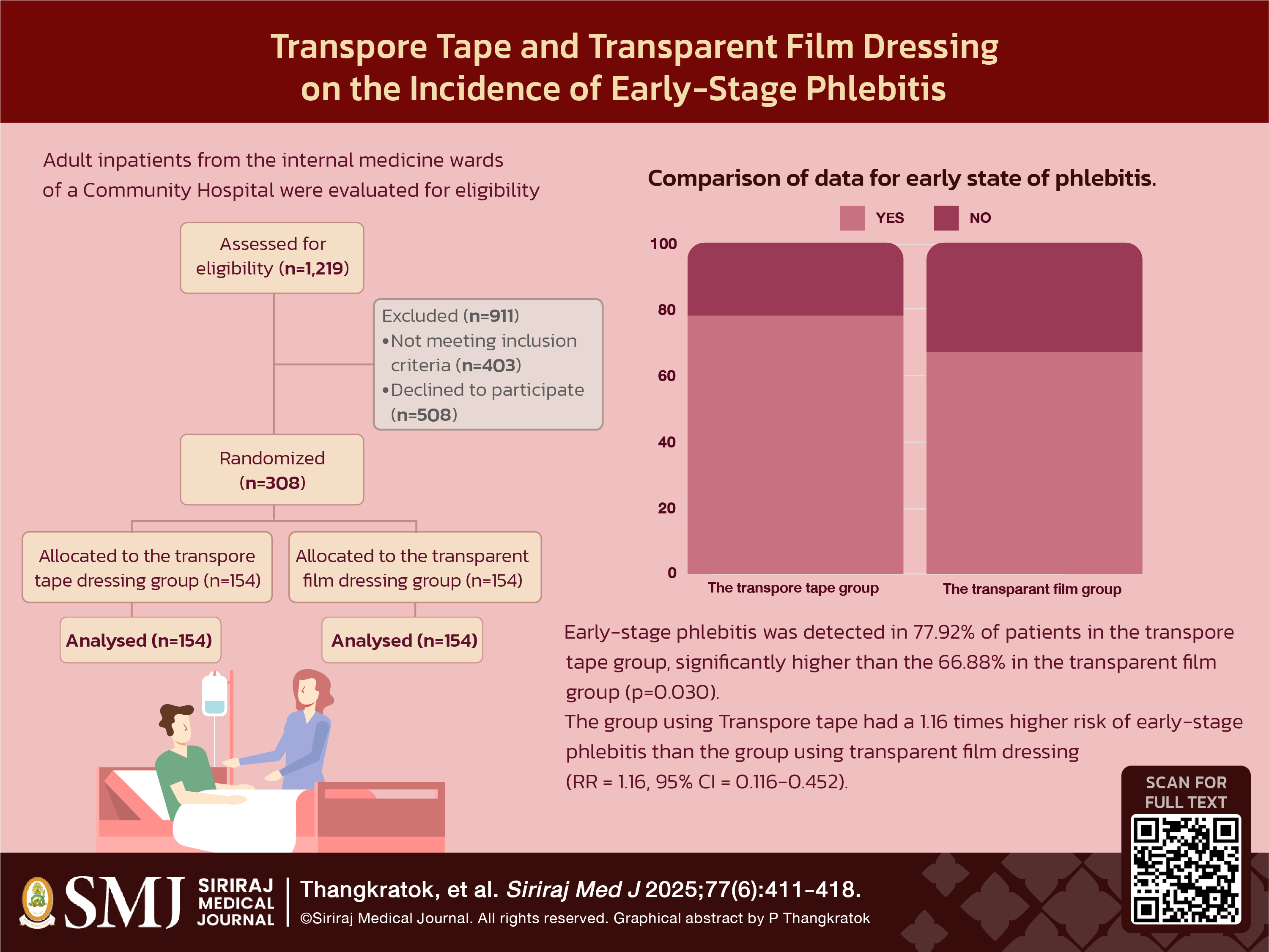
Materials and Methods: We conducted a randomized controlled prospective study on 308 inpatients in the internal medicine wards of a community hospital in Thailand, from November 2020 to March 2021. The visual infusion phlebitis scale was employed for assessments by registered nurses at least every eight hours.
Results: Demographic and health factors were similar in both transpore tape and transparent film dressing groups. Notably, early-stage phlebitis was detected in 77.92% of patients in the transpore tape group, significantly higher than the 66.88% in the transparent film group (p=0.030). The group using Transpore tape had a 1.16 times higher risk of early-stage phlebitis than the group using transparent film dressing (RR = 1.16, 95% CI = 0.116-0.452). Statistical analysis showed a significant difference in catheter removal time between the two groups.
Conclusion: Transparent film dressings demonstrated greater efficacy in reducing early-stage phlebitis incidences in patients with peripheral venous catheters, suggesting their preferable use in clinical settings.
References
Makafi S, Marfega M. Peripheral intravenous catheter (PIVC) related local complications among patients in KFCH-Jizan. Adv Practice Nurs. 2017;2(3).
Maki DG. Improving the safety of peripheral intravenous catheters. BMJ. 2008;337(7662):a630.
Zingg W, Pittet D. Peripheral venous catheters: an under-evaluated problem. Int J Antimicrob Agents. 2009;34 Suppl 4:S38-42.
Campbell L. IV-related phlebitis, complications and length of hospital stay: 1. Br J Nurs. 1998;7(21):1304-12.
Collin J, Constable F, Collin C, Johnston I. Infusion thrombophlebitis and infection with various cannulas. Lancet. 1975;306(7926):150-3.
Laudenbach N, Carie AB, Klaverkamp L, Hedman-Dennis S. Peripheral IV stabilization and the rate of complications in children: an exploratory study. J Pediatr Nurs. 2014;29(4):348-53.
Helm RE, Klausner JD, Klemperer JD, Flint LM, Huang E. Accepted but unacceptable: peripheral IV catheter failure. J Infus Nurs. 2015;38(3):189-203.
Enes SM, Opitz SP, Faro AR, Pedreira Mde L. Phlebitis associated with peripheral intravenous catheters in adults admitted to hospital in the Western Brazilian Amazon. Rev Esc Enferm USP. 2016;50(2):263-71.
Higginson R, Parry A. Phlebitis: treatment, care and prevention. Nurs Times. 2011;107(36):18-21.
Atay S, Yilmaz Kurt F. Effectiveness of transparent film dressing for peripheral intravenous catheter. J Vasc Access. 2021;22(1):135-40.
Forni C, Loro L, Tremosini M, Trofa C, D'Alessandro F, Sabattini T, et al. Effectiveness of sterile transparent dressing than the standard for attaching peripheral venous catheter (CVP) on the incidence of phlebitis: randomized controlled trial. Assist Inferm Ric. 2012;31(2):63-9.
Bausone-Gazda D, Lefaiver CA, Walters SA. A randomized controlled trial to compare the complications of 2 peripheral intravenous catheter-stabilization systems. J Infus Nurs. 2010;33(6):371-84.
Marsh N, Webster J, Mihala G, Rickard CM. Devices and dressings to secure peripheral venous catheters to prevent complications. Cochrane Database Syst Rev. 2015;(6):CD011070.
Gorski LA, Hadaway L, Hagle ME, Broadhurst D, Clare S, Kleidon T, et al. Infusion therapy standards of practice. J Infus Nurs. 2021;44(1S Suppl 1):S1-S224).
Alexandrou E, Ray-Barruel G, Carr PJ, Frost SA, Inwood S, Higgins N, et al. Use of short peripheral intravenous catheters: characteristics, management, and outcomes worldwide. J Hosp Med. 2018;13(5).
Boyce JM. Best products for skin antisepsis. Am J Infect Control. 2019;47(S):A17-A22.
Doesburg F, Smit JM, Paans W, Onrust M, Nijsten MW, Dieperink W. Use of infrared thermography in the detection of superficial phlebitis in adult intensive care unit patients: a prospective single-center observational study. PLoS One. 2019;14(3):e0213754.
Atay S, Sen S, Cukurlu D. Phlebitis-related peripheral venous catheterization and the associated risk factors. Niger J Clin Pract. 2018;21(7):827-31.
Gabriel J. Vascular access devices: securement and dressings. Nurs Stand. 2010;24(52):41-6.
Bernatchez SF. Care of peripheral venous catheter sites: advantages of transparent film dressings over tape and gauze. J Assoc Vasc Access. 2014;19(4):256-61.
De Bono S, Heling G, Borg MA. Organizational culture and its implications for infection prevention and control in healthcare institutions. J Hosp Infect. 2014;86(1):1-6.
Ezzelarab MH, Nouh O, Ahmed AN, Anany MG, Rachidi NGE, Salem AS. A randomized control trial comparing transparent film dressings and conventional occlusive dressings for elective surgical procedures. Open Access Maced J Med Sci. 2019;7(17):2844-50.
Chunhasuwankul R, Owattanapanich N, Somcharit L, Pantheepo H, Prasanrat S, Yiengpruksawan A. A prospective randomized controlled trial comparing infection rates of the daily dressing and scheduled dressing of sutured traumatic wounds. Siriraj Med J. 2018;70(5):377-81.
Loveday HP, Wilson JA, Pratt RJ, Golsorkhi M, Tingle A, Bak A, et al. epic3: National evidence-based guidelines for preventing healthcare-associated infections in NHS hospitals in England. J Hosp Infect. 2014;86(S1-S70).
Özkula U, Özhasenekler A, Kurtoğlu Çelik G, Tanrıverdi F, Pamukçu Günaydın G, Ergin M, et al. Tissue adhesives to secure peripheral intravenous catheters: a randomized controlled trial in patients over 65 years. Turk J Emerg Med. 2019;19(1):12-5.
Corley A, Marsh N, Ullman AJ, Rickard CM. Peripheral intravenous catheter securement: an integrative review of contemporary literature around medical adhesive tapes and supplementary securement products. J Clin Nurs. 2023;32(9-10):1841-57.
Published
How to Cite
License
Copyright (c) 2025 Siriraj Medical Journal

This work is licensed under a Creative Commons Attribution-NonCommercial-NoDerivatives 4.0 International License.
Authors who publish with this journal agree to the following conditions:
Copyright Transfer
In submitting a manuscript, the authors acknowledge that the work will become the copyrighted property of Siriraj Medical Journal upon publication.
License
Articles are licensed under a Creative Commons Attribution-NonCommercial-NoDerivatives 4.0 International License (CC BY-NC-ND 4.0). This license allows for the sharing of the work for non-commercial purposes with proper attribution to the authors and the journal. However, it does not permit modifications or the creation of derivative works.
Sharing and Access
Authors are encouraged to share their article on their personal or institutional websites and through other non-commercial platforms. Doing so can increase readership and citations.